
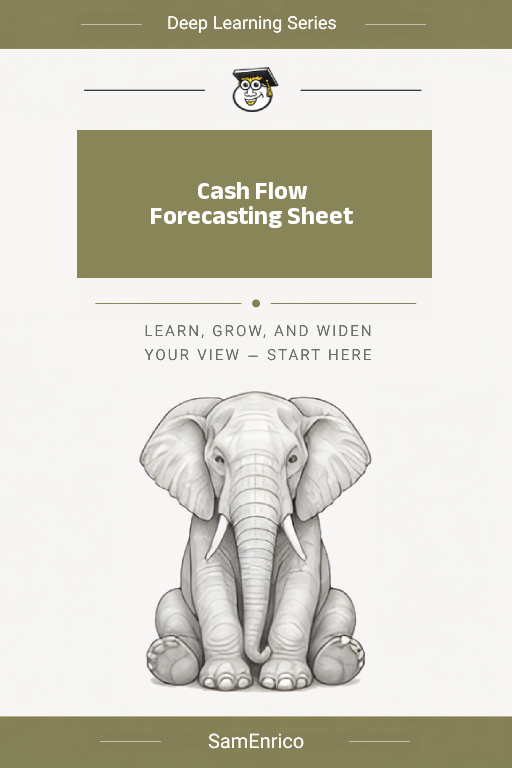
Non-FictionBusiness BriefForecasting
Cash Flow Forecasting Sheet eBook
Build a 12 month rolling cash flow forecast to pre
Build a 12 month rolling cash flow forecast to predict shortfalls before they happen.
Formats
Free sample
Chapter 1: The Profit Trap--–- The death certificate read "acute cash flow insufficiency." The business had been profitable every single quarter for four years. Its founders had celebrated record sales, expanded their team, and received awards from the local chamber of commerce. Six weeks after their most profitable month ever, they could not make payroll. The bank accounts were empty. Suppliers were demanding cash on delivery.
The accountant, reviewing the books in a futile attempt to find a miracle, discovered the truth: the company had been bleeding cash for eighteen months while reporting growing profits. No one had noticed because no one understood the difference between earning money and having money.This is not a cautionary tale from the 2008 financial crisis. It happens every day. According to a study by Jessie Hagen of U.S. Bank, 82 percent of small business failures are directly attributable to poor cash flow management.
Not lack of sales. Not uncompetitive products. Not even mismanagement of debt in the traditional sense. The culprit is simpler and more insidious: business owners confuse profitability with financial health.This chapter will dismantle that confusion permanently. By the time you finish reading, you will understand why a company can report record profits and still go bankrupt.
You will learn the mechanical difference between a Profit & Loss statement and a Cash Flow Statement. You will be introduced to the concept of timing traps and the cash conversion cycle. And most importantly, you will be convinced that a 12-month rolling cash flow forecast is not an academic exercise or a spreadsheet for accountants—it is a survival tool that reveals when your business will run out of money, regardless of how profitable it appears on paper.The Most Dangerous Sentence in Business"There's plenty of profit. We're fine."These seven words have destroyed more companies than any recession, competitor, or regulatory change in history. The sentence sounds reasonable.
It sounds like the confident assessment of a business owner who understands their numbers. But it is a lie—not a deliberate lie, but a structural lie baked into the way traditional accounting works.Here is the problem. Profit, as measured by standard accounting practices, is an opinion. Cash is a fact.Consider a simple example. You own a wholesale distribution company.
In January, you sell 100,000worthofgoodstoamajorretailer.Theretailerhasexcellentcredit,andyouinvoicethemwithpaymenttermsofnet−60days,meaningtheyhavetwofullmonthstopay.Youalsohavetopayyoursupplier100,000 worth of goods to a major retailer. The retailer has excellent credit, and you invoice them with payment terms of net-60 days, meaning they have two full months to pay. You also have to pay your supplier 100,000worthofgoodstoamajorretailer.Theretailerhasexcellentcredit,andyouinvoicethemwithpaymenttermsofnet−60days,meaningtheyhavetwofullmonthstopay.Youalsohavetopayyoursupplier60,000 for the goods you sold, and that invoice is due in 15 days. You have $10,000 in operating expenses for the month—rent, payroll, utilities.According to your accountant, you made a profit of 30,000in January(30,000 in January (30,000in January(100,000 revenue minus 60,000costofgoodssoldminus60,000 cost of goods sold minus 60,000costofgoodssoldminus10,000 operating expenses). Your Profit & Loss statement looks excellent.
You might even send a celebratory email to your team or take a distribution as the owner.But here is what your bank account looks like: You started January with 20,000.Youpaidyoursupplier20,000. You paid your supplier 20,000.Youpaidyoursupplier60,000 and your operating expenses 10,000.Thatis10,000. That is 10,000.Thatis70,000 leaving the account. Your customer has not paid yet. So your bank balance drops from 20,000tonegative20,000 to negative 20,000tonegative50,000 unless you have a line of credit to cover the gap.
You are profitable on paper and insolvent in reality.This is not a hypothetical edge case. It is the daily reality of thousands of growing businesses. The faster you grow, the more severe the problem becomes, because growth consumes cash before it generates cash. Every new sale requires upfront payment for inventory, labor, or marketing. That cash leaves your account today.
The cash from the sale arrives in 30, 60, or even 90 days. In the gap between outflows and inflows, companies die.The Two Statements That Will Save Your Business To understand why profit and cash are different, you must understand two fundamental financial statements. Most business owners have seen both, but few have internalized their distinct functions.The Profit & Loss Statement (The Opinion)The Profit & Loss statement, also called the income statement, measures economic activity over a period of time. It answers the question: "How much value did we create through our operations?" It does not answer the question: "How much cash did we receive?"The P&L operates on the accrual basis of accounting. Revenue is recorded when it is earned—typically when goods are shipped or services are performed—not when cash is received.
Expenses are recorded when they are incurred—when you receive a bill or consume a resource—not when you pay the bill.This creates enormous timing differences. A sale recorded in January might not generate cash until March. An expense recorded in December might not be paid until February. In between, the P&L shows profit while the bank account shows nothing.Worse, the P&L includes non-cash expenses. Depreciation is the classic example.
When you buy a 100,000 piece of equipment that will last ten years, the P&L shows a 10,000 depreciation expense each year for a decade. But you paid the $100,000 on the day you bought the equipment. The P&L treats that as ten small expenses over time; your bank account experienced one large expense immediately.The Cash Flow Statement (The Fact)The Cash Flow Statement measures actual dollars moving in and out of your bank account. It answers the question: "Where did our cash come from, and where did it go?" Unlike the P&L, the Cash Flow Statement has no opinion. It deals only in transactions that have already occurred.The Cash Flow Statement is divided into three sections:Operating Activities: Cash from customers, cash paid to suppliers, cash paid to employees, cash paid for taxes and interest.
This is your core business cash flow.Investing Activities: Cash spent on equipment, property, or acquisitions. Cash received from selling assets.Financing Activities: Cash from loans or equity investments. Cash paid as dividends or debt repayments.Here is the critical insight. A company can show strong profit from operating activities on the P&L while showing negative cash flow from operating activities on the Cash Flow Statement. This happens when the company is selling goods on credit (recording revenue but not receiving cash) while paying suppliers immediately (recording expenses and losing cash).
The P&L says you are profitable. The Cash Flow Statement says you are dying. Both are correct according to their own logic. The tragedy is that most business owners look only at the P&L.The Cash Conversion Cycle: Your Early Warning System The gap between paying for inputs and collecting from customers has a formal name: the Cash Conversion Cycle. It is the single most important metric for understanding your business's liquidity.The Cash Conversion Cycle is calculated using three components:Days Inventory Outstanding (DIO): How many days does inventory sit on your shelf before it is sold?
For a manufacturer, this includes raw materials, work-in-progress, and finished goods. For a retailer, this is the time between receiving inventory and selling it. For a service business, this number is zero because you have no inventory.Days Sales Outstanding (DSO): How…
This is the end of the free sample. Get the eBook to keep going. Buy now
About this book
Details
- Author
- Roberts Clyde
- Publisher
- SamEnrico
- Language
- English
- Genre
- Non-Fiction, Business Brief, Forecasting
- Released
- 2026-06-01
- Pages (approx.)
- 156
- Available as
- eBook, Audiobook

Read better in the ZLOADR app
Your eBooks on your phone or tablet. Sign in with your SamEnrico account and start reading.
More by Roberts Clyde
 Single Parent Time HacksRoberts Clyde$11.99
 MDD and Medical ComorbiditiesRoberts Clyde$11.99
 Vertical Arrow Down TechniqueRoberts Clyde$11.99
 Mobile Anki PracticeRoberts Clyde$11.99
 Pet Cremation Memorial GuideRoberts Clyde$11.99
 Mental Health MasterRoberts Clyde$11.99
 Double Depression GuideRoberts Clyde$11.99
 The Silent Oration: How a 19th-Century Deaf Woman Revolutionized Public SpeakingRoberts Clyde$11.99
 The Bloodstained Seas: Gang Wars on the Australia-New Zealand Passenger Routes (1850s-1870s)Roberts Clyde$11.99
 How to Start a Emergency and Other Relief Service BusinessRoberts Clyde$11.99
 How to Produce Colored TileRoberts Clyde$11.99
 Service Providers Guide to Roof CleaningRoberts Clyde$11.99
You may also like
 Hong Kong Handover 1997Dunn Johnnie$11.99
 Zumba For Postnatal Recovery CourseNeal Christian$11.99
 Zumba for BeginnersLadner Nikia$11.99
 YouTube Comment Mining GuideHumes Pandora$12.99
 Worry Box MeditationCarlin Rudy$11.99
 Workplace Stress MeditationNguyen Lynn$11.99
 Workplace Stress and Sleep RepairHawley Ivory$11.99
 Workplace Perfectionism CureDelaney Jeffry$11.99
 Workplace Injustice Anger GuideWallen Isabelle$11.99
 Work Addiction and Burnout LinkGreenwood Ester$11.99
 Women in Yoga and WellnessBeattie Galina$11.99
 Women in Stand Up ComedyChun Evangeline$11.99