
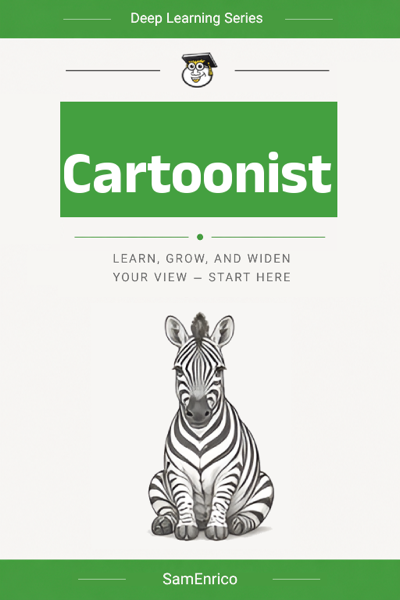
Non-FictionInformativeEducational
Cartoonist eBook
A Coursebook on Cartoonist
by Donnell Lulu
A Coursebook on Cartoonist
Formats
Free sample
Chapter 1: The Iconic Shortcut...--The first lie you were ever told about drawing is that more is better. More lines, more shading, more detail, more realism—these are the supposed markers of skill, the trophies you hang on your wall to prove you are a real artist. But if you want to be a cartoonist, you must unlearn this lie immediately. The cartoonist's greatest weapon is not addition but subtraction. It is not the photograph but the symbol.
It is not the thousand-line rendering but the three-line face that makes a stranger feel seen.This chapter is called The Iconic Shortcut because that is precisely what cartooning is: a shortcut through the noisy traffic of reality straight to the emotional heart of the reader. You are not a photographer. You are not a realist painter. You are a visual poet working in the language of suggestion, and the sooner you embrace that, the sooner your work will breathe.Why Your Brain Loves Shortcuts Let us begin with a simple experiment. Close your eyes for a moment and picture a face.
Not a specific face—just a generic human face. What do you see? If you are like most people, you do not see pores, wrinkles, individual hairs, or the subtle gradations of skin tone. You see two eyes, a nose, a mouth, and perhaps some hair. That is it.
That is the iconic face that lives in your imagination, and it is the same iconic face that cartoonists have been drawing for thousands of years, from cave paintings to hieroglyphics to the Sunday funnies.The reason for this is not laziness. It is neuroscience.Your brain is an extraordinary pattern-recognition machine, but it is also an energy-conserving one. Processing a photorealistic image requires enormous cognitive resources. Processing a simple cartoon requires almost none. A smiley face—two dots and a curve—triggers the same facial recognition circuitry in your brain as an actual photograph of a human being.
This is not an opinion. It is a measurable biological fact. The neurologist V.S. Ramachandran called this the "peak shift" effect: a caricature or cartoon actually activates the face-recognition neurons more strongly than a real face because it strips away irrelevant information and amplifies the signals that matter.Consider the work of Scott Mc Cloud, whose book Understanding Comics remains the single most important theoretical text for cartoonists. Mc Cloud identified what he called the "blank face" effect: when you draw a face with minimal features, readers project their own emotions, their own experiences, their own selves onto that character.
A hyper-realistic face belongs to someone else. A simple cartoon face belongs to everyone—including the reader.Think about Charlie Brown. Those four scribbles of hair, those two dots for eyes, that zigzag line for a mouth—and yet millions of people have wept over that character. They did not weep because Charles Schulz drew every tear duct and pore. They wept because the simplicity of Charlie Brown's face made him universal.
He is not a specific sad child. He is sadness itself, rendered in four lines.The Spectrum of Abstraction Not all cartooning is equally simple. There is a spectrum, and understanding where you fall on it is essential to finding your voice.At the far left end of the spectrum is pure abstraction: a single dot on a page. That dot is not a face, but it could be. It is a face in potentia.Moving right, you encounter the smiley face: two dots and a curve.
This is a face, but barely. It has no gender, no age, no race, no emotion beyond the crude curve of the mouth. And yet it is universally recognized.Further right, you encounter the classic comic strip face: Charlie Brown, Calvin and Hobbes, Garfield. These faces have features—eyebrows, noses, distinct mouth shapes—but they remain highly simplified. They occupy what Mc Cloud called "the middle of the abstraction spectrum," which is where most cartoonists live.Further still, you encounter manga and anime faces: large eyes, small mouths, highly stylized but with greater detail than Western comic strips.
These faces are still abstracted, but the abstraction follows different cultural rules.Near the far right end of the spectrum, you encounter realistic caricature: the work of Alex Ross or Dave Mc Kean. These faces are almost photographic, but they have been exaggerated in subtle ways—a jawline sharpened here, a brow ridge deepened there—to heighten emotional impact.At the far right end is photorealism: a face drawn so precisely that it could be mistaken for a photograph. This is technically impressive, but it is not cartooning. It is a different discipline entirely.Here is the secret that art school will never tell you: there is no hierarchy of value on this spectrum. A smiley face is not "worse" than a photorealistic portrait.
It is simply different. It serves a different purpose, speaks a different language, reaches a different part of the brain. The cartoonist's job is not to move as far right on the spectrum as possible. The cartoonist's job is to find the precise point on the spectrum that best serves their story.Pareidolia: Your Unfair Advantage There is a strange quirk of human perception that you, as a cartoonist, can exploit mercilessly. It is called pareidolia: the tendency to see faces in random patterns.
A pair of headlights on a car becomes a face. Two windows and a door on a house become a face. A electrical outlet becomes a surprised face. A piece of burnt toast becomes the Virgin Mary (if you are inclined toward that sort of thing).Pareidolia is not a bug in human perception. It is a feature.
Your brain is so desperate to find faces—because faces signal safety or danger, friend or foe—that it will invent them out of nothing. The cartoonist simply gives the brain the tiniest nudge in the right direction.This is why you can draw a face with three lines and a dot. This is why you can suggest an expression with nothing more than the angle of an eyebrow. Your reader's brain will do the heavy lifting for you.Consider the work of Ivan Brunetti, whose book Cartooning: Philosophy and Practice is required reading for anyone serious about this craft. Brunetti's exercises in reduction are legendary: he asks students to draw a face using only three lines, then two lines, then one.
The results are astonishing. A single curved line can be read as a closed, sleeping eye. A single straight line with a slight downturn can be read as a mouth expressing disappointment. A single dot can be read as a nostril, a pupil, a freckle, or a tear, depending entirely on context.The lesson here is liberating: you do not need to draw well. You need to draw clearly.
You need to understand which lines are essential and which are noise. You need to learn to see like a cartoonist—searching for essence, not detail.The Three-Line Challenge Let us put theory into practice. The following exercises are adapted from Brunetti and from the foundational exercises taught at the Center for Cartoon Studies. They will feel strange at…
This is the end of the free sample. Get the eBook to keep going. Buy now
About this book
Details
- Author
- Donnell Lulu
- Publisher
- SamEnrico
- Language
- English
- Genre
- Non-Fiction, Informative, Educational
- Released
- 2026-05-08
- Pages (approx.)
- 122
- Available as
- eBook, Audiobook

Read better in the ZLOADR app
Your eBooks on your phone or tablet. Sign in with your SamEnrico account and start reading.
More by Donnell Lulu
 Mountain Guide Career ValueDonnell Lulu$11.99
 Early Life Stress MicrobiomeDonnell Lulu$11.99
 Resentment After Home LossDonnell Lulu$11.99
 Twin Flames Universe EscapeeDonnell Lulu$11.99
 The Gambling Addiction and Tax Fraud GuideDonnell Lulu$11.99
 The Last Whisper of the Great Auk: A Feathered ExtinctionDonnell Lulu$11.99
 Understanding Lateral Body Wall DefectDonnell Lulu$17.99
 A Beginners Guide to Double disc court (Volume 1)Donnell Lulu$11.99
 Intermodal vs Trucking GuideDonnell Lulu$12.99
 Unstructured Data Organizer HandbookDonnell Lulu$12.99
You may also like
 Hong Kong Handover 1997Dunn Johnnie$11.99
 Zumba For Postnatal Recovery CourseNeal Christian$11.99
 Zumba for BeginnersLadner Nikia$11.99
 YouTube Comment Mining GuideHumes Pandora$12.99
 Worry Box MeditationCarlin Rudy$11.99
 Workplace Stress MeditationNguyen Lynn$11.99
 Workplace Stress and Sleep RepairHawley Ivory$11.99
 Workplace Perfectionism CureDelaney Jeffry$11.99
 Workplace Injustice Anger GuideWallen Isabelle$11.99
 Work Addiction and Burnout LinkGreenwood Ester$11.99
 Women in Yoga and WellnessBeattie Galina$11.99
 Women in Stand Up ComedyChun Evangeline$11.99