
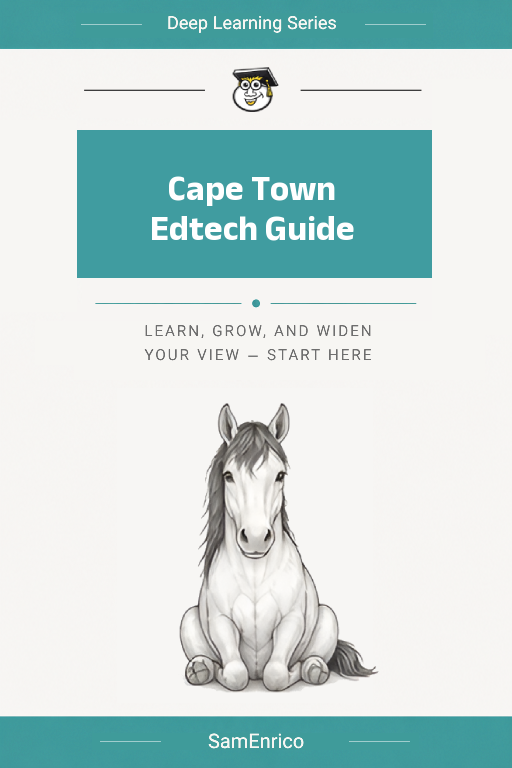
Non-FictionStartup GuideHub Comparison
Cape Town Edtech Guide eBook
Launch edtech startup in Cape Town. Digital learni
Launch edtech startup in Cape Town. Digital learning and education innovation.
Formats
Free sample
Chapter 1: The 83-Year-Old Student--– The first time I met Gladys, she was hunched over a public computer at the Bellville Smart Cape library, one finger pecking at the keyboard, her reading glasses perched halfway down her nose. She was 83 years old. She was learning how to send an email."Why are you doing this?" I asked, genuinely curious. I had spent months researching the South African edtech market, analyzing USD 1.1 billion in valuation figures, studying demographic trends, and interviewing investors. I thought I understood the opportunity.Gladys looked up at me, impatient.
"My grandson is in Grade 10 at a school in Khayelitsha. He has a smartphone, but no computer. The school sends homework online. If I don't learn this, I cannot help him. And if I cannot help him, who will?"That was the moment I understood something that no market report could ever teach me.
Edtech in Cape Town is not about platforms, algorithms, or venture capital. It is about Gladys. It is about the 550,000 registered users of Smart Cape libraries—children, parents, grandparents—who are desperate for learning but face barriers that Silicon Valley founders cannot imagine: no device, expensive data, unreliable electricity, and no one to guide them.This book is for the founder who builds for Gladys. Because here is the opportunity that the numbers hide: the people who need edtech the most are the ones who can pay the least. They are the ones with prepaid data that costs R50 per gigabyte.
They are the ones whose electricity goes off for four hours a day. They are the ones who share a single smartphone between six family members.And they are the ones who will make your startup succeed—if you build for them first.1.1 The R1.1 Billion Question Let us start with the number that every investor quotes, every pitch deck includes, and every article repeats: South Africa's edtech market is valued at USD 1.1 billion—approximately R20 billion.This number comes from credible sources. Industry analysts have tracked the growth of digital learning platforms, online tutoring services, virtual school offerings, and corporate training software across the country. The market has grown consistently year over year, accelerated by the COVID-19 pandemic, which forced even the most reluctant institutions to adopt digital tools.But here is the uncomfortable truth that the R1.1 billion figure does not tell you: most of that money is concentrated in wealthy suburbs, corporate training budgets, and international school fees. The real opportunity—the massive, underserved, transformative opportunity—lies in the townships, the rural areas, the low-fee private schools, and the public schools where 80% of South African learners sit in overcrowded classrooms with outdated textbooks and no computers.Gladys is not reflected in the R1.1 billion figure.
But she is the reason you should build your company.The Western Cape Advantage: Within the national market, Cape Town stands apart. The Western Cape consistently outperforms other provinces in educational infrastructure, digital readiness, and government support for innovation. The province has the highest matric pass rates, the most schools with internet access, and the most progressive education department when it comes to technology adoption.According to the Western Cape Education Department's annual reports, the province has invested heavily in connectivity, teacher training, and digital content. The Smart Cape programme, a City of Cape Town initiative, has placed computers in 101 libraries across the metropolitan area, registering over 550,000 users. That is not a pilot.
That is a distribution network waiting for your product.Your Addressable Market: Before you get too excited about R1.1 billion, you need to adjust for reality. The Western Cape accounts for approximately 11-12% of South Africa's population. A reasonable estimate of your addressable market in the province is roughly $120 million (R2.2 billion). Still substantial—but a fraction of the national figure. Smart founders build for their local market first, prove their model, and then expand.1.2 The Demographic Tsunami South Africa's population exceeds 60 million people.
The median age is approximately 28 years. This is a young, digitally curious population that has grown up with smartphones, Whats App, and social media.But raw demographics only tell part of the story. The more important number is this: according to the Department of Basic Education's 2023 National Learner Survey, 45% of learners in grades 10-12 now express a preference for online or blended learning platforms.Let me repeat that. Nearly half of all high school learners—the generation that will enter the workforce in the next five to ten years—want to learn online.Why? Because traditional schooling is failing them.
Overcrowded classrooms are the norm, not the exception. In many public schools, class sizes exceed 50 learners. Teachers are overworked and under-resourced. Textbooks are outdated or missing entirely. Extracurricular support—tutoring, enrichment, career guidance—is available only to those who can afford it.The COVID-19 pandemic accelerated this shift.
When schools closed, learners who had access to devices and data continued learning. Those who did not fell further behind. The gap between the digital haves and have-nots widened into a chasm. And learners noticed. They saw that online learning could be flexible, self-paced, and personalized in ways that traditional classrooms cannot match.The Retention Opportunity: For edtech founders, the 45% statistic has a second implication: churn is your biggest risk.
If nearly half of learners prefer online platforms, they are also more likely to switch between platforms if you do not meet their expectations. Retention strategies—progress tracking, community features, parent engagement—are not optional add-ons. They are core to your business model.1.3 Government Policy: The Third Pillar Market demand and demographic trends mean nothing without an enabling environment. Fortunately, South African government policy has shifted decisively in favor of digital education over the past five years.National Digital and Future Skills Strategy: This is the flagship policy, launched in 2021 with dedicated budget allocation for digital education initiatives. The strategy recognizes that South Africa cannot compete in the global economy without a digitally literate workforce.
It calls for integrating digital skills into the curriculum from Grade R through tertiary education, training teachers in technology use, and expanding access to devices and connectivity.For edtech founders, the strategy creates both opportunity and obligation. The opportunity is clear: government is actively seeking digital solutions to address the skills gap. The obligation is equally clear: your product must align with national priorities. If you build a platform that teaches coding to teenagers, you are aligned. If you build a platform that offers entertainment disguised as education, you are not.Digital Education Strategy: This companion policy sets specific, measurable targets.
The most important: bringing 85% of schools into the digital learning ecosystem by 2030. What does "digital learning ecosystem" mean? It means internet connectivity, devices for learners, digital content aligned to the curriculum, and trained teachers who can use it all effectively.For edtech founders, this target is a five-year countdown. Schools that are not yet digitized will need solutions. Schools that are partially digitized will need better solutions.
And the government will need partners—not vendors—to make it happen.Smart Cape Programme: While national policy sets the direction, local implementation creates the opportunity. The Smart Cape programme, operated by the City of Cape Town, has placed computers with free internet access in 101 libraries across the metropolitan…
This is the end of the free sample. Get the eBook to keep going. Buy now
About this book
Details
- Author
- Farias Petronila
- Publisher
- SamEnrico
- Language
- English
- Genre
- Non-Fiction, Startup Guide, Hub Comparison
- Released
- 2026-05-28
- Pages (approx.)
- 143
- Available as
- eBook, Audiobook

Read better in the ZLOADR app
Your eBooks on your phone or tablet. Sign in with your SamEnrico account and start reading.
More by Farias Petronila
 Moonlight Visualization SleepFarias Petronila$11.99
 Digital Minimalism GuideFarias Petronila$11.99
 Pelvic Floor Obesity ImpactFarias Petronila$11.99
 The German Zollverein GuideFarias Petronila$11.99
 Grandparent Childcare Health BenefitFarias Petronila$11.99
 Blood and Jade: The Olmec Colossal Heads' Secret WhisperFarias Petronila$11.99
 Delivery LeadFarias Petronila$11.99
 Non Resident LLC SaaS GuideFarias Petronila$12.99
 How to Start a Body for Locomotive Business (Beginners Guide)Farias Petronila$11.99
 The Breeder's Guide to Cornish ChickensFarias Petronila$11.99
You may also like
 Hong Kong Handover 1997Dunn Johnnie$11.99
 Zumba For Postnatal Recovery CourseNeal Christian$11.99
 Zumba for BeginnersLadner Nikia$11.99
 YouTube Comment Mining GuideHumes Pandora$12.99
 Worry Box MeditationCarlin Rudy$11.99
 Workplace Stress MeditationNguyen Lynn$11.99
 Workplace Stress and Sleep RepairHawley Ivory$11.99
 Workplace Perfectionism CureDelaney Jeffry$11.99
 Workplace Injustice Anger GuideWallen Isabelle$11.99
 Work Addiction and Burnout LinkGreenwood Ester$11.99
 Women in Yoga and WellnessBeattie Galina$11.99
 Women in Stand Up ComedyChun Evangeline$11.99