
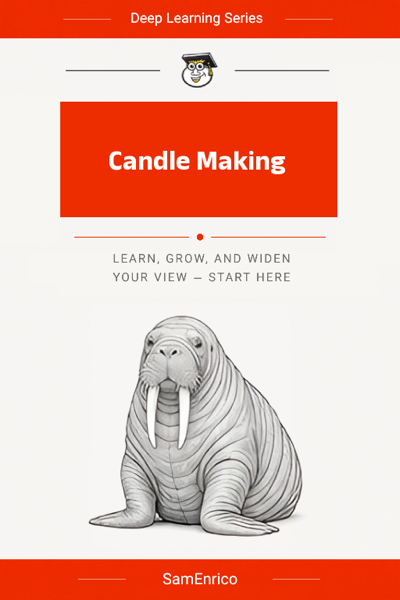
Candle Making eBook
A Coursebook on Candle Making
by Hackett King
A Coursebook on Candle Making
Formats
Free sample
Chapter 1: Your First Pour--– The smell of melted wax is the first thing you will notice. It is not the scented oil you are about to add, but something earthier—the faint sweetness of vegetable fat warming up, the whisper of a transformation about to happen. If you have never made a candle before, that smell will become the gateway to something addictive. Because what follows is a process that feels like kitchen witchcraft: liquid turning solid, a simple string becoming a flame, and a jar of raw materials becoming an object of comfort, memory, and light.Welcome. You are about to make your first candle.But here is what I need you to understand before we begin: this first candle will not be perfect.
It might have a rough top. It might frost. The scent might be weaker than you hoped. You might look at it and see every flaw. That is not failure.
That is data. Every professional candle maker on earth has a box of failed experiments under their workbench. The difference between them and someone who gives up is that they kept the box and learned from it.This book is a coursebook. That means we are not just going to give you recipes to follow blindly. We are going to teach you why those recipes work, how to fix them when they break, and eventually how to write your own.
By the time you finish these twelve chapters, you will understand candle making at the molecular level—and you will also know exactly which rules you can break for creative effect.But first, you need to get your hands dirty.Why We Start Here Instead of With History or Chemistry Most candle making books begin with three chapters of history, safety, and materials science. That makes logical sense but psychological nonsense. You did not pick up this book because you wanted to read about nineteenth-century paraffin distillation. You picked it up because you want to make something beautiful, something useful, something that will make your home smell amazing and your friends say, "Wait, you made this?"So we are going to start by making a candle. Tonight.
With materials you can buy at any craft store or online. With equipment you probably already have in your kitchen. And with a method that is deliberately forgiving—designed to produce a burnable candle even if you make several small mistakes.The theory comes after the practice. Because once you have felt wax melt, once you have watched a wick center, once you have lit a flame that you created from raw materials—every concept in the later chapters will land differently. You will not be memorizing abstract information.
You will be understanding why your first candle behaved the way it did.What Makes This Different From a You Tube Tutorial You have probably watched candle making videos before picking up this book. They make it look easy: melt wax, add oil, pour, done. And it is that simple in the same way that baking a cake is that simple. You can absolutely produce something edible by throwing flour and eggs into a bowl. But to produce something consistently excellent—something that burns cleanly, throws scent reliably, and looks professional—you need to understand what is actually happening inside that jar.This book is the difference between following a recipe and becoming a cook.In this first chapter, I am going to give you a recipe.
But I am also going to explain why each step exists, what can go wrong, and how to tell if it did. By the end of this chapter, you will have made a candle. By the end of this book, you will be able to look at any candle—yours or someone else's—and diagnose exactly what went right or wrong.The Philosophy of the First Candle Before we gather materials, let me state something clearly: the candle you are about to make is not the candle you will make forever. The wax is beginner-friendly but not high-performance. The wick is pre-selected so you do not have to think about sizing yet.
The jar is something you probably already own. The fragrance load is conservative to prevent overwhelming the wax.This candle will have flaws. It will likely frost—white crystalline patches on the surface. It may develop a small sinkhole around the wick. The hot throw (scent when burning) will be present but not spectacular because we are only curing it for 24 hours instead of the optimal two weeks.None of that matters.What matters is that you complete the cycle.
You will melt. You will pour. You will wait. You will light. And you will see, with your own eyes, that you can take raw materials and transform them into something that burns.
That experience is the foundation upon which everything else is built.Materials for Your First Candle Let me be specific about what you need and why. Do not substitute freely—these materials are chosen because they forgive beginner mistakes.The Wax: Soy Flakes You need 8 ounces of soy wax flakes by weight. Not paraffin, not beeswax, not a coconut-soy blend. Pure soy wax is the most forgiving wax for beginners for three reasons. First, it has a lower melting point than paraffin (120–130°F versus 130–150°F), which gives you a wider safety margin.
Second, it cleans up with soap and hot water—paraffin requires solvents. Third, it releases from glass easily, so if your wick is slightly off-center, you can re-melt and try again without destroying the container.Soy wax is not perfect. It frosts. It has a reputation for weaker hot throw than paraffin (though much of that reputation comes from improper curing). It requires patience.
But for learning, it is unmatched.Do not use wax beads labeled "universal" or "blend" unless the package specifies the exact ratio. Many craft store blends contain paraffin additives that change the wax behavior unpredictably. Start with 100 percent soy.The Wick: CD-12 Pre-Tabbed You need one CD-12 wick attached to a metal sustainer base (the flat metal tab at the bottom). The "CD" stands for "continuous draft," a wick family designed specifically for vegetable waxes like soy. The number 12 indicates the wick size.
For an 8-ounce wide-mouth mason jar, a CD-12 is very slightly oversized. This is intentional. An oversized wick will produce a larger flame and a wider melt pool, which guarantees you will not experience tunneling (wax wasted on the sides) on your first burn. The tradeoff is that the candle will burn slightly faster and may produce a small amount of soot if you burn it for more than four hours.The wick should come pre-waxed (coated in a thin layer of wax for stiffness) and pre-tabbed. If you buy wick by the spool and separate tabs, you will need to crimp the tab onto the wick yourself.
For this first candle, buy pre-assembled wicks.The Container: A Clean Glass Jar You need one clean, dry, heat-safe glass jar. A finished pasta sauce jar works perfectly. A wide-mouth pint mason jar is ideal. The jar should hold approximately 8 ounces of water when filled to one inch from the…
This is the end of the free sample. Get the eBook to keep going. Buy now
About this book
Details
- Author
- Hackett King
- Publisher
- SamEnrico
- Language
- English
- Genre
- Non-Fiction, Informative, Educational
- Released
- 2026-05-09
- Pages (approx.)
- 152
- Available as
- eBook, Audiobook

Read better in the ZLOADR app
Your eBooks on your phone or tablet. Sign in with your SamEnrico account and start reading.
More by Hackett King
 Parenting Multiple ChildrenHackett King$11.99
 Body Language For Emotional Intelligence WorkbookHackett King$11.99
 OCD And Sleep DisturbanceHackett King$11.99
 Survey Data Quality Scoring with AIHackett King$11.99
 Creative Thinking for EngineersHackett King$11.99
 The Unseen Hand: How a Studio Secretary Shaped the Golden AgeHackett King$11.99
 Tracking the Moon: How the Indian Ocean Helped Apollo Land on the MoonHackett King$11.99
 Understanding Camptodactyly Syndrome Galajara Type 1Hackett King$17.99
 Clinical PhD Without PublicationsHackett King$12.99
 How to Start a Construction of Parking Garages Business (Beginners Guide)Hackett King$11.99