
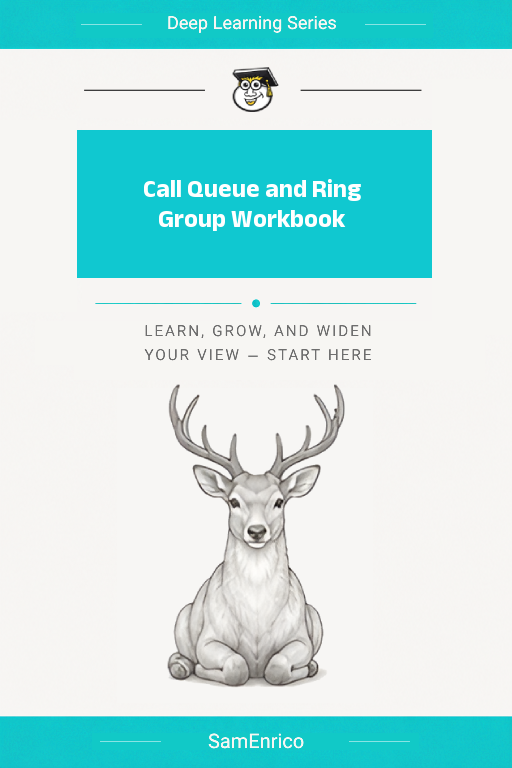
Non-FictionFirst 30 DaysCall Distribution
Call Queue and Ring Group Workbook eBook
Distribute incoming calls across multiple team mem
Distribute incoming calls across multiple team members or departments.
Formats
Free sample
Chapter 1: The Anatomy of Silence...–- The phone rings. You watch it. Your team watches it. Everyone assumes someone else will pick it up. By the fourth ring, the caller has already formed an opinion about your company.
By the sixth ring, they have hung up and called your competitor. This isn’t a failure of technology. It’s a failure of understanding.Call routing seems simple. A call comes in. Someone answers.
But beneath that surface simplicity lies a complex ecosystem of choices—choices that most managers don’t even know they are making. Every time a caller hears a ringtone instead of a human voice, your routing system is making a decision. The question is: did you design that decision, or did you inherit it from the default settings of your phone system?This chapter dismantles the jargon that paralyzes non-technical managers and establishes a clear, consistent vocabulary for the rest of this workbook. By the time you finish these pages, you will understand the three primary routing structures, why most configuration errors happen, and how to diagnose whether your current setup is helping or hurting your business. More importantly, you will complete a diagnostic flowchart that tells you exactly what kind of routing system you need—before you change a single setting.The Hidden Cost of a Ringing Phone Before we define terms, let’s talk about what’s at stake.
Every unanswered ring costs you something. Sometimes it’s obvious: a lost sale, a canceled appointment, a one-star review. Sometimes it’s invisible: a slowly eroding reputation, a customer who doesn’t complain but never comes back.Consider this. A phone rings for six seconds before going to voicemail. That doesn’t sound like much.
But if your business receives one hundred calls per day, and twenty percent of callers hang up during those six seconds, you have lost twenty opportunities daily. Over a year, that is more than seven thousand lost conversations. Seven thousand chances to solve a problem, close a deal, or build a relationship. All because of six seconds.The math gets worse when you factor in what happens after voicemail. Most callers do not leave a message.
The ones who do often wait hours for a callback—hours during which they have already found another solution. Your phone system is not just a utility. It is a conversion engine. And like any engine, it needs the right configuration to run efficiently.The Three Primary Routing Structures Let’s establish definitions that will serve as the foundation for every subsequent chapter. These definitions have been carefully chosen to avoid the confusion that plagues most telecom documentation.
Unlike many technical manuals that use terms loosely, this workbook maintains strict consistency.Structure One: Ring Groups (The Basic Category)A Ring Group is a category of call distribution where a set of extensions receives notification of an incoming call simultaneously or in a predetermined sequence. Think of a Ring Group as a simple announcement system: “There is a call. Someone should take it.”Ring Groups have two subtypes, which we will explore in depth in Chapter 2:Simultaneous Ringing: Every phone in the group rings at the same time. The first agent to pick up gets the call. This is fast, chaotic, and prone to the “herd mentality” problem where everyone assumes someone else will answer.Sequential Ringing (also called Cascade): Phones ring in a specific order.
The first phone rings for a set number of seconds. If unanswered, the second phone rings, and so on. This is orderly but creates resentment when the same agents always ring first.Ring Groups are simple to configure and work well for small teams with low call volumes. They do not, however, provide call queuing, wait time announcements, or detailed reporting. Once the call reaches a Ring Group, it either gets answered or goes to voicemail.
There is no “holding” mechanism.Structure Two: Call Queues (The Advanced Category)A Call Queue is a virtual waiting line with prioritization, reporting, and advanced features like position announcements, estimated wait times, and overflow routing. Unlike a Ring Group, which can only handle one call at a time (or one call per agent in simultaneous mode), a Call Queue can hold multiple callers simultaneously and manage them intelligently.When a call enters a Queue, the caller hears a greeting, then hold music or announcements while they wait. The system tracks how long each caller has been waiting, how many callers are ahead of them, and which agents are available. Calls are distributed according to algorithms (covered in Chapter 3) rather than simply ringing every phone.Queues are essential for any business that receives more than twenty calls per day or has more than three agents. They provide accountability through metrics, reduce caller frustration through transparency, and enable sophisticated routing based on agent skills or call priority.Structure Three: IVR Menus (The Gatekeeper)An IVR Menu (Interactive Voice Response) is the automated attendant that greets callers and offers choices.
“Press 1 for Sales. Press 2 for Support. Press 3 for Billing.” IVRs feed calls into either Ring Groups or Call Queues.The IVR is not a routing method itself. It is a triage system. Its job is to ask one question: “What do you need?” and then send the caller to the appropriate destination.
Poorly designed IVRs frustrate callers and increase abandonment. Well-designed IVRs reduce wait times by routing callers to the right place immediately.The 80% Error: Why Most Configuration Fails Here is a statement backed by decades of telecom support data: Eighty percent of configuration errors stem from confusing simultaneous ringing with round-robin distribution.Managers hear “round robin” and assume it means “everyone rings at once.” That is incorrect. Round robin is a distribution method typically implemented within Call Queues (not basic Ring Groups) where calls rotate through agents in a fixed order, regardless of who answered last. Simultaneous ringing, by contrast, rings everyone at once.The confusion leads to predictable failures:The Herd Mentality Failure: A support team of five agents is configured with simultaneous ringing. A call comes in.
All five phones ring. Each agent assumes one of the other four will answer. The call goes to voicemail. The caller hangs up and leaves a one-star review. The manager checks the logs and sees that all five agents were “available.” The system worked perfectly.
The human behavior failed.The Round Robin Confusion: A reception desk of three agents wants to distribute calls fairly. They ask for round robin. The technician, equally confused, configures simultaneous ringing instead. Now all three phones ring at once. The most conscientious agent answers ninety percent of calls.
Burnout follows. Turnover follows.The Cascade Resentment: A sales team of four agents is configured with sequential ringing. Agent A rings first. Agent A answers eighty percent of calls. Agent A asks why they are punished while Agent D takes naps.
The manager has no answer because they didn’t understand the configuration.These failures are not technical. They are linguistic. The industry has failed to standardize its vocabulary, and managers suffer the consequences.A Unified Terminology Framework To prevent these errors, this workbook uses the following unified terminology:Term Definition Implemented In Ring Group A category where…
This is the end of the free sample. Get the eBook to keep going. Buy now
About this book
Details
- Author
- Almond Angelyn
- Publisher
- SamEnrico
- Language
- English
- Genre
- Non-Fiction, First 30 Days, Call Distribution
- Released
- 2026-06-01
- Pages (approx.)
- 127
- Available as
- eBook, Audiobook

Read better in the ZLOADR app
Your eBooks on your phone or tablet. Sign in with your SamEnrico account and start reading.
More by Almond Angelyn
 Marketing Layoff RecoveryAlmond Angelyn$11.99
 Carson Presidential Medal LegacyAlmond Angelyn$11.99
 The Apology Conversation GuideAlmond Angelyn$11.99
 Autism Parenting Anger GuideAlmond Angelyn$11.99
 Point of View FrameAlmond Angelyn$11.99
 Joyful Eating GuideAlmond Angelyn$11.99
 Creative Confidence for DepressionAlmond Angelyn$11.99
 Hadestown Orpheus And EurydiceAlmond Angelyn$11.99
 The Banker's Betrayal: The 1876 Stockholm Heist and the Inside ManAlmond Angelyn$11.99
 The Hollow Throne: How a Forgotten Queen Abandoned Her EmpireAlmond Angelyn$11.99
 How to Start a Cosmetics (wholesale) Business (Beginners Guide)Almond Angelyn$11.99
 How to Produce Other Lights and Lighting ProductsAlmond Angelyn$11.99
You may also like
 Hong Kong Handover 1997Dunn Johnnie$11.99
 Zumba For Postnatal Recovery CourseNeal Christian$11.99
 Zumba for BeginnersLadner Nikia$11.99
 YouTube Comment Mining GuideHumes Pandora$12.99
 Worry Box MeditationCarlin Rudy$11.99
 Workplace Stress MeditationNguyen Lynn$11.99
 Workplace Stress and Sleep RepairHawley Ivory$11.99
 Workplace Perfectionism CureDelaney Jeffry$11.99
 Workplace Injustice Anger GuideWallen Isabelle$11.99
 Work Addiction and Burnout LinkGreenwood Ester$11.99
 Women in Yoga and WellnessBeattie Galina$11.99
 Women in Stand Up ComedyChun Evangeline$11.99