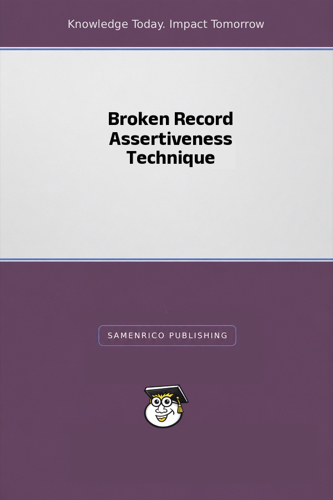
Broken Record Assertiveness Technique eBook
Teaches calmly repeating your position without eng
Teaches calmly repeating your position without engaging in debate or justification.
Formats
Free sample
Chapter 1: The Trap of “Because”--–- You are about to say the single most dangerous word in the English language. It is not “no.” It is not “stop.” It is not even “I quit.” The most dangerous word, the one that will cost you more time, energy, and self-respect than any other, is a small, innocent, three-letter word that you have been taught is polite, reasonable, and necessary. That word is “because.”Every time you say “because,” you hand the other person a loaded weapon and invite them to fire. You think you are explaining. You think you are being reasonable.
You think that if you just offer the right reason, the perfect justification, the other person will nod wisely and say, “Oh, I see. Now I understand. Please proceed with your no.” That never happens. What actually happens is that your “because” becomes a hook. And the other person pulls on that hook until you collapse.This chapter will dismantle the myth of the good fight—the belief that if you explain yourself well enough, you will be understood and accepted.
You will learn why every justification is an invitation to argue, how manipulators weaponize the simple question “Why?” and why the most assertive people on earth never explain themselves. By the end of this chapter, you will understand that giving reasons is not a courtesy. It is a trap.The Day Sarah Lost Her Friday Night Let us begin with a story. Sarah is a senior analyst at a marketing firm. It is 4:55 PM on a Friday.
She has been working since 7:00 AM. Her bag is packed. Her coat is on her chair. She is mentally already in her car, then on her couch, then asleep. Her boss, Mark, appears at her cubicle.“Sarah, I need you to stay late tonight.
The Johnson proposal needs revisions.”Sarah’s heart sinks. She has plans. She has been looking forward to this dinner for two weeks. She takes a breath and says what she has been taught is the right thing to say: “I can’t stay late tonight because I have dinner plans with my partner.”Mark does not hear “no.” He hears an obstacle. And obstacles can be removed.“Oh, just push the dinner back an hour.
It’s no big deal.”Sarah now has a choice. She can repeat her no. Or she can offer another justification. She chooses the latter because she has been conditioned to believe that if Mark just understood why, he would relent.“I can’t. We have reservations at a restaurant that doesn’t take late seating.”Mark smiles.
He is a problem-solver. “Cancel the reservation and order takeout at home. Romantic night in. Problem solved.”Sarah is now trapped. Every justification she offers gives Mark a new angle of attack.
She has explained her dinner plans. He solved that. She has explained the reservation. He solved that. She has no more justifications left.
So she stays. She works until 8:00 PM. She cries in her car. She texts her partner an apology. And she does not understand why her perfectly reasonable “no” was not accepted.Here is why: Sarah never said no.
She said “no because.” And “no because” is not a no at all. It is the beginning of a negotiation.The JADE Acronym: Your New Best Friend There is a simple acronym that will save you from Sarah’s fate. It is called JADE. It stands for:J ustify A rgue D efend E xplain Do not do any of these things. When you say no, you say no.
You do not justify why. You do not argue your case. You do not defend your decision. And you certainly do not explain your reasoning as if the other person is entitled to a full debriefing.JADE is the single most important safeguard in assertive communication. It is a fence around your no.
Every time you are tempted to say “because,” imagine a bright red stop sign with the letters J-A-D-E on it. Stop. Breathe. And say only your no.Why is JADE so powerful? Because the moment you offer a reason, you have implicitly agreed that your no is conditional.
You have said, in effect, “My no stands unless you can find a way around my reason.” And manipulators are exceptionally good at finding ways around reasons. They have been practicing their entire lives.The Weaponization of “Why?”Let us examine the most dangerous question in the English language: “Why?”When someone asks you “Why can’t you?” or “Why won’t you?” or simply “Why not?” they are not seeking information. They are not curious about your internal state. They are opening a door that you should have kept closed.Consider the difference between these two exchanges:Exchange A (without JADE):Them: “Can you lend me $200?”You: “No.”Them: “Why not?”You: “I don’t have to explain my no.”Conversation over. Your boundary stands.Exchange B (with JADE violation):Them: “Can you lend me $200?”You: “No, because I have bills to pay.”Them: “Oh, but you get paid next week.
You can lend it to me until then.”You: “No, because I also have to save for my vacation.”Them: “You can save next month. Come on, it’s just $200.”You are now in a debate. You are justifying, arguing, defending, and explaining. You are JADE-ing. And you will lose.The question “Why?” is a weapon.
It is a crowbar inserted into the crack of your justification. The person asking it does not want to understand you. They want to find the weakness in your reason so they can pry open your no. Do not hand them the crowbar.The Three Responses: Passive, Aggressive, and Assertive Before we go further, we need to establish a shared vocabulary for the rest of this book. Every human response to a request or demand falls into one of three categories: passive, aggressive, or assertive.The Passive Response The passive response is silence or surrender.
It sounds like: “Okay, fine.” “I guess so.” “If you really need me to.” “It’s not a big deal.” (It is always a big deal.) The passive person says yes when they mean no. They comply externally while resenting internally. They trade their own needs for the illusion of peace. But there is no peace. There is only slow-burning resentment that will eventually explode or, more commonly, curdle into quiet depression.Passive people are not kind.
They are dishonest. They lie with their yes. And everyone around them knows it.The Aggressive Response The aggressive response is attack. It sounds like: “Are you kidding me?” “Get out of my face.” “I can’t believe you would even ask.” “No, and you’re an idiot for asking.” The aggressive person defends their boundary by destroying the other person. They win the battle and lose the relationship.
They may get their no, but they also get a reputation for being difficult, hostile, or cruel.Aggressive people are not strong. They are frightened. Their volume and venom are masks for the terror that their no will not be heard unless they scream it.The Assertive Response The assertive response is…
This is the end of the free sample. Get the eBook to keep going. Buy now
About this book
Details
- Author
- Cantrell Leone
- Publisher
- SamEnrico
- Language
- English
- Genre
- Non-Fiction, Self-Help, Persistence
- Released
- 2026-06-08
- Pages (approx.)
- 143
- Available as
- eBook, Audiobook

Read better in the ZLOADR app
Your eBooks on your phone or tablet. Sign in with your SamEnrico account and start reading.
More by Cantrell Leone
 Teen Self Talk Rewiring GuideCantrell Leone$11.99
 Geo Arbitrage for Virtual AssistantsCantrell Leone$11.99
 Girondin vs Montagnard GuideCantrell Leone$11.99
 The Vendor Negotiation PlaybookCantrell Leone$11.99
 Opioid Recovery Withdrawal Coping HandbookCantrell Leone$11.99
 Cut Off Recovery ProtocolCantrell Leone$11.99
 Shoulder Pain Fix with Mobility DrillsCantrell Leone$11.99
 Postpartum Depression Light TherapyCantrell Leone$11.99
 The Mariner of the Southern Seas: James Cook and the Charting of a New WorldCantrell Leone$11.99
 The Bones of the Pacific: The Hunt for Ancient Humanity’s FootprintsCantrell Leone$11.99
 Code Red: The Unsung Surgeons of KandaharCantrell Leone$11.99
 School Bus Driver OttawaCantrell Leone$11.99