
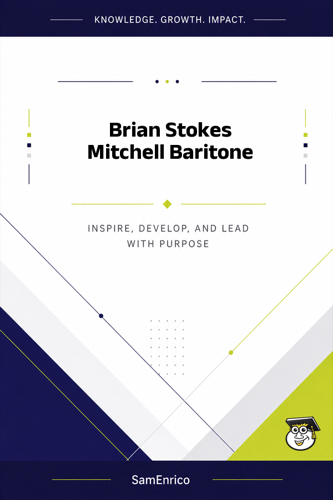
Non-FictionBiographyBaritone Singers
Brian Stokes Mitchell Baritone eBook
The man with the voice that filled the Majestic Th
The man with the voice that filled the Majestic Theatre.
Formats
Free sample
Chapter 1: The Architecture of Sound...–- The boy who would one day fill the Majestic Theatre with nothing but the flesh and breath of his own body learned his first lesson about sound in a place where silence was a matter of survival. It was not a voice teacher who taught him. It was not a choir director or a Broadway star or any of the mentors who would later claim him. It was his father, George Mitchell, a man who had spent his youth teaching Tuskegee Airmen how to read the sky and his adulthood engineering systems that could not fail. The lesson was this: every sound is a structure.
And every structure, no matter how beautiful, is only as strong as its foundation.The Geography of a Voice Brian Stokes Mitchell was born in Seattle, Washington, on October 31, 1957, but he might as well have been born in the air. His father's career in the United States Navy meant that the family moved the way other families breathed—constantly, necessarily, without much ceremony. By the time Brian was six years old, he had lived on naval bases in Guam, in the Philippines, and finally in San Diego, California. Each location left a residue in his developing ear: the percussive pidgin of Guam, the melodic lilt of Tagalog, the flat vowels of Midwestern Navy brats whose parents had dragged them to the Pacific, and the Chicano-inflected English of Southern California. He absorbed them all without knowing he was absorbing anything.
This was simply how people sounded. He would later understand that this early immersion in linguistic and musical variety had given him something that no conservatory could replicate: a phonetic flexibility that allowed him to move between vocal registers as if they were neighboring rooms rather than locked chambers.The Mitchell household was not a show-business family. Neither of his parents had ever stood on a stage or harbored dreams of doing so. His mother, Lillian Mitchell, was a school administrator—a woman who believed that discipline was the highest form of love. She corrected her children's grammar the way other mothers corrected table manners.
She insisted on precise diction, not because she wanted them to become actors but because she believed that sloppy speech was a form of intellectual laziness. "If you cannot say it clearly," she would tell young Brian, "you do not understand it clearly enough to say it at all." This insistence on clarity would later manifest in Mitchell's legendary diction, the way every consonant landed and every vowel found its exact shape. Audiences at the Majestic Theatre, sitting in the last row of the balcony, could understand every word he sang without amplification. That was Lillian's doing.His father, George Mitchell, was a different kind of teacher. George had grown up in the segregated South, had watched the Tuskegee Airmen train from the ground, had absorbed an engineer's faith in systems and measurements.
When he looked at the world, he saw levers and pulleys, stresses and loads, inputs and outputs. When he looked at his son's voice, he saw the same thing. "Where did that note come from?" he would ask after Brian sang along to the radio. "Feel it. Is it in your chest?
Your throat? Your head? Find the place and then tell me what it feels like."This was an extraordinary question for a father to ask a six-year-old. Most parents say, "That was lovely, dear." George Mitchell asked for a technical report. And young Brian, eager to please, learned to locate his voice in his body with the precision of a mechanic identifying a rattle under the hood.
He learned that low notes vibrated in his sternum, that middle notes settled in his throat, that high notes rang behind his eyes. He learned that he could move a note from one place to another by changing the shape of his mouth or the position of his tongue. He was learning vocal pedagogy without knowing the word for it, learning resonance and placement and registration from a man who had never sung a solo in his life.The Piano That Taught Itself When Brian was six, the family acquired a piano. It was not a particularly good piano—an upright with several sticky keys and a pedal that squeaked—but it was a piano, and from the moment he touched it, Brian was possessed. He did not take lessons.
The Mitchells could not afford them, and in any case, the Navy bases where they lived rarely had qualified instructors within driving distance. Instead, Brian taught himself.The way he learned was telling. Most self-taught pianists begin by picking out melodies with one finger, then slowly adding chords. Brian did something stranger. He would sit at the keyboard and play a single note.
Then he would play another note somewhere else on the keyboard and listen to the interval between them. Then he would play a third note and listen to the chord. He was not learning songs; he was learning relationships. He was reverse-engineering the physics of harmony, building the structure of Western music from its smallest components. Later, he would describe this process as "hearing the architecture"—the ability to listen to a chord and understand not just which notes were present but how they stacked on one another, which note was the foundation, which note was the roof.This was the engineering mindset his father had cultivated, applied to art.
Where another child might have heard a song as a sequence of emotions, Brian heard it as a sequence of problems to be solved. How did that chord lead to that chord? Why did that dissonance feel like tension and that resolution feel like release? He was, without knowing it, training his ear to do what his voice would later do: to move through harmonic space with the confidence of someone who could see the structure beneath the surface.By the time he was eight, he could play any song he heard on the radio, not perfectly but functionally, finding the chords by trial and error until the architecture revealed itself. By the time he was ten, he was playing for church services and school assemblies, not because he was asked but because he could not help himself.
The piano was the first instrument he mastered, but it was not the last. The piano taught him that music was a language with its own grammar. The voice would teach him that grammar could become prayer.The Geography of Race The Mitchell family's move to San Diego in the late 1960s placed young Brian in a new kind of environment: not a Navy base, where everyone was transient and difference was normalized, but a civilian city with its own entrenched racial hierarchies. For the first time, Brian became aware that his skin color mattered in ways that had nothing to do with his voice.He was not sheltered from this awareness. George Mitchell had lived through the Jim Crow South and had chosen the Navy in part because the military, for all its flaws, offered a Black man a career path that civilian America often denied him.
He did not lecture his son about racism. He demonstrated it by example: the careful way he spoke to white…
This is the end of the free sample. Get the eBook to keep going. Buy now
About this book
Details
- Author
- Elizondo Teddy
- Publisher
- SamEnrico
- Language
- English
- Genre
- Non-Fiction, Biography, Baritone Singers
- Released
- 2026-06-10
- Pages (approx.)
- 118
- Available as
- eBook, Audiobook

Read better in the ZLOADR app
Your eBooks on your phone or tablet. Sign in with your SamEnrico account and start reading.
More by Elizondo Teddy
 Veterinarian Compassion FatigueElizondo Teddy$11.99
 The Resuscitation Mask GuideElizondo Teddy$11.99
 Infant Loss Photography HealingElizondo Teddy$11.99
 Fingerprint Trace EvidenceElizondo Teddy$11.99
 Child Loss In LGBTQ FamiliesElizondo Teddy$11.99
 Lesotho Independence 1966Elizondo Teddy$11.99
 Family Recovery After AlcoholismElizondo Teddy$11.99
 The Star-Crossed Voyages of Henry Hudson: A Tale of Ice and AmbitionElizondo Teddy$11.99
 The Last Great Voyage: Franklin and Back’s Arctic OdysseyElizondo Teddy$11.99
 How to Become a Sail CutterElizondo Teddy$11.99
 Nova Scotia Duck Tolling Retriever: Energetic & SmartElizondo Teddy$11.99
 How to Produce Floor PolishElizondo Teddy$11.99
You may also like
 Hong Kong Handover 1997Dunn Johnnie$11.99
 Zumba For Postnatal Recovery CourseNeal Christian$11.99
 Zumba for BeginnersLadner Nikia$11.99
 YouTube Comment Mining GuideHumes Pandora$12.99
 Worry Box MeditationCarlin Rudy$11.99
 Workplace Stress MeditationNguyen Lynn$11.99
 Workplace Stress and Sleep RepairHawley Ivory$11.99
 Workplace Perfectionism CureDelaney Jeffry$11.99
 Workplace Injustice Anger GuideWallen Isabelle$11.99
 Work Addiction and Burnout LinkGreenwood Ester$11.99
 Women in Yoga and WellnessBeattie Galina$11.99
 Women in Stand Up ComedyChun Evangeline$11.99