
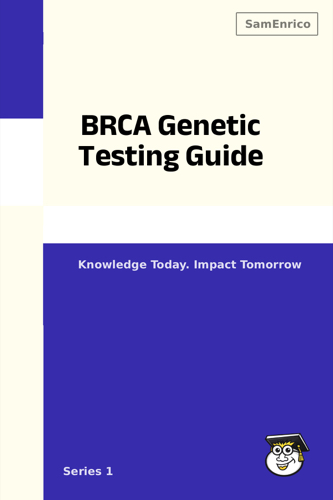
BRCA Genetic Testing Guide eBook
Learn about hereditary breast cancer genes and whe
by Lugo Bethel
Learn about hereditary breast cancer genes and whether testing is right for you.
Formats
Free sample
Chapter 1: The Family Ghost...--The first time you hear the phrase “hereditary cancer,” it might come in a whisper from a well-meaning aunt at a wedding, or in an offhand comment from your mother about your grandmother’s “female troubles,” or in a surgeon’s note buried in a medical record you weren’t supposed to see. The phrase carries no weight until it lands on your own doorstep. Then it feels less like a whisper and more like a knock at midnight. This chapter is about answering that knock—not with fear, but with information. We are going to build a family tree, decode the patterns hidden in plain sight, and learn the language of risk.
By the end, you will know whether your own family history crosses the threshold for genetic counseling. And you will understand that knowledge, no matter how unsettling, is never the enemy.The Misconception That Keeps Us Silent We have been taught that cancer is random. A roll of the dice. Bad luck. This belief is comforting because it absolves us of responsibility: if cancer strikes, there was nothing anyone could have done.
But this belief is also dangerously incomplete. Most cancers—approximately 90 to 95 percent of all cases—are indeed sporadic. They occur without an inherited cause, often driven by age, environment, lifestyle, or simply the accumulation of random mutations over a lifetime. The remaining 5 to 10 percent are hereditary, passed down through families in predictable patterns. These are not random.
They are written into the DNA that your parents gave you and that you may pass to your children.The problem is that families do not talk about hereditary cancer. We talk about “the cancer that ran through the family” as though it were a weather system—something that happened, not something that follows rules. We say, “Grandma had breast cancer, and her sister had ovarian cancer, and Uncle Joe had prostate cancer,” without connecting the dots. But those dots form a pattern. That pattern is the subject of this book.
And recognizing it is the first step toward taking control.Why do we stay silent? Shame plays a role. Some families view cancer as a personal failure or a curse. Fear plays a larger role. If cancer runs in your family, acknowledging it means acknowledging that you might be next.
It is easier to treat each case as an isolated tragedy than to see the thread running through generations. But that thread, once identified, becomes a map. And a map is far less terrifying than a dark forest.Your Family Tree Is a Medical Document You likely think of your family tree as a sentimental object—a chart of names and dates for reunions and ancestry websites. But for the purpose of hereditary cancer assessment, your family tree is a clinical tool. Genetic counselors call it a pedigree.
A well-constructed pedigree records not just who is related to whom, but who had which cancer, at what age, and whether anyone had multiple primary cancers. It is the single most important piece of information you will bring to a genetic counseling appointment.Let us build one together. Start with yourself. Write your name, date of birth, and any cancer diagnoses you have had, including the specific type and age at diagnosis. If you have had multiple cancers, list them all.
Draw a square for a male relative, a circle for a female relative, and a diamond if gender is unknown or non-binary. A horizontal line connects partners; vertical lines descend to children. This is a standard pedigree, and you do not need artistic skill to create one—only honesty.Now go back one generation. Your parents. Your aunts and uncles.
Record their cancer histories. If a relative has died, include the age at death and cause. If they had cancer, note the type and age at diagnosis. If they had bilateral cancer (both breasts, for example), note that separately—it matters. If they had multiple primary cancers (breast and ovarian, or breast and melanoma), note both.Now go back another generation.
Grandparents. Their siblings. Great-aunts and great-uncles. This three-generation pedigree is the standard used in medical genetics. You do not need to go further back unless there are unusual patterns, such as cancer appearing in every generation going back four or more.
For most families, three generations provides enough information to assess hereditary risk.As you build this tree, you will encounter gaps. People who died before cancer was diagnosed. Relatives who are estranged. Adoptions. Families where cancer information was deliberately kept secret.
These gaps are frustrating but not insurmountable. Death certificates, obituaries, and medical records can fill some holes. For others, you may simply note “unknown” and move forward. Genetic counselors are accustomed to incomplete information.The Red Flags That Change Everything Not every cancer in a family tree is a red flag. Most families have some cancer—it is a common disease, especially as people live into their seventies, eighties, and beyond.
But certain patterns should make you sit up and pay attention. These are the red flags that warrant a conversation with a genetic counselor, regardless of whether you ultimately decide to test.First red flag: cancer across multiple generations. Sporadic cancer tends to cluster in a single generation or in older individuals. Hereditary cancer jumps generations because it follows the DNA. If your grandmother had breast cancer, your mother did not, and you have breast cancer at age 35, that skipping of a generation is actually characteristic of autosomal dominant inheritance—the mutation can be passed silently through a carrier who never develops cancer themselves.
The pattern is not “everyone gets it”; the pattern is “it appears in every generation but not in every person.”Second red flag: early age at diagnosis. Sporadic breast cancer typically occurs after age 50. Hereditary breast cancer often appears before age 50, and frequently before age 40. The younger the diagnosis, the more concerning the hereditary pattern. Ovarian cancer at any age is a red flag because it is relatively rare; a single case of ovarian cancer in a family raises suspicion of a BRCA mutation even without other cancers.
Pancreatic cancer before age 50, prostate cancer before age 55 (especially if aggressive or metastatic), and male breast cancer at any age are all red flags.Third red flag: bilateral cancer. If a relative had cancer in both breasts—either at the same time or years apart—that suggests an underlying genetic predisposition. The same applies to kidney cancer in both kidneys or other paired organs. A single person developing two different cancers (breast and ovarian, or breast and melanoma) is also a red flag. This is called multiple primary cancers, and it strongly suggests a hereditary syndrome.Fourth red flag: rare cancers.
Male breast cancer is rare, comprising less than one percent of all breast cancers. Triple-negative breast cancer (a specific subtype that lacks estrogen, progesterone, and HER2 receptors) is more common in BRCA1 carriers. Ovarian cancer, fallopian tube cancer, and primary peritoneal cancer are all relatively rare and often hereditary. Pancreatic cancer in a family with breast or ovarian cancer raises suspicion of BRCA2. Medullary thyroid cancer, adrenocortical carcinoma, and certain childhood cancers (like retinoblastoma or adrenocortical carcinoma)…
This is the end of the free sample. Get the eBook to keep going. Buy now
About this book
Details
- Author
- Lugo Bethel
- Publisher
- SamEnrico
- Language
- English
- Genre
- Non-Fiction, Health & Wellness, Genetics
- Released
- 2026-06-08
- Pages (approx.)
- 142
- Available as
- eBook, Audiobook

Read better in the ZLOADR app
Your eBooks on your phone or tablet. Sign in with your SamEnrico account and start reading.
More by Lugo Bethel
 Generalized Anxiety Daily PracticeLugo Bethel$11.99
 Divorce After InfertilityLugo Bethel$11.99
 Commuting Without Anger GuideLugo Bethel$11.99
 Children Understanding Anticipatory GriefLugo Bethel$11.99
 Constraints for AccountantsLugo Bethel$11.99
 Boundary Setting for Truck DriversLugo Bethel$11.99
 The Last Broadcast: When the World Stopped for the 1967 Total Solar EclipseLugo Bethel$11.99
 The Sword of Hephaestus: A Blacksmith’s Oath to the GodsLugo Bethel$11.99
 How to Produce Packaging Product StockLugo Bethel$11.99
 Chimpanzees: Pan TroglodytesLugo Bethel$11.99
 Stakeholder Analysis PromptsLugo Bethel$12.99
 How to Produce Contact CementLugo Bethel$11.99
You may also like
 IBS And Ehlers DanlosHillman Carie$11.99
 Growth Hormone Receptor GeneticsLoomis Gena$11.99
 DNA Vaccine Technology GuideNicholson Katlyn$11.99
 The APOE4 Prevention GuideGladden Piper$11.99
 HRT For Women With Family History Cancer CourseWolff Conchita$11.99
 Bipolar And Genetics GuideClose Myles$11.99
 BRCA Gene Mutation GuideWang Hayley$11.99
 The DNA Risk Assessment GuideDenson Sharen$11.99
 The IBS Genetic GuideMontalvo Sondra$11.99
 BRCA Testing GuideHummel Jenise$11.99
 Adrenal Fatigue and MTHFR MutationSena Lashawnda$11.99
 The Bipolar Genetics GuideFrierson Deane$11.99