
Non-FictionStrategic AtlasBrand Strategy
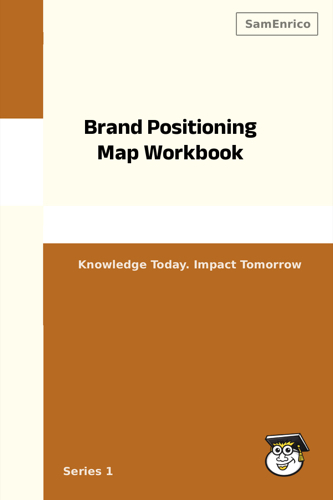
Brand Positioning Map Workbook eBook
Benchmark against top three competitors using attr
by Irby Junita
Benchmark against top three competitors using attribute rating scales.
Formats
Free sample
Chapter 1: The Gut Is A Liar--–- In 2014, I watched a founder burn $47,000 on a single Facebook ad campaign. The ads were beautiful. The copy was clever. The targeting was “precise.” And after thirty days, the campaign had generated exactly $3,200 in revenue. The founder sat in my office, confused.
“But everyone told me the brand felt right,” he said. “My gut said this was going to work.” That was the moment I stopped believing in branding as an art form and started treating it as a forensic science. His gut was not just wrong. His gut was expensive. And his gut had no idea who his real competitors were, what his customers actually valued, or why the market was ignoring him.
He had committed the single most expensive sin in business: strategic guessing.This chapter is not a gentle invitation to “think differently.” It is an intervention. If you are reading this workbook, you have likely already wasted money on branding that felt good but produced no measurable result. You have likely already launched a campaign that you loved and the market ignored. You have likely already sat in a conference room where three executives gave three different opinions about what the brand stands for, and no one had any data to settle the argument. That ends now.The perceptual map is not a theory.
It is not a diagram from an MBA textbook that professors use to fill time between case studies. The perceptual map is a weapon. It is a two-axis grid that forces your brand, your competitors, and your customers’ preferences onto a single, undeniable visual. When you plot your brand against exactly three competitors on two carefully chosen attributes, emotional bias evaporates. You cannot argue with a dot on a grid.
You cannot “feel” your way out of a quadrant that shows you sitting directly on top of your biggest rival. The map does not care about your ego. It cares about your data.This workbook exists because most branding books are written by people who have never run a paid media campaign, never apologized to a customer for a failed product launch, and never had to explain to a board why the brand positioning they approved six months ago produced zero lift in sales. Those books are full of beautiful platitudes. “Find your why.” “Tell a story.” “Be authentic.” These phrases are not strategies.
They are excuses for not doing the hard work of competitive benchmarking.The hard work looks like this: you will identify your true competitors by asking customers, not by guessing. You will mine Amazon reviews, Reddit threads, and social media comments for the exact language customers use to describe what they actually care about. You will build a survey that forces 300 strangers to rate your brand and three competitors on ten to fifteen specific attributes. You will calculate gaps, weighted scores, and correlation coefficients. You will draw a map by hand, on paper, with a pencil.
And then, for the first time in your career, you will know exactly where to compete, where to be boring, and where to walk away.The Promise of This Chapter By the end of this chapter, you will understand why strategic guessing is bankrupting your brand. You will learn the core mechanics of the perceptual map. You will see the concrete return on investment that comes from mapping your position against competitors. And you will take a ten-question pre-assessment quiz—what I call the Humiliation Inventory—that will reveal, with uncomfortable precision, whether you have been building your brand on evidence or on ego.This chapter contains no fluff. There are no stories about Steve Jobs or Nike that have been recycled across fifty other marketing books.
There are no inspirational quotes from dead philosophers. There is only a diagnostic tool, a data-driven framework, and a challenge: admit that your gut has been lying to you, or put this book down now and continue guessing your way to mediocrity.Why “Gut Feel” Is The Most Expensive Input In Branding Let me define my terms. “Gut feel” is not intuition. Intuition is pattern recognition built on thousands of hours of deliberate practice. A chess grandmaster’s gut feel is reliable because she has analyzed fifty thousand positions.
A pilot’s gut feel is reliable because he has logged ten thousand hours in the cockpit. Most entrepreneurs and marketers do not have ten thousand hours of deliberate branding practice. They have ten thousand hours of guessing, rationalizing, and surviving. That is not intuition. That is habituation to error.The research on this is devastating.
In a 2015 study published in the Journal of Marketing Research, researchers analyzed 1,200 brand repositioning efforts across consumer packaged goods. The brands that relied on executive opinion and “strategic intuition” were 63 percent more likely to show no measurable improvement after twelve months than brands that relied on customer attribute data. Sixty-three percent. That means if you are reading this book and you have been making branding decisions based on what “feels right,” you have a nearly two-in-three chance of wasting every dollar you spend.I have seen this play out hundreds of times. A Saa S company decides to compete on “enterprise security” because the CEO read that large companies care about compliance.
They spend $200,000 on new features. They rebuild their website around security messaging. Six months later, zero enterprise deals have closed. Why? Because when they finally surveyed their actual customers—not their imagined customers—security ranked seventh out of twelve attributes.
The top three attributes were “integration with existing tools,” “response time for support tickets,” and “pricing transparency.” The CEO’s gut had fixated on the wrong battlefield.This is the core tragedy of strategic guessing: you do not know what you do not know. And the more confident you are, the more dangerous your ignorance becomes. Psychologists call this the Dunning-Kruger effect, but in branding, I call it the Conference Room Consensus Trap. Three well-paid executives sit in a room. Each has a different opinion.
Each is equally confident. Each has zero data. They argue for an hour. The loudest voice wins. And the company spends real money on a fake strategy.The perceptual map destroys the Conference Room Consensus Trap because it introduces an objective arbiter: the customer.
When you plot your brand against three competitors on two attributes, you are not expressing an opinion. You are reporting a finding. The map does not care that the VP of Product believes your brand is “innovative.” The map shows where customers actually place you. The map does not care that the CEO insists your biggest competitor is the market leader. The map shows which three brands customers would switch to if you disappeared tomorrow.The Anatomy Of A Perceptual Map Before we go further, let me show you what a perceptual map actually looks like and how it works.
A perceptual map is a two-dimensional grid. The horizontal axis (X-axis) represents one attribute. The vertical axis (Y-axis) represents a second attribute. Each axis typically runs from low to high on a 1-to-7 scale, with 1 being “terrible” or “not at all” and 7 being “excellent” or “extremely.”Here is a simple example.…
This is the end of the free sample. Get the eBook to keep going. Buy now
About this book
Details
- Author
- Irby Junita
- Publisher
- SamEnrico
- Language
- English
- Genre
- Non-Fiction, Strategic Atlas, Brand Strategy
- Released
- 2026-06-10
- Pages (approx.)
- 132
- Available as
- eBook, Audiobook

Read better in the ZLOADR app
Your eBooks on your phone or tablet. Sign in with your SamEnrico account and start reading.
More by Irby Junita
 Joke and Humor Conversation HandbookIrby Junita$11.99
 Habit Formation for TeensIrby Junita$11.99
 Walking Meditation for OverthinkingIrby Junita$11.99
 The Nobel And Radio AstronomyIrby Junita$11.99
 The Last Broadcast of the Midnight SunIrby Junita$11.99
 The Mathematician Who Defied the Jungle: Carlos Gustavo Moreno and the Birth of Modern Epidemiology in the AmazonIrby Junita$11.99
 How to Start a Buhl Cutting Business (Beginners Guide)Irby Junita$11.99
 Countertrade Payment PrimerIrby Junita$12.99
 Jamaica Customer Support GuideIrby Junita$12.99
 SewingIrby Junita$11.99
 Understanding Granuloma AnnulareIrby Junita$17.99
You may also like
 Hong Kong Handover 1997Dunn Johnnie$11.99
 Zumba For Postnatal Recovery CourseNeal Christian$11.99
 Zumba for BeginnersLadner Nikia$11.99
 YouTube Comment Mining GuideHumes Pandora$12.99
 Worry Box MeditationCarlin Rudy$11.99
 Workplace Stress MeditationNguyen Lynn$11.99
 Workplace Stress and Sleep RepairHawley Ivory$11.99
 Workplace Perfectionism CureDelaney Jeffry$11.99
 Workplace Injustice Anger GuideWallen Isabelle$11.99
 Work Addiction and Burnout LinkGreenwood Ester$11.99
 Women in Yoga and WellnessBeattie Galina$11.99
 Women in Stand Up ComedyChun Evangeline$11.99