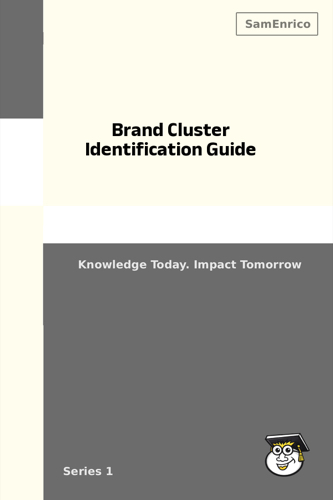
Brand Cluster Identification Guide
Use clustering algorithms to group competitors int
by Diehl Fae
Use clustering algorithms to group competitors into strategic groups on positioning maps.
Formats
About this book
Free sample
Chapter 1: The Blind Spot--–- Every executive believes they know who their competitors are. Ask the CEO of any mid-sized company to name their top three rivals, and you will receive an answer within seconds. The names will come easily, almost reflexively. Ask them to explain how those competitors differ from one another, and the answers will become slower, more hedged. Ask them to explain which of those competitors pose the greatest long-term threat, and you will see the first flickers of uncertainty.
Ask them to draw a map of their competitive landscape—to show you where the real battles are fought, where the profits are earned, and where the next disruptor will emerge—and most will hand you a napkin sketch that bears little relation to economic reality.–- This is not because executives are uninformed or lazy. It is because the human brain is not designed to perceive the hidden structure of competitive markets. We see individual competitors because they have names, logos, and quarterly earnings calls. We see market share because it is reported in tidy percentages. But we do not naturally see strategic groups—the clusters of firms that compete using similar combinations of assets, capabilities, and business models.
We do not see mobility barriers—the invisible walls that keep discount brands from becoming luxury brands overnight. And we do not see white space—the unoccupied positions on the map where no competitor currently exists, but where profitable new ventures could take root.–- This blind spot is not a minor perceptual quirk. It is a strategic liability of enormous proportions. Companies that fail to see the cluster structure of their industries make the same mistakes over and over: they attack rivals that are not actually their direct competitors, they defend against threats that never materialize, they miss the disruptors that are quietly assembling in adjacent clusters, and they pour resources into positions that cannot be defended while ignoring white space that could be claimed for a fraction of the cost.–- This chapter exists to open your eyes. You will learn why the "average competitor" is a dangerous fiction.…
This is the end of the free sample. Get the eBook to keep going. Buy now
Contents
- Chapter 1
- Chapter 2
- Chapter 3
- Chapter 4
- Chapter 5
- Chapter 6
- Chapter 7
- Chapter 8
- Chapter 9
- Chapter 10
- Chapter 11
- Chapter 12
Details
- Author
- Diehl Fae
- Publisher
- SamEnrico
- Language
- English
- Genre
- Non-Fiction, Strategic Atlas, Data Science
- Released
- 2026-06-08
- Pages (approx.)
- 146
- Available as
- eBook, Audiobook

Read better in the ZLOADR app
Your eBooks on your phone or tablet. Sign in with your SamEnrico account and start reading.
More by Diehl Fae
 Digital Planner Niche Research CourseDiehl Fae$11.99
 Forgetting Curve Prevention GuideDiehl Fae$11.99
 Trepanation Ancient Brain SurgeryDiehl Fae$11.99Trepanation Ancient Brain SurgeryDiehl Fae$11.99
 Memory and Bedtime RoutineDiehl Fae$11.99
 The First Atlantic Crossers: Neanderthals and the Ice Age OdysseyDiehl Fae$11.99
 The Silent Diplomat: How a Forgotten Spy Shaped Cold War SecretsDiehl Fae$11.99
 Understanding ChickenpoxDiehl Fae$17.99
 Hot Tub TechnicianDiehl Fae$11.99
 Emergency Comms For Global TeamsDiehl Fae$12.99
 How to Become a Buffing-wheel Former - HandDiehl Fae$11.99