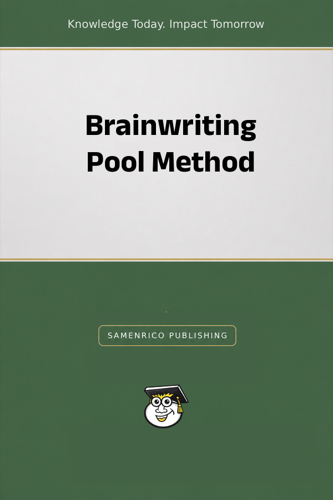
Brainwriting Pool Method Audiobook
Uses 6-3-5 technique where six writers generate th
Uses 6-3-5 technique where six writers generate three ideas in five minutes each.
Formats
Free sample
Chapter 1: The Brainstorming Lie--For the past seventy years, you have been lied to about creativity.Not by accident. Not through benign neglect. But systematically, repeatedly, and with astonishing confidence by people who should have known better. The lie is this: that getting a group of people in a room, telling them to shout out ideas, and promising that “no criticism is allowed” is the most effective way to generate breakthrough thinking.This is false. It has always been false.
And the evidence that it is false has been sitting in peer-reviewed journals since the 1950s, ignored by consultants, managers, and facilitators who preferred a story that felt good over a method that actually worked.The man who started it all was named Alex Osborn. In 1953, he published a book called Applied Imagination, in which he introduced a technique he called “brainstorming.” The rules were simple: generate as many ideas as possible, withhold all criticism, encourage wild and unusual ideas, and build on the ideas of others. The book became a sensation. Advertising agencies adopted brainstorming. Corporations trained their managers in the method.
By the 1960s, brainstorming had become synonymous with group creativity, a default setting for any team facing a difficult problem.There was just one problem. No one had ever tested whether it actually worked.The Man Who Proved Brainstorming Wrong In 1958, just five years after Osborn’s book was published, a Yale University researcher named Donald Taylor decided to run an experiment. He gathered groups of four participants and asked them to solve creative problems using Osborn’s exact brainstorming rules. He also had control groups: the same number of people working alone on the same problems, with their ideas later combined.The results were devastating. The groups working alone generated nearly twice as many ideas as the brainstorming groups.
And when independent judges rated the quality of those ideas, the individuals working alone also produced higher-quality solutions.Taylor’s findings were replicated again and again over the following decades. In 1987, researchers Michael Diehl and Wolfgang Stroebe published a meta-analysis of twenty-two separate studies comparing group brainstorming to individual ideation. The conclusion was unambiguous: people working alone generate more ideas than people working in groups, even when those groups follow Osborn’s rules perfectly.The difference was not small. Across the studies, individuals generated between 30 and 50 percent more ideas than groups. The more complex the problem, the larger the…
This is the end of the free sample. Get the Audiobook to keep going. Buy now
About this book
Details
- Author
- Richie Raeann
- Publisher
- SamEnrico
- Language
- English
- Genre
- Non-Fiction, Self-Help, Ideation Methods
- Released
- 2026-06-07
- Pages (approx.)
- 145
- Available as
- eBook, Audiobook

Listen in the VoxFlicks app
Audiobooks and audio dramas wherever you go. Sign in with your SamEnrico account and press play.
More by Richie Raeann
 NYC Influencer InvitesRichie Raeann$11.99
 Sitting with UncertaintyRichie Raeann$11.99
 De escalation for Customer ServiceRichie Raeann$11.99
 SAD In New EnglandRichie Raeann$11.99
 Workplace Gratitude PracticeRichie Raeann$11.99
 Reframing Failure as FeedbackRichie Raeann$11.99
 Resilience for Single ParentsRichie Raeann$11.99
 The Frozen Trial: The First Stanley Cup Controversy (1793)Richie Raeann$11.99
 Galileo's Telescope: The Lens That Changed the CosmosRichie Raeann$11.99
 How to Produce Lawn Striping KitsRichie Raeann$11.99
 Nifty Agile Roadmap GuideRichie Raeann$12.99
 How to Start a Archery Equipment Business (Beginners Guide)Richie Raeann$11.99