
Non-FictionForecast & OutlookNeurotech
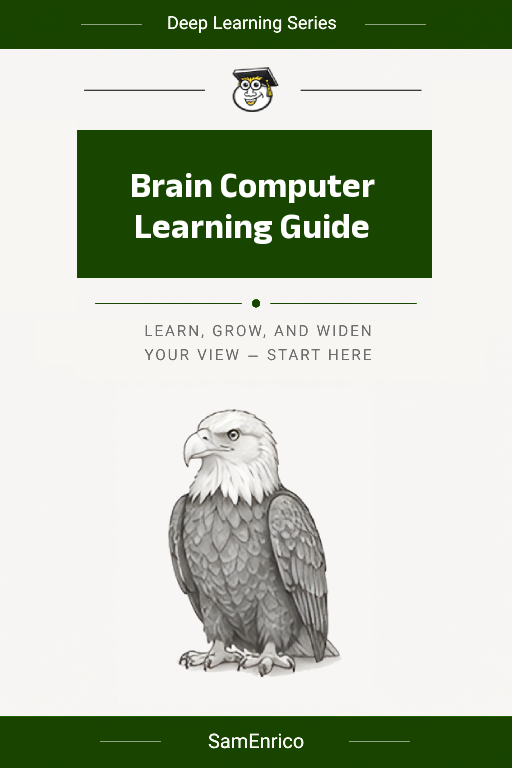
Brain Computer Learning Guide eBook
Discover neurofeedback devices measuring focus and
Discover neurofeedback devices measuring focus and attention to optimize study sessions.
Formats
Free sample
Chapter 1: The Willpower Lie...--The first time I watched a student fail a test they studied twelve hours for, I stopped believing in effort.Her name was Sarah. Pre-med. Organic chemistry. She had highlighters color-coded by molecular functional group. She had rewritten her notes three times.
She had sacrificed sleep, social plans, and her sanity. And then she sat down for the exam and blanked completely. Not because she didn't know the material. Because her brain refused to retrieve it under pressure.Sarah did not have a knowledge problem. She had a regulation problem.Her story is not unique.
Every semester, millions of students do exactly what society tells them to do: try harder. Wake up earlier. Drink more coffee. Eliminate distractions. Buy the fancy planner.
Use the Pomodoro technique. Install the website blockers. Repeat affirmations. And yet, the results do not scale with the effort. Somewhere around hour six of a study marathon, something breaks.
The words stop landing. The formulas blur. The brain, despite all conscious intention, simply drifts away.This chapter demolishes the most expensive myth in education: that willpower is the primary lever for academic success. It introduces an alternative framework based not on effort but on measurement. And it lays the foundation for everything that follows—a practical, data-driven method for training your brain to focus on command, using technology that fits in your pocket and costs less than a semester's worth of textbooks.If you have ever felt like your own mind is working against you, this chapter is the beginning of a different relationship.The $87,000 Mistake (A True Story)Let me tell you about Michael.
Not his real name. But his numbers are real.Michael was a second-year medical student at a top-twenty university. He had already accumulated $87,000 in student debt. He had passed his first-year courses by grinding—eighteen-hour days, caffeine pills, no social life. But by the time he reached his board exams, the strategy collapsed.
He failed the first attempt. Then the second. Each failure cost him not just tuition but residency placement, career trajectory, and self-respect.His school's academic support office gave him standard advice: study in shorter bursts, take more practice tests, get more sleep. All true. All useless.
Because Michael's problem was not his schedule. It was his brain.When I met him, he was skeptical of anything that smelled like "wellness." He did not meditate. He did not journal. He did not believe in biohacking or brain training or any of the Silicon Valley nonsense he had read about. But he was desperate.
So he agreed to try something unusual: a consumer EEG headset that promised to measure his focus in real time.The first baseline measurement was humiliating.We put the headset on Michael, launched the calibration software, and asked him to read a dense paragraph about renal physiology—a topic he knew well. The screen showed his brainwaves in real time. For the first ninety seconds, his Beta waves (active concentration) were strong. His Theta waves (mind-wandering) were low. He was locked in.Then, at ninety-seven seconds, something happened.
His Theta spiked. His Beta collapsed. And Michael kept reading. He did not notice. He could not feel it.
His conscious mind believed he was still focused. But his EEG told a different story: his brain had left the building.This pattern repeated every ninety to one hundred twenty seconds for the entire ten-minute session. Michael's attention was not failing gradually. It was oscillating. Short bursts of genuine focus followed by micro-lapses he was completely unaware of.
By the end of the session, he had retained less than forty percent of what he read.Here is what Michael said afterward: "I thought I was just bad at studying. I didn't know my brain was lying to me."Over the next eight weeks, Michael used neurofeedback for twenty minutes per day. He did not change his study schedule. He did not take new supplements. He did not wake up earlier.
He simply trained his brain to recognize and shorten those micro-lapses. By week six, his attention drift window had extended from ninety-seven seconds to nearly four minutes. By week eight, he passed his board exam.Michael's story is not magic. It is measurement. He stopped trying harder and started seeing clearly.Why "Just Try Harder" Fails Every Time The myth of willpower is ancient and appealing.
It says that success is a function of effort. That those who fail simply did not want it enough. That if you just apply more discipline, more focus, more grit, the results will follow.This myth persists because it is self-serving for everyone except the struggling student. Teachers can blame effort instead of instruction. Parents can blame laziness instead of neurology.
And students can blame themselves instead of their tools—which keeps them buying planners, apps, and courses instead of demanding better solutions.But the neuroscience is unambiguous: willpower is a finite, depletable, and surprisingly weak lever for sustained cognitive performance.Let us start with the most famous study in this field. In the late 1990s, psychologist Roy Baumeister demonstrated that participants who were asked to resist eating fresh-baked chocolate chip cookies (and instead eat radishes) gave up on a subsequent puzzle task significantly faster than those who had not exercised willpower. He called this "ego depletion"—the idea that self-control draws from a limited resource.Subsequent research complicated the picture. Some studies failed to replicate the effect. Others suggested that depletion is not about running out of energy but about shifting motivation.
What is not controversial is this: relying on willpower for tasks that require sustained, high-quality attention is a losing strategy. Because willpower fatigues. And the brain, left to its own devices, defaults to the path of least resistance.Consider what happens in your brain during a typical study session.When you begin, your prefrontal cortex—the region behind your forehead responsible for executive function, attention, and impulse control—is fully online. It suppresses distracting impulses. It maintains task goals.
It directs your cognitive resources toward the material.But as time passes, two things happen. First, your prefrontal cortex tires. It consumes glucose at a high rate. Without a steady supply, its activity diminishes. Second, your default mode network (DMN)—a set of brain regions active when you are not focused on an external task—begins to intrude.
The DMN is responsible for mind-wandering, self-referential thought, and daydreaming. It is not evil. It is essential for creativity and memory consolidation. But when it activates at the wrong time, it hijacks your attention.The result is the classic study crash: you are reading the same paragraph for the fourth time. You look up and realize ten minutes have passed.
You have no idea what you just "read." And then you feel guilty, which triggers stress, which further impairs prefrontal function, which makes the next cycle even worse.This is not a character flaw. It is a neurophysiological fact. And you cannot willpower your way out of it any more than you can willpower your way out of needing sleep.The Alternative: Brain-Computer Interfaces as a Mirror If willpower is a weak lever, what is the alternative?The alternative is measurement. Specifically, the…
This is the end of the free sample. Get the eBook to keep going. Buy now
About this book
Details
- Author
- Woodson Mirtha
- Publisher
- SamEnrico
- Language
- English
- Genre
- Non-Fiction, Forecast & Outlook, Neurotech
- Released
- 2026-05-28
- Pages (approx.)
- 142
- Available as
- eBook, Audiobook

Read better in the ZLOADR app
Your eBooks on your phone or tablet. Sign in with your SamEnrico account and start reading.
More by Woodson Mirtha
 Operation Car Wash International ImpactWoodson Mirtha$11.99
 Email Preference Center GuideWoodson Mirtha$11.99
 Latvian Household Efficiency AidWoodson Mirtha$11.99
 Marriage Self Esteem PreservationWoodson Mirtha$11.99
 The Golden Scrolls of Timbuktu: Where Wisdom Flowed Like GoldWoodson Mirtha$11.99
 The Day the Sky Spoke: The 1977 Soviet UFO Encounter That Changed EverythingWoodson Mirtha$11.99
 Hospitality AssistantWoodson Mirtha$11.99
 Understanding HypotropiaWoodson Mirtha$17.99
 How to Start a Hobby in MySpaceWoodson Mirtha$11.99
You may also like
 Hong Kong Handover 1997Dunn Johnnie$11.99
 Zumba For Postnatal Recovery CourseNeal Christian$11.99
 Zumba for BeginnersLadner Nikia$11.99
 YouTube Comment Mining GuideHumes Pandora$12.99
 Worry Box MeditationCarlin Rudy$11.99
 Workplace Stress MeditationNguyen Lynn$11.99
 Workplace Stress and Sleep RepairHawley Ivory$11.99
 Workplace Perfectionism CureDelaney Jeffry$11.99
 Workplace Injustice Anger GuideWallen Isabelle$11.99
 Work Addiction and Burnout LinkGreenwood Ester$11.99
 Women in Yoga and WellnessBeattie Galina$11.99
 Women in Stand Up ComedyChun Evangeline$11.99