
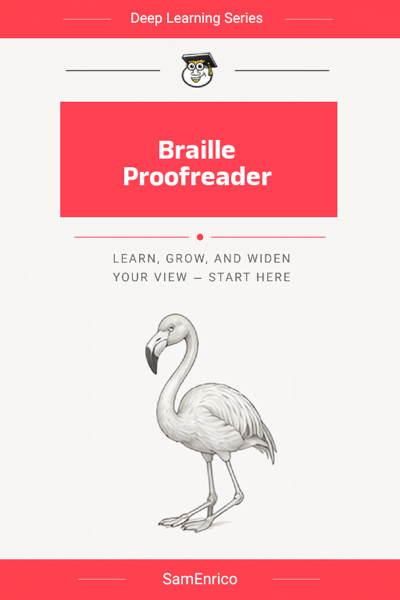
Non-FictionInformativeEducational
Braille Proofreader eBook
A Coursebook on Braille Proofreader
by Lugo Lenny
A Coursebook on Braille Proofreader
Formats
Free sample
Chapter 1: The Last Pair of Eyes...--The first thing you must understand about braille proofreading is that you are not a transcriber. You are not a teacher. You are not a quality assurance manager, though you may become one later. You are, quite simply, the last pair of eyes—or more accurately, the last pair of fingertips—that stands between a flawed transcription and a blind reader who will never know that an error existed unless you fail to catch it.This is not hyperbole. It is the structural reality of braille production.Every printed book that enters the transcription pipeline passes through multiple hands.
First, a project manager assesses the source material—a novel, a textbook, a technical manual, a children's picture book with supplementary tactile graphics. Second, a transcoder (often using specialized software like Duxbury Braille Translator) converts the print text into a digital braille file, applying automated contraction rules. Third, a human transcriber reviews that automated output, correcting errors that the software introduced, applying formatting decisions that no algorithm can reliably make, and ensuring that the tactile layout will make sense to fingers rather than eyes. Fourth, an embosser prints the braille onto heavy paper, punching dots into every page. And then, finally, the proofreader receives the stack of embossed pages—sometimes hundreds, sometimes thousands—alongside the original print text.At that moment, everyone else has moved on.
The project manager is already assigning the next book. The transcriber has started a new manuscript. The embosser is humming away on another job. The reader—a student, a professional, a child, a senior citizen—is waiting.You are the only one still looking at this specific page.This chapter establishes the foundational mindset that every successful braille proofreader must internalize before learning a single symbol or contraction rule. You will learn why accuracy matters more than speed, why your role is fundamentally different from that of a transcriber, and why the seemingly small errors you catch can have outsized consequences on a blind reader's comprehension, safety, and dignity.
By the end of this chapter, you will understand not just what a braille proofreader does, but why this work matters in ways that extend far beyond the page.The Invisible Gatekeeper Braille proofreading occupies a strange position in the publishing ecosystem. It is almost invisible to outsiders. Ask a hundred sighted people what a "proofreader" does, and most will describe someone who catches typos in a manuscript before it goes to print. Ask those same people what a "braille proofreader" does, and the blank stares multiply. Yet within the blindness community and the transcription industry, the proofreader is revered—or, when errors slip through, reviled.Consider what happens when a proofreader misses an error.A middle school student who is blind is studying for a geography exam.
Her embossed textbook contains a tactile map of South America. The transcriber accidentally shifted the entire map two centimeters to the left during the embossing process, so the raised line that represents the Andes Mountains now runs through what should be the Amazon Basin. The proofreader, rushing to meet a deadline, did not compare the tactile map's alignment against the print original. The student studies the map, memorizes the incorrect mountain placement, and fails her exam. She does not know why she failed.
She only knows that the mountains were not where she thought they would be.That is a failure of proofreading.Or consider a more dangerous scenario. A blind patient receives a medication information sheet in braille, as required by hospital regulations. The transcription was automated, but no one proofread the output. The word "half" was mistranscribed as "whole" because the OCR software misread the print letterforms. The patient takes double the prescribed dose.
The consequences are not academic; they are medical.These are not hypothetical nightmares. They are the reasons that the National Library Service and the National Federation of the Blind maintain rigorous proofreading certification programs. They are the reasons that state braille production centers employ full-time proofreaders who never transcribe—they only verify. And they are the reasons that this book exists.The proofreader is not a second transcriber. You are not there to improve the text, to rephrase awkward sentences, or to make creative decisions.
You are there to compare two artifacts—the print original and the braille reproduction—and certify that they are functionally identical for a blind reader. Your judgment must be mechanical, not artistic. Your loyalty is not to the author's voice but to the reader's right to access that voice without distortion.The Expectation Effect: Why You Cannot Proofread Your Own Work Before we go any further, you must understand a psychological phenomenon that will defeat you every time you try to ignore it. It is called the expectation effect, and it is the single greatest enemy of accurate proofreading.Here is how it works. When you read a sentence that you have seen before—especially a sentence that you yourself wrote or transcribed—your brain does not read every letter.
It recognizes the shape of the word, anticipates what should come next, and fills in the gaps. This is how sighted readers can skim text and still understand it. This is also how transcribers miss their own errors.Imagine you are a transcriber. You have just finished converting a 300-page novel into Grade 2 braille. You applied the contraction rules correctly.
You formatted the headings according to UEB standards. You are proud of your work. Now, your supervisor asks you to proofread your own manuscript before sending it to the QA department. You agree, because you are diligent and you trust your own attention to detail.You will miss errors.Not because you are careless. Because your brain has already decided what the text says.
When you look at a line of braille that you created, you are not truly reading it. You are remembering it. Your fingers (or your eyes, if you are sighted) glide over the dots, and your brain supplies the expected words. A missing contraction indicator? Your brain supplies it.
A transposed pair of cells? Your brain corrects the order. A missing space between two words? Your brain inserts the boundary automatically.This is not a personal failing. It is a feature of human neurology.
The expectation effect has been documented in every field that involves verification of one's own work—from accounting to journalism to software testing. The only reliable countermeasure is distance. You must not proofread your own transcriptions, and you must not transcribe the materials you will later proofread. The two roles require fundamentally different cognitive orientations: creation versus verification.This is why professional braille production houses use a three-tier system. The transcriber creates.
A different proofreader verifies. A senior proofreader or QA manager audits a sample of the verified pages. At no point does the same person occupy two roles on the same manuscript. When you are the proofreader, you are seeing the braille for the first time. You have no prior expectations about what it should say.
You are free to see what is actually there.The Four Deadly Sins of Proofreading In the decades that braille has existed as a standardized code, the…
This is the end of the free sample. Get the eBook to keep going. Buy now
About this book
Details
- Author
- Lugo Lenny
- Publisher
- SamEnrico
- Language
- English
- Genre
- Non-Fiction, Informative, Educational
- Released
- 2026-05-09
- Pages (approx.)
- 152
- Available as
- eBook, Audiobook

Read better in the ZLOADR app
Your eBooks on your phone or tablet. Sign in with your SamEnrico account and start reading.
More by Lugo Lenny
 Speaker Anxiety Protocol WorkbookLugo Lenny$11.99
 Indian Chat Support OptimizationLugo Lenny$11.99
 Benzodiazepine Alcohol DetoxLugo Lenny$11.99
 Workplace Anger Meditation PracticeLugo Lenny$11.99
 The Low Libido Testosterone GuideLugo Lenny$11.99
 The Dark Whisperers: New Zealand’s Forgotten Cult of the 1920sLugo Lenny$11.99
 Short Term Rental Spending GuideLugo Lenny$12.99
 YouTube for Local Business BrandsLugo Lenny$12.99
 How to Become a Occupational-safety-and-health InspectorLugo Lenny$11.99
 Understanding Polycystic Kidney Disease, Type 1Lugo Lenny$17.99
You may also like
 Hong Kong Handover 1997Dunn Johnnie$11.99
 Zumba For Postnatal Recovery CourseNeal Christian$11.99
 Zumba for BeginnersLadner Nikia$11.99
 YouTube Comment Mining GuideHumes Pandora$12.99
 Worry Box MeditationCarlin Rudy$11.99
 Workplace Stress MeditationNguyen Lynn$11.99
 Workplace Stress and Sleep RepairHawley Ivory$11.99
 Workplace Perfectionism CureDelaney Jeffry$11.99
 Workplace Injustice Anger GuideWallen Isabelle$11.99
 Work Addiction and Burnout LinkGreenwood Ester$11.99
 Women in Yoga and WellnessBeattie Galina$11.99
 Women in Stand Up ComedyChun Evangeline$11.99