
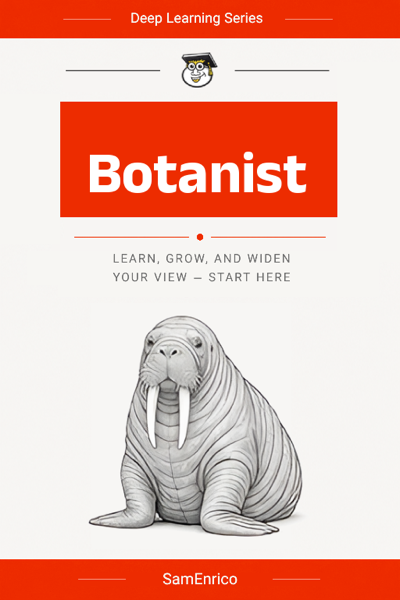
Non-FictionInformativeEducational
Botanist eBook
A Coursebook on Botanist
A Coursebook on Botanist
Formats
Free sample
Chapter 1: The Invisible Kingdom...--We are surrounded by miracles we have trained ourselves not to see.Consider, for a moment, the ordinary dandelion pushing through a crack in a city sidewalk. Its yellow head turns toward the sun, tracking the star across the sky with a precision that would require complex machinery if humans built it. Its roots have fractured concrete—a force that engineers calculate as hundreds of pounds per square inch. Its seeds fly miles on structures so exquisitely aerodynamic that aerospace engineers have studied them for inspiration. And yet, you walked past it this morning without a glance.
You have walked past thousands of such miracles in your life. This is not a failure of attention. It is a failure of education. You have been trained to see plants as background, as wallpaper, as the green static that fills the spaces between the interesting things. This book is designed to break that training.The Most Successful Organisms You Have Never Truly Seen Let us begin with a humbling fact: plants dominate this planet by every measurable metric.
They compose approximately eighty percent of the total biomass of Earth. If you gathered every living thing on the planet—every whale, every human, every ant, every bacterium, every fungus—and placed them on one side of a cosmic scale, and all the plants on the other, the plants would be four times heavier. Animals are a thin film of activity on the surface of a botanical world. We are guests in their house.And yet, most people cannot name ten native plants in their own county. They can name twenty brands of car, thirty actors, forty song titles.
The average person can identify more corporate logos than they can identify tree species. This phenomenon has a name: plant blindness. Coined by botanists James Wandersee and Elisabeth Schussler in 1998, plant blindness refers to the human tendency to overlook plants as static, interchangeable background elements. We notice a squirrel running across a lawn; we do not notice the lawn itself, which is a complex ecosystem of grasses, sedges, clovers, and dandelions engaged in constant competition, cooperation, and chemical warfare. We see the bird landing on the branch; we do not see the branch as a living structure that has solved the engineering problem of cantilevered support without steel or concrete.This book is an intervention against plant blindness.
It will teach you to see plants not as scenery but as actors, not as objects but as organisms, not as simple green blobs but as the most sophisticated chemical factories, structural engineers, and behavioral strategists on the planet. By the time you finish these twelve chapters, you will never look at a weed, a tree, or a houseplant the same way again.What Is Botany, Anyway?Before we can become botanists—and this book is designed to turn you into one, whether you enroll in a formal course or not—we must define our terms. Botany is the scientific study of plants. But that definition is deceptively simple. Let us distinguish it from two related fields.Horticulture is the art and science of garden cultivation.
A horticulturist cares about growing better tomatoes, more beautiful roses, or hardier lawn grasses. The horticulturist asks: How do I make this plant thrive in this specific setting? Horticulture is practical, applied, and human-centered. Forestry is the management of timberlands. A forester asks: How do I harvest wood sustainably while maintaining forest health?
Forestry is economic, ecological, and large-scale.Botany is different. Botany asks: What is this plant? How does it work? Where did it come from? How does it relate to other plants?
Botany is not primarily about utility. It is about understanding. A botanist might study a rare orchid that grows only on a single mountainside in Ecuador, not because that orchid cures cancer or produces valuable timber, but simply because it exists and deserves to be understood. This pure curiosity is the engine of all science, and it is the spirit that drives this book.Botany encompasses an astonishing range of sub-disciplines. Plant morphology (the study of form and structure) asks why leaves are shaped the way they are.
Plant physiology (the study of function) asks how water climbs a hundred-foot tree. Plant anatomy (the study of internal structure) looks at cells and tissues under microscopes. Plant taxonomy (the study of classification) builds the family tree of all green life. Plant ecology (the study of interactions) asks how plants compete, cooperate, and co-evolve with animals, fungi, and bacteria. Economic botany (the study of useful plants) traces how wheat, rice, and corn built civilizations.
Ethnobotany (the study of cultural plant use) learns from indigenous peoples who understood plant medicines long before laboratories isolated their active compounds. And newer fields like plant behavior and plant neurobiology (a controversial but productive term) ask whether plants might possess forms of intelligence, memory, and communication entirely different from our own.This book will touch on all of these. By the end, you will not be a specialist in any one sub-discipline, but you will have a working map of the entire territory.The Three Great Differences: Why Plants Are Not Animals If you are new to botany, the most useful place to start is not with what plants have but with what plants lack—and what they have instead. Animals and plants diverged more than 1.5 billion years ago, and we have been evolving in radically different directions ever since. Three fundamental differences underpin everything else.Difference One: The Cell Wall Animal cells are surrounded by a flexible plasma membrane, like a water balloon.
Plant cells have that membrane, but they also have a rigid cell wall outside it, made primarily of cellulose—the most abundant organic polymer on Earth. A plant cell is a water balloon inside a cardboard box.This single difference explains an enormous amount. Because animal cells are flexible, animals can move—muscles pull on a flexible skeleton, and the whole body changes shape and location. Because plant cells are locked in rigid walls, plants cannot move. A plant is born where its seed lands, and it dies there (or, occasionally, spreads via runners or seeds, but the individual plant remains rooted).
This immobility has driven every aspect of plant evolution. Since they cannot run from danger, they have evolved chemical defenses. Since they cannot hunt for food, they have evolved photosynthesis. Since they cannot seek out mates, they have evolved elaborate pollination strategies that trick animals into carrying their pollen.But the cell wall also gives plants a superpower animals lack. A plant cell can absorb water into its vacuole (a large internal sac), pressurizing the cell wall until it becomes as stiff as bone.
This is called turgor pressure. It is why a well-watered lettuce leaf stands upright and a wilted one droops. It is why grass blades can slice through soil. It is how a tiny seedling can crack open a boulder. Animals build skeletons out of calcium; plants build skeletons out of water pressure inside cellulose boxes.Difference Two: Autotrophy Animals are heterotrophs.
We must eat other organisms to survive. We consume organic carbon—sugars, fats, proteins—that someone else has made. Plants are autotrophs.…
This is the end of the free sample. Get the eBook to keep going. Buy now
About this book
Details
- Author
- Bingham Columbus
- Publisher
- SamEnrico
- Language
- English
- Genre
- Non-Fiction, Informative, Educational
- Released
- 2026-06-02
- Pages (approx.)
- 141
- Available as
- eBook, Audiobook

Read better in the ZLOADR app
Your eBooks on your phone or tablet. Sign in with your SamEnrico account and start reading.
More by Bingham Columbus
 Peace Corps Resume ValueBingham Columbus$11.99
 Disappointment in Dating GuideBingham Columbus$11.99
 Breaking the Casino Chase CycleBingham Columbus$11.99
 Dysbiosis And Brain Fog GuideBingham Columbus$11.99
 Body Language for EtiquetteBingham Columbus$11.99
 The Jade Serpent’s Curse: How a Dragon’s Wrath Shaped the Yellow RiverBingham Columbus$11.99
 How to Start a Bakery Machinery and Ovens Business (Beginners Guide)Bingham Columbus$11.99
 Security Vulnerability Scanner HandbookBingham Columbus$12.99
 Green Technology Merger GuideBingham Columbus$12.99
 Understanding Landouzy–dejerine Muscular DystrophyBingham Columbus$17.99
You may also like
 Hong Kong Handover 1997Dunn Johnnie$11.99
 Zumba For Postnatal Recovery CourseNeal Christian$11.99
 Zumba for BeginnersLadner Nikia$11.99
 YouTube Comment Mining GuideHumes Pandora$12.99
 Worry Box MeditationCarlin Rudy$11.99
 Workplace Stress MeditationNguyen Lynn$11.99
 Workplace Stress and Sleep RepairHawley Ivory$11.99
 Workplace Perfectionism CureDelaney Jeffry$11.99
 Workplace Injustice Anger GuideWallen Isabelle$11.99
 Work Addiction and Burnout LinkGreenwood Ester$11.99
 Women in Yoga and WellnessBeattie Galina$11.99
 Women in Stand Up ComedyChun Evangeline$11.99