
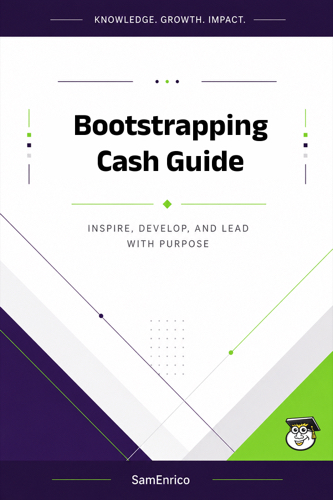
Non-FictionBusiness BriefBootstrapping
Bootstrapping Cash Guide eBook
Operate with minimal external capital through cash
Operate with minimal external capital through cash discipline.
Formats
Free sample
Chapter 1: The Runway Lie--The moment you calculate your "runway," you have already lost.Not because the math is wrong. The math is usually correct. You have $50,000 in the bank. You spend $10,000 per month. You have five months of runway.
That is simple arithmetic. The problem is not the calculation. The problem is what the calculation does to your brain.Runway is not a financial metric. It is a psychological trap. It is the single most destructive concept in modern entrepreneurship because it creates the illusion of time.
And time, when you have a cushion of cash, is the enemy of discipline.Let me tell you about two founders. Both started identical software companies in the same month. Both had identical backgrounds. Both pursued identical markets. The only difference was their starting capital.Founder A raised $2 million from a venture capital firm.
The money hit her bank account on a Tuesday. By Friday, she had rented a We Work office for twelve people, hired a recruiting agency, and purchased $40,000 worth of software subscriptions. She calculated her runway: eighteen months. She felt safe.Founder B started with $500 from his personal savings. He could not afford an office.
He could not afford employees. He could not afford software subscriptions. He calculated his runway: negative. He had no safety net. He felt terrified.Eighteen months later, Founder A's company was dead.
She had burned through all $2 million. Her team had built a beautiful product that nobody wanted. Her investors had stopped returning her emails. She was back to applying for jobs.Founder B's company was generating $50,000 per month in profit. He had zero employees.
He worked from his apartment. He had never taken a dollar of outside capital. He was not rich, but he was free.What happened?Founder A had been killed by her own runway.The Paradox of Plenty Every entrepreneur believes that more cash is always better. This belief is so deeply embedded in startup culture that questioning it feels like heresy. More cash means more time.
More time means more chances to find product-market fit. More chances mean higher probability of success. This logic seems unassailable.It is also completely wrong.Behavioral economists have studied this phenomenon for decades. The technical term is "resource slack"—the cushion of excess resources that organizations maintain to absorb unexpected shocks. In theory, slack is good.
It allows you to experiment, to pivot, to survive mistakes. In practice, slack does something insidious: it removes the pressure that makes good decisions inevitable.When you have no money, every decision matters. You cannot afford to hire the wrong person. You cannot afford to build the wrong feature. You cannot afford to spend a week on marketing that doesn't work.
Your mistakes are immediately painful. You learn fast because you have to.When you have money, mistakes feel like experiments. You can afford to hire the wrong person—just fire them next month. You can afford to build the wrong feature—just pivot next quarter. You can afford to waste a week—you have eighteen months of runway.
The pain is delayed. The learning is slower. The discipline never develops.This is the paradox of plenty: having too much cash makes you stupid.The Three Ways Runway Destroys Discipline Runway damages your decision-making in three specific and predictable ways. Understanding these mechanisms is the first step to escaping them.1. The Procrastination Spiral When you have twelve months of runway, you face no immediate pressure to generate revenue.
You can spend months building, researching, designing, and "validating." You tell yourself that you are being thorough. You are actually being afraid.Revenue is the only true validation of a business model. Not surveys. Not waitlists. Not "letters of intent." Actual money changing hands from a customer who is not your mother, your friend, or your former colleague.
Revenue forces you to confront the brutal question: does anyone actually want this enough to pay for it?Runway allows you to avoid that question. You can keep building, keep tweaking, keep perfecting. You can convince yourself that you are just one feature away from product-market fit. You can spend six months building something that could have been validated in six days with a simple smoke test.Every day you delay revenue is a day you are lying to yourself.2. The Feature Bloat Death March When you have limited cash, you build only what customers demand.
You ask: "What is the absolute smallest thing I can build that someone will pay for?" You ship that thing. You get feedback. You iterate. This is lean. This is smart.
This is how successful bootstrapped companies are built.When you have runway, you build what you imagine customers want. You add features that seem important. You build for scale you will never reach. You optimize for problems you do not yet have. You create a bloated, complicated product that tries to do everything and does nothing well.I have watched funded startups spend $500,000 building a product that could have been replaced by a Google Doc and a manual process.
They built authentication systems, payment gateways, and analytics dashboards before a single customer had ever used the core feature. By the time they launched, they had solved problems nobody had and created new problems nobody needed.The bootstrapped competitor launched with a spreadsheet and a Pay Pal link. They had revenue on day one. By the time the funded startup launched, the bootstrapper had already iterated twelve times based on real customer feedback.3. The Hiring Death Spiral The single most expensive mistake a founder can make is hiring too early.
Runway makes this mistake almost inevitable.When you have cash, you feel pressure to spend it. Investors expect you to grow. Growth requires people. So you hire. You hire a marketer before you have a message that resonates.
You hire a salesperson before you have a repeatable sales process. You hire a developer before you know what to build. You build a team before you have a business.Each new hire creates fixed costs. Fixed costs require more revenue. More revenue requires more customers.
More customers require more features. More features require more hires. You have created a death spiral disguised as growth.The bootstrapper does the opposite. They automate before they hire. They outsource before they employ.
They keep costs variable until the revenue is proven. They hire only when the pain of not hiring exceeds the pain of writing a paycheck. This is not cheapness. This is discipline.The Science of Constructive Scarcity The power of constraints is not just anecdotal. It is well-documented in psychology, economics, and organizational behavior.Psychologists have studied what happens when people face scarcity.
The finding is consistent across dozens of studies: scarcity focuses attention. When resources are limited, people become more selective, more creative, and more efficient. They waste less. They prioritize better. They make fewer errors.Economists call this the "scarcity effect." When something is abundant, we treat it as cheap.
When something is scarce, we treat it as valuable. Cash is no different. Abundant cash leads to wasteful decisions. Scarce cash leads to disciplined decisions.Organizational behavior researchers have studied companies that deliberately impose artificial constraints. They…
This is the end of the free sample. Get the eBook to keep going. Buy now
About this book
Details
- Author
- Billings Donn
- Publisher
- SamEnrico
- Language
- English
- Genre
- Non-Fiction, Business Brief, Bootstrapping
- Released
- 2026-06-08
- Pages (approx.)
- 141
- Available as
- eBook, Audiobook

Read better in the ZLOADR app
Your eBooks on your phone or tablet. Sign in with your SamEnrico account and start reading.
More by Billings Donn
 Messner Mount Everest North FaceBillings Donn$11.99
 Keyboard Shortcut Focus ModeBillings Donn$11.99
 Emotional Intelligence for EntrepreneursBillings Donn$11.99
 Twelve Step Living AmendsBillings Donn$11.99
 Perfectionism and WorkaholismBillings Donn$11.99
 Universal Needs NVC GuideBillings Donn$11.99
 Plane Crash MiracleBillings Donn$11.99
 The Alter of SlabodkaBillings Donn$11.99
 Red Dust: The Untold Story of the First Martian Dust StormBillings Donn$11.99
 The Silk Road of Legends: How 18th-Century Japanese Playwrights Rewrote King ArthurBillings Donn$11.99
 Billionaire’s Gambit: The Secret War Over the World’s Most Powerful PhilanthropyBillings Donn$11.99
 Push Notification Marketing SystemsBillings Donn$11.99
You may also like
 Hong Kong Handover 1997Dunn Johnnie$11.99
 Zumba For Postnatal Recovery CourseNeal Christian$11.99
 Zumba for BeginnersLadner Nikia$11.99
 YouTube Comment Mining GuideHumes Pandora$12.99
 Worry Box MeditationCarlin Rudy$11.99
 Workplace Stress MeditationNguyen Lynn$11.99
 Workplace Stress and Sleep RepairHawley Ivory$11.99
 Workplace Perfectionism CureDelaney Jeffry$11.99
 Workplace Injustice Anger GuideWallen Isabelle$11.99
 Work Addiction and Burnout LinkGreenwood Ester$11.99
 Women in Yoga and WellnessBeattie Galina$11.99
 Women in Stand Up ComedyChun Evangeline$11.99