
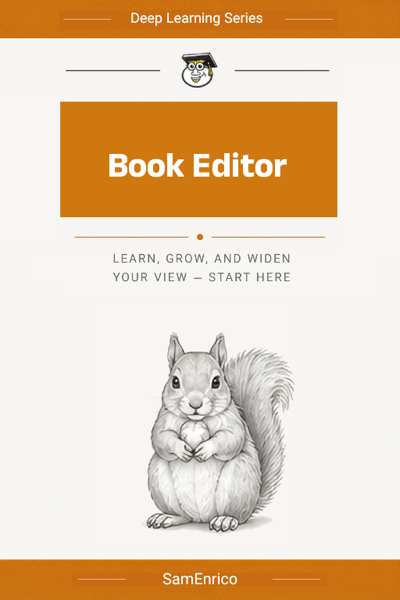
Non-FictionInformativeEducational
Book Editor eBook
A Coursebook on Book Editor
A Coursebook on Book Editor
Formats
Free sample
Chapter 1: The Four Knives...--You have picked up this book because somewhere inside you, there is a quiet suspicion that the manuscript on your screen—whether it is your own or someone else's—could be better. Not just polished. Not just corrected. Better. Tighter.
More alive. The kind of book that readers cannot put down and cannot stop talking about.I am going to tell you something that most publishing professionals will not admit in public: most manuscripts that cross an editor's desk are not terrible. They are not hopeless. They are not beyond saving. They are simply mis-edited.
Someone opened the file and started fixing commas before anyone had asked the only question that matters: What kind of surgery does this patient actually need?You do not perform open-heart surgery on someone who needs a bandage. And you do not put a bandage on someone who is bleeding internally.Editing is surgery. And like a surgeon, you must choose your instrument based on the diagnosis, not your comfort zone. This chapter introduces you to the four knives in every editor's satchel—the four distinct levels of edit—and teaches you how to select the right one before you make a single change.But first, a confession. I learned this lesson the hard way.The Ten-Thousand-Dollar Comma Early in my career, a first-time novelist hired me to edit her manuscript.
She was self-publishing, had saved for months, and trusted me completely. I opened the file—four hundred pages of literary fiction with ambition that outpaced execution—and I did what I had been trained to do. I started copyediting.I fixed every comma splice. I corrected every dangling modifier. I standardized her hyphenation.
I wrote queries in the margins about verb tense consistency. I worked for three weeks. The manuscript came back to her gleaming, technically flawless, and completely lifeless.She called me crying."You took my voice," she said. "It doesn't sound like me anymore."She was right. I had performed micro-surgery on a patient who needed a bone reset.
The manuscript's problem was not grammatical. The problem was structural: the second act collapsed, the protagonist had no arc, and the ending contradicted everything that came before it. But instead of diagnosing those macro issues, I reached for the tool I was most comfortable with—copyediting—and made everything worse.I refunded her money. It cost me ten thousand dollars in lost work and reputation. But it taught me the single most important rule in editing:Triage first, edit second.The rest of this chapter teaches you how.The Four Knives: A Complete Taxonomy of Editorial Levels Editing is not one thing.
It is four distinct disciplines, each with its own tools, goals, and judgment calls. Confusing them is the most common mistake new editors make—and the fastest way to lose clients, frustrate authors, and produce bad books.Let me define each level clearly, from the largest incision to the smallest.Knife Number One: Developmental Editing – The Bone Saw Developmental editing is structural. It asks: Does this book work as a whole? A developmental editor looks at plot, pacing, character arcs, narrative tension, argument architecture, and organizational logic. This editor moves chapters, cuts entire scenes, suggests adding new characters, and sometimes tells the author to throw away a hundred pages and start over.This is the most invasive level of edit—and the most valuable for manuscripts that are sick at the structural level.
A good developmental edit can save a book that seems hopeless. A bad developmental edit—or none at all—can leave a technically perfect manuscript that no one wants to read.Think of developmental editing as resetting a broken bone. It is painful. The author will resist. But without it, the bone will heal wrong, and the patient will never walk properly.Knife Number Two: Line Editing – The Scalpel Line editing lives between structure and sentence.
It asks: Does this book sing? A line editor focuses on rhythm, voice, word choice, and sentence flow. This editor trims redundancies, breaks up monotonous sentence structures, strengthens weak verbs, and tightens dialogue. The goal is not correctness but beauty—making the prose a pleasure to read at the micro level.Line editing respects the author's voice while removing whatever obscures it. A line edit on a poorly structured manuscript is like polishing the paint on a car with no engine.
A line edit on a soundly structured manuscript can elevate it from good to unforgettable.Knife Number Three: Copyediting – The Precision Forceps Copyediting is mechanical. It asks: Is this book consistent and correct? A copyeditor enforces grammar rules, checks spelling and hyphenation, verifies that character names are spelled the same way every time, and ensures that the manuscript follows a consistent style guide (usually The Chicago Manual of Style for books).Copyediting does not change voice. It cleans the windows so the voice can shine through. A copyedit on a manuscript that needs developmental work is like dusting the lamps in a burning building.
A copyedit on a manuscript that is structurally sound and beautifully written is the final layer of polish that makes the book feel professional.Knife Number Four: Proofreading – The Magnifying Glass Proofreading is the final check. It asks: Did anything break during production? A proofreader compares the final page proofs to the copyedited manuscript, catching typos, formatting errors, missing page numbers, and inconsistencies introduced during design. Proofreading is not editing—it is quality control.Here is the critical distinction that most books get wrong: who performs each level depends on your workflow. We cover that distinction in depth in Chapter Ten.
But for now, understand that in the freelance model, you may perform all four levels yourself. In the in-house model, proofreading is typically done by a specialist who never saw the manuscript before.The Two Workflows: Freelance Versus In-House Before you edit a single word, you must know which model you are working in, because it changes who does what.The Freelance Model – Editor as Sole Provider When an author hires you directly—whether for self-publishing or submission to agents—you are often expected to perform all four levels yourself. The author does not have a production team. They have you. Your contract should specify which levels you are providing, but in practice, freelance editors frequently wear all four hats on a single project.In this model, you are the proofreader.
You create the style sheet. You write the editorial memo and the marginal queries. The buck stops with you. This is liberating because you have complete control. It is terrifying because there is no one to catch your mistakes.The In-House Model – Editor as Specialized Team Member When you work inside a publishing house, the workflow is divided.
A developmental editor writes the big-picture memo. A separate copyeditor (often a freelancer) performs the mechanical edit. A production team manages design, and a specialist proofreader (who has never seen the manuscript before) performs the final check.In this model, you may never touch the proofreading stage. Your job ends when you hand off the manuscript to production. This is liberating because you can focus on what you do best.
It is terrifying because you have less control over the final product.This book teaches both models. When I say "the…
This is the end of the free sample. Get the eBook to keep going. Buy now
About this book
Details
- Author
- Satterfield Janessa
- Publisher
- SamEnrico
- Language
- English
- Genre
- Non-Fiction, Informative, Educational
- Released
- 2026-05-08
- Pages (approx.)
- 141
- Available as
- eBook, Audiobook

Read better in the ZLOADR app
Your eBooks on your phone or tablet. Sign in with your SamEnrico account and start reading.
More by Satterfield Janessa
 Remote Therapy GuideSatterfield Janessa$11.99
 Iceland Highlands GuideSatterfield Janessa$11.99
 Understanding Alcohol Use DisorderSatterfield Janessa$11.99
 Stun Gun Or Train TrackSatterfield Janessa$11.99
 The Ball Master of the Andes: How a Forgotten Strategist Revolutionized Ancient FootballSatterfield Janessa$11.99
 Equity for Non Technical CofounderSatterfield Janessa$12.99
 Learn to Play the ConchSatterfield Janessa$11.99
 How to Start a Caravan Residential Site Letting Business (Beginners Guide)Satterfield Janessa$11.99
You may also like
 Hong Kong Handover 1997Dunn Johnnie$11.99
 Zumba For Postnatal Recovery CourseNeal Christian$11.99
 Zumba for BeginnersLadner Nikia$11.99
 YouTube Comment Mining GuideHumes Pandora$12.99
 Worry Box MeditationCarlin Rudy$11.99
 Workplace Stress MeditationNguyen Lynn$11.99
 Workplace Stress and Sleep RepairHawley Ivory$11.99
 Workplace Perfectionism CureDelaney Jeffry$11.99
 Workplace Injustice Anger GuideWallen Isabelle$11.99
 Work Addiction and Burnout LinkGreenwood Ester$11.99
 Women in Yoga and WellnessBeattie Galina$11.99
 Women in Stand Up ComedyChun Evangeline$11.99