
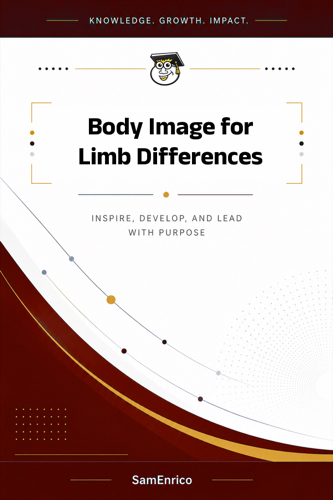
Body Image for Limb Differences eBook
Embrace shorter arms or legs without hiding or lon
Embrace shorter arms or legs without hiding or longing for normal.
Formats
Free sample
Chapter 1: The Inventory of Longing--Before we talk about embracing your body, we need to talk about what you actually want. Not the surface answer—the one you give to doctors or well-meaning relatives. The real one. The one you whisper to yourself at 2 a.m. when the house is quiet and the mirror is honest.
You want a different body. You want the limb you don't have, or the length you were denied, or the symmetry that biology refused to give you. You have imagined it a thousand times: the effortless wave, the two-sleeved shirt, the walk that doesn't announce you before you speak. This is not vanity. This is longing.
And longing, left unexamined, becomes a cage.This chapter is not going to tell you to stop wanting what you want. Toxic positivity has no place here. You will not be asked to "just love yourself" or "focus on the positive." Those commands are cruelty disguised as encouragement. Instead, this chapter will ask you to do something harder and more useful: to take inventory of your longing. To name it.
To categorize it. To trace it back to its source. Because you cannot make peace with a ghost you refuse to acknowledge. And make no mistake—the body you wish for is a ghost. It has never existed.
It will never exist. And yet you have been mourning it your whole life.The goal of this chapter is simple: to move your longing from the shadows into the light. Once you can see it clearly, you can decide which parts of it deserve your energy and which parts were never yours to carry. This is the first step toward Radical Enoughness—the belief that you are not missing what you need to live a full life. Not that you don't grieve.
Not that you don't wish things were different. But that your enoughness and your longing can coexist. One does not cancel the other.Let us begin.The Mirror Ritual Every person with a limb difference knows a specific kind of silence. It is the silence that falls when you are alone in front of a mirror, and your eyes do something strange. They skip.
They edit. They perform a small, unconscious amputation of reality. You look at your reflection and imagine the missing inches. You rotate your shoulder to see what the arm would look like if it continued to your wrist. You shift your weight to one leg to simulate a gait without a limp.
You hold your breath and try to see the person you would have been if biology had been kinder.This is not something you talk about. It feels too shameful, too vain, too ungrateful. After all, you are alive. You are functional. People have survived worse.
And yet you do it anyway. You have done it thousands of times. You will probably do it again.Let us name this ritual: The Mirror Edit.The Mirror Edit is not a sign of weakness. It is a sign of imagination. Your brain is doing what brains evolved to do—envisioning alternatives, solving problems, seeking safety.
The problem is that the alternative your brain keeps showing you does not exist. You are grieving a phantom. Not the phantom limb that doctors talk about, the one that tingles and aches where flesh used to be. This is a different phantom. This is the phantom of a life you never lived, attached to a body you were never given.I want you to pause here.
Think about the last time you did the Mirror Edit. What did you change? Was it the length of your arm? The number of fingers? The straightness of your spine?
The evenness of your hips? Now ask yourself: who taught you that the edited version was better? Who told you that symmetry is beautiful, that two is better than one, that longer is stronger? You did not invent those standards. You absorbed them.
And you have been measuring yourself against them ever since.This chapter is not asking you to stop the Mirror Edit overnight. That would be like asking a river to stop flowing. But we can change the channel. We can redirect the current. And the first step is to stop doing the Mirror Edit in secret.
Say it out loud. Write it down. Tell someone you trust: "I look in the mirror and I imagine a longer arm." The moment you speak the longing aloud, it loses some of its power. Secrets shrink us. Confession expands us.Two Kinds of Longing Not all longing is the same.
If you want to untangle yourself from the wish for a different body, you need to distinguish between two very different categories of desire. Most people lump them together. That is a mistake.Clinical Longing The first category is clinical longing. This is the wish for a body that performs tasks more easily. You want to tie your shoes with two hands.
You want to carry a coffee mug and a book at the same time. You want to button a shirt without adaptive tools. You want to walk without pain or fatigue. This kind of longing is real, and it deserves acknowledgment. Adaptive equipment, surgery, physical therapy—these are all appropriate responses to clinical longing.
There is no shame in wanting your body to work better. Function matters.Here is what clinical longing is not: it is not a judgment on your worth as a human being. When you wish you could tie your shoes faster, you are not saying that you are broken. You are saying that shoelaces were designed for a different kind of hand. That is a fact about shoelaces, not a fact about you.Societal Longing The second category is societal longing.
This is the wish for social invisibility. You want to walk into a room without becoming a story. You want to meet someone's eyes without watching them glance down at your arm. You want to go to the beach without feeling like a spectacle. You want to be asked about your job, your hobbies, your opinions—not about what happened to you.Societal longing is trickier than clinical longing because it is not really about your body at all.
It is about the gaze of others. You do not actually need a longer arm to stop being stared at. What you need is a different world—one where limb difference is normalized, where curiosity is expressed kindly, where staring is taught out of children instead of ignored. But you cannot build that world alone. And you cannot wait for it to arrive before you start living.Most of the pain you feel about your limb difference is not clinical.
It is societal. You are not grieving a missing function. You are grieving a missing ease—the ease of moving through the world without being noticed, questioned, or pitied. And that grief is real. But it is also borrowed.
You did not invent the standards that make you feel less than. You inherited them. And what is inherited can be rejected.Here is the distinction in one sentence: Clinical longing says, "I wish this task were easier."…
This is the end of the free sample. Get the eBook to keep going. Buy now
About this book
Details
- Author
- Hines Monique
- Publisher
- SamEnrico
- Language
- English
- Genre
- Non-Fiction, Self-Help
- Released
- 2026-06-11
- Pages (approx.)
- 147
- Available as
- eBook, Audiobook

Read better in the ZLOADR app
Your eBooks on your phone or tablet. Sign in with your SamEnrico account and start reading.
More by Hines Monique
 NASCAR Fuel Saving GuideHines Monique$11.99
 Emotional Disappointment CopingHines Monique$11.99
 Cigarette Money Jar SystemHines Monique$11.99
 Cialdini For EntrepreneursHines Monique$11.99
 Theodore Roosevelt BiographyHines Monique$11.99
 Divorce and Hope GuideHines Monique$11.99
 Mendeleev Final Days In LabHines Monique$11.99
 The Shadow Puppeteer of Botany Bay: George Howe’s Forgotten Artistry in Colonial AustraliaHines Monique$11.99
 A Collector's Handbook to the BMW 501 V8Hines Monique$11.99
 How to Produce Food Service UniformsHines Monique$11.99
 Understanding Amyotrophic Lateral Sclerosis (ALS)Hines Monique$11.99
 Faceless YouTube Stock Footage StarterHines Monique$12.99
You may also like
 Hong Kong Handover 1997Dunn Johnnie$11.99
 Zumba For Postnatal Recovery CourseNeal Christian$11.99
 Zumba for BeginnersLadner Nikia$11.99
 YouTube Comment Mining GuideHumes Pandora$12.99
 Worry Box MeditationCarlin Rudy$11.99
 Workplace Stress MeditationNguyen Lynn$11.99
 Workplace Stress and Sleep RepairHawley Ivory$11.99
 Workplace Perfectionism CureDelaney Jeffry$11.99
 Workplace Injustice Anger GuideWallen Isabelle$11.99
 Work Addiction and Burnout LinkGreenwood Ester$11.99
 Women in Yoga and WellnessBeattie Galina$11.99
 Women in Stand Up ComedyChun Evangeline$11.99