
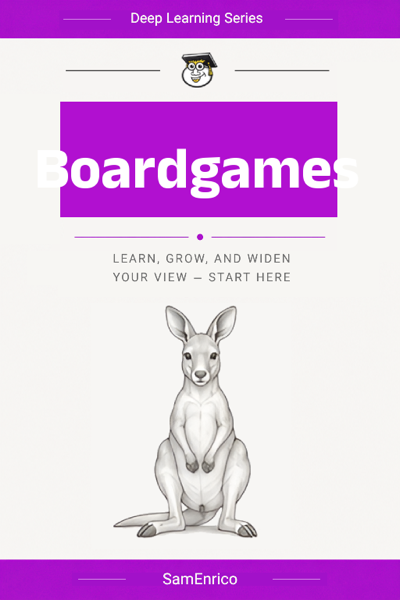
Non-FictionInformativeEducational
Boardgames eBook
A Coursebook on Boardgames
A Coursebook on Boardgames
Formats
Free sample
Chapter 1: The Original Social Network...--–- You are holding a small cardboard box. Inside are wooden cubes, a folded map, a deck of cards, and a rulebook printed in four languages. Nothing in this box has a battery. Nothing connects to Wi-Fi. Nothing tracks your behavior or sells your attention to advertisers.
And yet, when you set this box on a table and invite three friends to sit down, something remarkable happens. Phones are placed face-down. Voices rise and fall in laughter and protest. Inside jokes are born. Alliances are formed and betrayed.
For the next ninety minutes, no one checks Instagram. No one scrolls. You are, all four of you, entirely present.This is not nostalgia. This is not a rejection of technology. This is something stranger and more powerful: a deliberately chosen constraint that produces joy.
You have just entered what game scholars call the Magic Circle—a psychological boundary inside which ordinary rules are suspended and game rules become sacred. Outside the circle, you would never call your friend a traitor for taking the last wheat. Outside the circle, you would never celebrate rolling a six with a theatrical fist pump. But inside the circle, these absurd behaviors are not only acceptable; they are required. And they work.
They work so reliably that board games have survived the invention of television, the internet, smartphones, and virtual reality. They work so reliably that the board game industry grew twelve percent per year throughout the 2010s, even as video games went free-to-play and social media became omnipresent.Why? What is the primal, stubborn magic of putting cardboard on a table?This chapter answers that question. We will explore the philosophy of play, the history of the modern board game renaissance, and the psychology that explains why "unnecessary obstacles" (that is, rules) are actually the source of deep satisfaction. We will discover that board games are not an escape from reality but a sharper, more generous version of it—a technology for generating conversation, laughter, and social bonding without algorithms, engagement metrics, or outrage optimization.
By the end of this chapter, you will never look at a game box the same way again. You will see it for what it is: an invitation to the oldest and most reliable social network ever invented.The Philosophy of Play: Why We Crave Walls Let us begin with a deceptively simple question: Why do we play? Not why do children play—that seems almost tautological. Children play because that is what children do. But why do adults play?
Why do intelligent, busy, time-poor people voluntarily submit to rules that make tasks harder? Why does anyone choose to move a wooden cube along a printed path when they could simply declare themselves the winner and go back to watching television?The Dutch historian Johan Huizinga asked this question in 1938, and his answer, published in a book called Homo Ludens (which means "Man the Player"), remains the foundation of all modern play theory. Huizinga observed that play is not a frivolous addition to human life but a fundamental category of human activity, as basic as work or worship. He identified five characteristics of play that distinguish it from ordinary life. First, play is voluntary.
You cannot force someone to play a board game; the moment coercion enters, the magic evaporates. Second, play is separate from ordinary life. It happens in a designated time and space—"after dinner," "around the table," "until someone reaches ten points." Third, play creates its own秩序 (order). Inside the game, the rules are absolute. Fourth, play is uncertain.
If you know the outcome before you start, it is not a game; it is a ritual or a lecture. Fifth, and most important, play is unproductive. It creates no wealth, no goods, no measurable output. Play is its own reward.This last point is the counterintuitive secret of board games. In a culture obsessed with productivity, self-optimization, and return on investment, board games are gloriously useless.
No one plays Catan to acquire wheat in real life. No one plays Pandemic to acquire real virology credentials. You play because the activity itself is satisfying. And that satisfaction, Huizinga argued, is not an escape from meaning but a source of meaning. When you play, you are fully alive in a way that work, with its compromises and contingencies, rarely allows.The Magic Circle: Entering Another World Huizinga's most enduring concept is the "Magic Circle"—the invisible boundary that separates the game space from the real world.
Inside the Magic Circle, a different set of laws applies. Outside, you would never accept a deal that leaves you with fewer resources than your neighbor. Inside, you embrace that deal because it is part of the game. Outside, you would never applaud someone else's good fortune. Inside, you congratulate your opponent on a clever move.
Outside, you would never tolerate a system that randomly decides important outcomes by rolling dice. Inside, you hold your breath and cheer when the die comes up six.The Magic Circle is not a physical place. It is a social contract. It requires the consent of every player. And it is fragile.
One person checking their phone, one rules dispute that turns personal, one player who refuses to lose gracefully—and the circle shatters. But when the circle holds, it creates something extraordinary: a temporary, voluntary community bound by shared rules and a common goal.Think of the last time you played a cooperative game like Pandemic or The Crew. You and your friends were not competing; you were collaborating against the game itself. You discussed strategy. You shared information.
You made sacrifices for the common good. And when you won—or lost—you experienced a collective emotional event. That is not trivial. That is not a waste of time. That is the deliberate construction of shared meaning through play.The philosopher Bernard Suits, writing a generation after Huizinga, refined this idea with a famous definition: "Playing a game is the voluntary attempt to overcome unnecessary obstacles." The phrase "unnecessary obstacles" is crucial.
In real life, obstacles are necessary. You have to pay taxes, commute to work, and feed yourself. These obstacles are not optional. But in a game, every obstacle is chosen. You choose to try to get a ball through a hoop while other people try to stop you.
You choose to build a settlement that requires brick, wood, grain, and wool—resources that do not exist outside the game. You choose to follow turn order, action limits, and scoring rules that no one imposed on you.Why would anyone do this? Because unnecessary obstacles, freely chosen, produce a state that the psychologist Mihaly Csikszentmihalyi called "flow"—the experience of being completely absorbed in an activity that is challenging but not overwhelming. Flow requires clear goals, immediate feedback, and a balance between skill and difficulty. Board games are flow machines.
The goal is printed on the box. The feedback is every card you draw, every move your opponent makes, every point on the scoring track. And the difficulty is calibrated by design—or, in good games, by the players you choose to compete against.The Renaissance: How Board Games Saved Themselves…
This is the end of the free sample. Get the eBook to keep going. Buy now
About this book
Details
- Author
- Sager Laquita
- Publisher
- SamEnrico
- Language
- English
- Genre
- Non-Fiction, Informative, Educational
- Released
- 2026-05-11
- Pages (approx.)
- 142
- Available as
- eBook, Audiobook

Read better in the ZLOADR app
Your eBooks on your phone or tablet. Sign in with your SamEnrico account and start reading.
More by Sager Laquita
 Psychological Relapse Prevention for SchizophreniaSager Laquita$11.99
 The Adaptor Gesture GuideSager Laquita$11.99
 Time Restricted Eating For RhythmSager Laquita$11.99
 Caregiving for Aging ParentsSager Laquita$11.99
 The Scholarship Anxiety GuideSager Laquita$11.99
 Sandbox Game Addiction HelpSager Laquita$11.99
 Food Addiction Abstinence ModelSager Laquita$11.99
 Childhood Sexual Abuse RecoverySager Laquita$11.99
 Testosterone Growth Hormone SynergySager Laquita$11.99
 Whispers in the Dark: The Underground Press That Defied the NazisSager Laquita$11.99
 The Last Echoes of the Arctic: Knud Rasmussen’s Epic Quest for Indigenous LanguagesSager Laquita$11.99
 The Atlantic Chieftains: Celtic Navigators of the Iron AgeSager Laquita$11.99
You may also like
 Hong Kong Handover 1997Dunn Johnnie$11.99
 Zumba For Postnatal Recovery CourseNeal Christian$11.99
 Zumba for BeginnersLadner Nikia$11.99
 YouTube Comment Mining GuideHumes Pandora$12.99
 Worry Box MeditationCarlin Rudy$11.99
 Workplace Stress MeditationNguyen Lynn$11.99
 Workplace Stress and Sleep RepairHawley Ivory$11.99
 Workplace Perfectionism CureDelaney Jeffry$11.99
 Workplace Injustice Anger GuideWallen Isabelle$11.99
 Work Addiction and Burnout LinkGreenwood Ester$11.99
 Women in Yoga and WellnessBeattie Galina$11.99
 Women in Stand Up ComedyChun Evangeline$11.99