
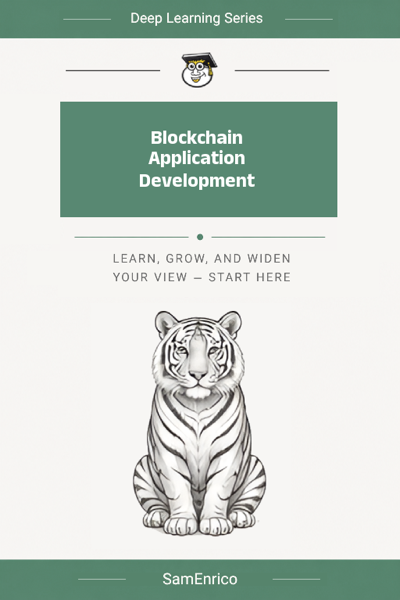
Blockchain Application Development eBook
A Coursebook on Blockchain Application Development
A Coursebook on Blockchain Application Development
Formats
Free sample
Chapter 1: The $500 Million Typo--– The year is 2017. A young developer named Devin sits at his desk, reviewing code that he has just copied from the official Ethereum documentation. He is building a multisignature wallet—a smart contract that requires multiple approvals before moving funds. The documentation is clear. The code looks clean.
He runs the tests. Everything passes. He deploys the contract to the mainnet, and within weeks, over $500 million worth of Ether flows into similar wallets built by his colleagues at Parity Technologies.Then, on November 6, 2017, a user who calls themselves "devops199" accidentally clicks a button on a block explorer. They were not trying to steal anything. They were just curious.
But that single click calls a function called init Wallet() on a Parity wallet library contract. Because of one line of code—one misplaced internal visibility modifier—the function initializes the wallet to zero owners. The library contract self-destructs. Every wallet relying on that library freezes instantly. $500 million becomes permanently inaccessible.
Not stolen. Not hacked. Just… frozen. Because of a typo.Devin watches the news in horror. His own wallet is among the frozen ones.
He did everything right. He followed the official documentation. He tested his code. Yet the money is gone. And here is the most terrifying part: the code was open source.
Hundreds of developers looked at it. Auditors reviewed it. No one caught the mistake until it was too late.This is not a story about greed or crime. It is a story about the unforgiving nature of blockchain development. In traditional software, when you make a mistake, you push a fix.
You roll back a database. You deploy a patch. On a blockchain, you cannot. Once a transaction is mined, it is permanent. The code you write becomes law, and the law has no appeals court.If you are reading this book, you probably already know that blockchain is interesting.
You may have heard about Bitcoin, Ethereum, or NFTs. You might even have traded some crypto. But you are here because you want to build. You want to write smart contracts, launch tokens, or create the next decentralized application. That is exactly what this book will teach you.
But before you write a single line of code, you need to understand what you are getting into.Blockchain development is not like web development. It is not like mobile development. It is closer to rocket science than to building a blog. You are writing code that manages value, that cannot be undone, and that will be attacked relentlessly by some of the smartest adversaries in the world. The stakes are higher.
The margin for error is zero. And yet, the rewards—both financial and intellectual—are extraordinary.This chapter is the foundation for everything that follows. It will not teach you to code. It will not walk you through a tutorial. Instead, it will answer the question that every successful blockchain developer must answer before they write a single function: Why does blockchain exist, what problem does it solve, and why is it so damn hard?By the end of this chapter, you will understand the double-spend problem, the blockchain trilemma, and—most importantly—whether the project you want to build actually needs a blockchain at all.
Because the hardest lesson in this book comes first: most projects should not use blockchain. But for the ones that should, nothing else works.The Internet of Information Versus the Internet of Value Let us start with a simple observation that will shape your entire development career. The internet is incredibly good at moving information. You can send an email to the other side of the world in milliseconds. You can stream a 4K video from a server in Tokyo while sitting in a café in Buenos Aires.
You can share a document with a thousand collaborators simultaneously. This is the Internet of Information, and it has transformed human civilization.But the internet is terrible at moving value. Try sending $100 to a friend in another country. You will wait days. You will pay fees.
You will trust banks, payment processors, and clearinghouses to update their databases. Why is that? After all, money is just information—a number in a database, a balance in an account. Why can we move cat videos instantly but not dollars?The answer is the double-spend problem. When you send a cat video, you are sending a copy.
You still have the original file on your phone. That is fine for information. But when you send money, you cannot still have the money. You cannot spend the same dollar twice. In a digital system, preventing double-spending requires a central authority—a bank, a credit card company, a payment processor—that keeps a master list of who owns what.
That authority can freeze accounts, reverse transactions, and charge fees. It works, but it introduces friction, delay, and trust.Blockchain solves the double-spend problem without a central authority. It creates a shared, immutable ledger that no single party controls. Every copy of the ledger is identical. Every transaction is verified by consensus.
Once a transaction is recorded, it cannot be reversed or altered—not by a government, not by a hacker, not by the creator of the system.This is the Internet of Value. For the first time in history, you can send value to anyone, anywhere, without asking for permission. No bank account required. No approval process. No chargebacks.
Just a transaction that settles in minutes, with fees determined by supply and demand, not by a corporate pricing committee.But that power comes with a cost. The same immutability that prevents fraud also prevents refunds. The same decentralization that removes gatekeepers also removes customer support. If you send money to the wrong address, it is gone. If you lose your private keys, no one can help you recover them.
Blockchain is not better than traditional finance. It is different. And as a developer, your job is to understand those differences and build applications that leverage the strengths while mitigating the weaknesses.The Birth of Digital Cash: A History of Failed Experiments To understand why blockchain matters, you need to understand what came before. The dream of digital cash is older than the internet itself. In the 1980s, cryptographers like David Chaum dreamed of anonymous, electronic money that could be spent online without government surveillance.
Chaum's company, Digi Cash, launched in 1989 with a working product—e-cash that used blind signatures to preserve privacy. For a few years, it worked. You could buy digital tokens from a bank, spend them at participating merchants, and the bank would verify that the tokens had not been double-spent.But Digi Cash failed. Not because the technology was broken—it was brilliant—but because it was centralized. The company was the bank.
When Digi Cash filed for bankruptcy in 1998, all of its systems shut down. Users lost their tokens. Merchants lost their revenue. The lesson was clear: if digital cash depends on a single company, it dies when that company dies.The next wave came in the early 2000s with systems like e-gold and Liberty Reserve. These were centralized digital currencies backed by precious metals or simply hosted balances.
They grew rapidly, processing billions of dollars in transactions. But they also attracted money launderers, fraudsters, and hackers. The US…
This is the end of the free sample. Get the eBook to keep going. Buy now
About this book
Details
- Author
- Valles Ursula
- Publisher
- SamEnrico
- Language
- English
- Genre
- Non-Fiction, Informative, Educational
- Released
- 2026-05-09
- Pages (approx.)
- 141
- Available as
- eBook, Audiobook

Read better in the ZLOADR app
Your eBooks on your phone or tablet. Sign in with your SamEnrico account and start reading.
More by Valles Ursula
 Road Rage and New DriversValles Ursula$11.99
 Immigrant Landscaping Empire CourseValles Ursula$11.99
 Stress And SciaticaValles Ursula$11.99
 1031 Exchange Related Party RulesValles Ursula$11.99
 Nap HandbookValles Ursula$11.99
 Loving Kindness for a Spouse's CareerValles Ursula$11.99
 Visualization GuideValles Ursula$11.99
 Two Hour Deep Work BlockValles Ursula$11.99
 NVC For NeighborsValles Ursula$11.99
 Jingwei's Vengeance: The Phoenix That Drowned the SeaValles Ursula$11.99
 The Last Lament of the Silk RoadValles Ursula$11.99
 The Great Bitcoin Heist: How a Trusted CEO Vanished with MillionsValles Ursula$11.99