
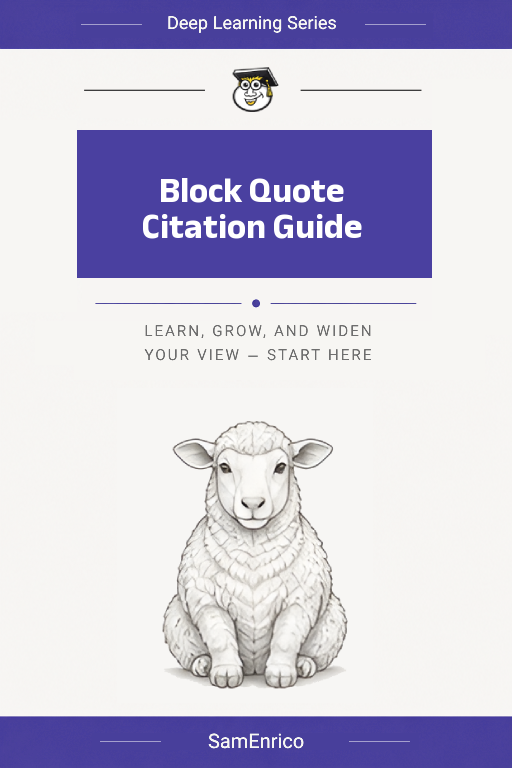
Non-FictionStudent's ShortcutBlock Quotes
Block Quote Citation Guide eBook
Format and cite long quotations properly including
Format and cite long quotations properly including indentation, citation placement, and punctuation rules.
Formats
Free sample
Chapter 1: The Invisible Threshold...–- Every academic writer remembers the moment. You are deep in a source—a dense piece of criticism, a landmark study, a judicial opinion—and you encounter a passage so perfectly phrased, so tightly argued, or so devastatingly conclusive that paraphrasing feels like a betrayal. Your first instinct is to quote it in full. But then you look at the length. Four lines.
Five. Forty words. The text seems too large to drop into your paragraph between quotation marks. You hesitate. Do you break the quote into smaller pieces?
Do you force it in and hope the reader doesn't notice the formatting disaster? Or do you do what you have seen other writers do—indent the whole thing, drop the quotation marks, and let it stand alone?If you have ever faced that hesitation, you have encountered the threshold of the block quote. And like most writers, you probably never learned the formal rules. You approximated. You imitated what you saw in published articles.
You hoped your professor or editor would not notice the missing period, the misplaced citation, the extra space that should not be there. This chapter exists to ensure you never have to guess again.The block quote is one of academic writing's most powerful and most misunderstood tools. When used correctly, it signals to your reader that a passage deserves special attention—that it is not merely evidence but the evidence, a moment of such significance that it must be seen in its original form, uninterrupted, at full scale. When used incorrectly, it announces that you do not know the rules, that you are padding your page count, or that you have given up on integrating sources into your own argument. This chapter will teach you the difference.We begin not with mechanics but with meaning.
Before you learn how to format a block quote, you must understand why it exists, when to deploy it, and what it communicates to your reader. The mechanics matter enormously—Chapters 2 and 3 will drill down into every comma, every space, every period—but mechanics without rhetorical purpose produce nothing but correctly formatted irrelevance. By the end of this chapter, you will know not only the length thresholds that trigger a block quote in MLA, APA, and Chicago style, but also the ethical considerations, the genre-specific exceptions, and the critical question you must ask yourself before every single block: Does this passage need to be seen as a unit?What a Block Quote Actually Is (And Is Not)Let us clear away confusion immediately. A block quote is a direct quotation from a source that is formatted as a freestanding block of text, indented from the left margin (and sometimes the right), without quotation marks at the beginning or end. That is the technical definition.
But the rhetorical definition is more revealing: a block quote is a typographical signal that tells your reader, Stop. Pay attention. What follows is important enough to be set apart from my own voice.This signaling matters because it changes the reading experience. When you run a short quotation into your own sentence—what style guides call a run-in quote (see the Glossary for this term)—the reader moves smoothly from your words to the source's words and back again. The quotation is integrated, subordinate to your argument.
But when you block a quotation, you create a visual break. The reader's eye pauses at the indentation. The white space around the block announces a shift: the source is now speaking at length, and you are stepping back to let it speak.That shift can be powerful. It can also be abused.Consider what a block quote is not. It is not merely "a long quote." Length is a necessary condition but not a sufficient one.
A block quote is also not "a quote you want to highlight"—you can highlight a short quote with a signal phrase ("Smith makes a striking claim: ...") without blocking it. It is not a way to avoid paraphrasing difficult material. And it is certainly not a tool for filling space when you have run out of things to say.The best writers use block quotes sparingly and strategically. A twenty-page paper might contain one or two block quotes. A dissertation might contain a handful per chapter.
If you find yourself blocking multiple quotations on a single page, stop and ask whether you are really writing an argument or merely assembling a collage of other people's words.The Threshold Debate: When Does Long Become Too Long?Every citation style recognizes that extremely long quotations disrupt the flow of a run-in format. But the styles disagree on where to draw the line. This section provides a practical decision matrix based on the three most common academic styles: MLA, APA, and Chicago. (Chapter 7 covers specialized styles including Bluebook and CSE.)MLA Style: The 4-Line Rule The Modern Language Association, used primarily in literary studies and humanities disciplines, sets the threshold at four typed lines of prose in your paper. Note the crucial phrase: in your paper.
The rule does not refer to four lines in the original source. A passage might be three lines in a printed book but stretch to five lines in your document due to font size, margin width, or line spacing. The only thing that matters is how many lines it occupies on your page.Here is how the rule works in practice. You are writing a paper in MLA format: 12-point Times New Roman, double-spaced, one-inch margins. You select a quotation from a novel.
You type it out, still in quotation marks, as part of your paragraph. If the typed quotation runs to four or more lines in your document, you must convert it to a block quote. If it runs to three lines or fewer, you leave it as a run-in quote with quotation marks.This rule is strict and unforgiving. There is no "almost four lines" exception. A quotation that takes up 3.9 lines on your page is not a block quote; a quotation that takes up 4.0 lines is.
The only ambiguity comes from line breaks that occur at the end of a word. If your quotation ends exactly at the end of the fourth line, it counts as four lines. If it spills onto a fifth line even by a single word, it counts as five lines and is still a block quote (MLA has no upper limit; all quotes of four lines or more are blocked).Poetry in MLA follows a different rule, which we will explore in Chapter 4. For now, remember the number: four typed lines.APA Style: The 40-Word Rule The American Psychological Association, used in the social sciences, education, and business, rejects line counts as unreliable. Font sizes vary.
Margin widths differ. A line count that works for one paper may fail for another. Instead, APA uses a word count threshold: any quotation of 40 words or more must be formatted as a block quote.Why 40 words? Research in reading comprehension suggests that passages longer than approximately 40 words become difficult to process when embedded within a paragraph. The reader loses track of whose voice is speaking.
The block quote's visual separation restores clarity.Counting words is straightforward but requires precision. Use your word processor's word-count tool on…
This is the end of the free sample. Get the eBook to keep going. Buy now
About this book
Details
- Author
- Salisbury Etta
- Publisher
- SamEnrico
- Language
- English
- Genre
- Non-Fiction, Student's Shortcut, Block Quotes
- Released
- 2026-06-01
- Pages (approx.)
- 152
- Available as
- eBook, Audiobook

Read better in the ZLOADR app
Your eBooks on your phone or tablet. Sign in with your SamEnrico account and start reading.
More by Salisbury Etta
 Burnout Recovery For Police OfficersSalisbury Etta$11.99
 Hoffa Disappearance Irish Mob ConnectionSalisbury Etta$11.99
 Goal Framework for TeamsSalisbury Etta$11.99
 The Confident Learner MindsetSalisbury Etta$11.99
 Untappd Beer Snobbery ComparisonSalisbury Etta$11.99
 Startup Founder Money StressSalisbury Etta$11.99
 Distraction Free Remote WorkSalisbury Etta$11.99
 Beginner Strength PlanSalisbury Etta$11.99
 Lee Miller: The War Photographer Who Became a Surrealist IconSalisbury Etta$11.99
 Dr. Fatoumata Diallo: The Angel of Sierra Leone's Football FieldsSalisbury Etta$11.99
 How to Produce Low-voc Multipurpose CleanerSalisbury Etta$11.99
 How to Start a Metalware for Domestic Use (wholesale) Business (Beginners Guide)Salisbury Etta$11.99
You may also like
 Hong Kong Handover 1997Dunn Johnnie$11.99
 Zumba For Postnatal Recovery CourseNeal Christian$11.99
 Zumba for BeginnersLadner Nikia$11.99
 YouTube Comment Mining GuideHumes Pandora$12.99
 Worry Box MeditationCarlin Rudy$11.99
 Workplace Stress MeditationNguyen Lynn$11.99
 Workplace Stress and Sleep RepairHawley Ivory$11.99
 Workplace Perfectionism CureDelaney Jeffry$11.99
 Workplace Injustice Anger GuideWallen Isabelle$11.99
 Work Addiction and Burnout LinkGreenwood Ester$11.99
 Women in Yoga and WellnessBeattie Galina$11.99
 Women in Stand Up ComedyChun Evangeline$11.99