
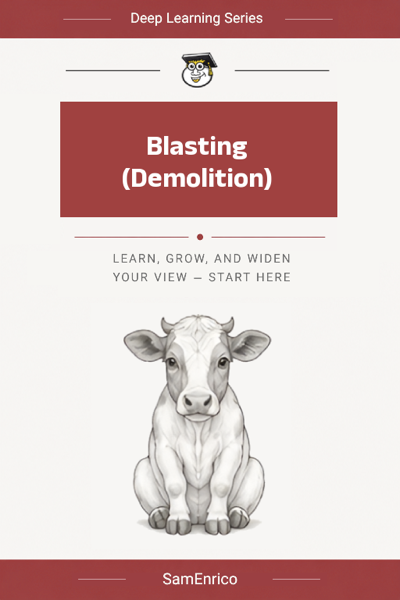
Non-FictionInformativeEducational
Blasting (Demolition) eBook
A Coursebook on Blasting (Demolition)
by Mims Delma
A Coursebook on Blasting (Demolition)
Formats
Free sample
Chapter 1: The Intelligent Explosive...–- The first thing you need to understand about demolition blasting is that explosives are not the intelligent part of the operation. They are the servant. They carry out commands they do not understand, in materials they cannot see, for purposes they will never comprehend. The intelligence resides entirely in you—in your ability to read the target, calculate the load, sequence the delays, and anticipate the consequences. Explosives are extraordinarily powerful, but they are also extraordinarily stupid.
They will detonate with equal enthusiasm whether you have placed them correctly or catastrophically wrong. This is why Chapter 1 is not about explosives. It is about everything that happens before the explosive arrives on site.Most textbooks on blasting begin with chemistry. They dive into oxygen balance, detonation pressure, and the difference between deflagration and detonation. Those topics matter, and they will appear in Chapter 2.
But they do not belong at the beginning. You cannot select the right explosive until you understand what you are trying to break. You cannot calculate the right charge weight until you understand the strength and structure of your target. You cannot design a safe blast until you understand how the material will respond to stress. The explosive is the final decision, not the first one.
This chapter therefore builds the foundation upon which every later decision rests: the physical and mechanical nature of the materials you will destroy.The demolition blaster works on three families of material: natural rock, cast concrete, and structural steel. Each family has its own personality, its own weaknesses, and its own ways of surprising you. Rock is ancient and variable, full of hidden fractures that can either help your blast or ruin it. Concrete is artificial and inconsistent, a composite of cement, aggregate, and steel that behaves differently from any natural material. Steel is homogeneous and predictable but stores energy in ways that can kill you if you misread it.
You will learn to understand all three, because a project that involves only one family is rare. Most demolitions present a mixture—concrete columns with steel beams, rock foundations beneath masonry walls, steel frames with concrete cores. The blaster who cannot move fluently between these families is the blaster who will eventually be surprised.The First Family: Natural Rock Rock is not a uniform substance. It is a collection of mineral crystals that have been compressed, heated, folded, fractured, weathered, and otherwise abused for millions of years before you arrived with your drill rig. The idea that "rock is rock" is the first mistake that inexperienced blasters make.
Granite from one quarry may break like window glass. Granite from a quarry fifty kilometers away may crumble like stale bread. The difference lies in the rock's composition, its grain structure, and most importantly, its history of deformation.The three great families of rock—igneous, sedimentary, and metamorphic—each behave differently under blast loading. Igneous rocks like granite and basalt crystallized from molten magma. They tend to have interlocking grain structures that make them strong in compression but unpredictable in tension because their grain boundaries are often the sites of microscopic cracks.
Sedimentary rocks like limestone and sandstone formed from accumulated particles compressed over time. They are often layered, with bedding planes that act as natural failure surfaces. Metamorphic rocks like marble and slate started as sedimentary or igneous rocks and were transformed by heat and pressure. They have foliation or schistosity—directional alignments of minerals that create pronounced anisotropy. A slate that breaks cleanly along its foliation may be nearly impossible to break across it.The practical implication is brutal but simple: you cannot design a blast from a geological map alone.
You must see the rock. You must touch it. You must walk the site and observe the joint system—the network of natural fractures that already exists in the rock mass. These joints are your allies. They are pre-cut surfaces that the explosive energy can exploit.
A blast that aligns with the joint system will produce excellent fragmentation with modest explosive consumption. A blast that fights the joint system will produce boulders, overbreak, and expensive headaches.Joint systems are described by four parameters. Orientation is the direction the joint faces, measured as dip (the angle from horizontal) and strike (the compass direction of the joint trace). Spacing is the average distance between parallel joints, which can range from millimeters in slate to meters in massive granite. Persistence is how far a joint extends through the rock mass, from centimeters to tens of meters.
Roughness affects how easily the joint opens under tensile stress—rough joints interlock and require more energy to open; smooth joints slide apart like opening a book.Your job as a blaster is to read these parameters and design your blast pattern accordingly. If the joint spacing is close, you can use wider borehole spacing because the natural fractures will help the fragmentation. If the joint spacing is wide, you need tighter borehole spacing and more explosive to create new fractures between the existing ones. If the joints are oriented parallel to your planned free face, you will need more energy because the shock wave will travel along the joints rather than across them. If the joints are perpendicular to the free face, the shock wave will cross the joints and create multiple intersecting failures.
These are not subtle effects. They can change your powder factor by a factor of two or more.The Mechanical Properties That Matter Before you can calculate a charge weight, you need numbers. The relevant numbers describe how the material responds to stress. Do not be intimidated by the terminology. The concepts are straightforward, and you will use them on every job.Compressive strength is the maximum stress a material can withstand when being squeezed.
It is measured in megapascals or pounds per square inch. Typical values for rock range from 20 MPa for soft limestone to 250 MPa for very hard granite. Concrete ranges from 20 MPa for low-strength mixes to 80 MPa for high-strength structural concrete. Compressive strength matters because it affects drilling difficulty and the energy required to create new fractures.Tensile strength is the maximum stress a material can withstand when being pulled apart. This number is much smaller—typically one-tenth to one-twentieth of the compressive strength.
A granite with 150 MPa compressive strength may have only 10 MPa tensile strength. This enormous ratio is the secret of blasting. Explosives work by creating a shock wave that reflects off free faces as tensile waves. Because rock and concrete are so weak in tension, these reflected waves cause the material to fail. You are not crushing the material.
You are pulling it apart.Young's Modulus, also called the elastic modulus, measures the stiffness of a material—how much it deforms under a given stress. High modulus means the material is stiff and transmits stress quickly. Low modulus means the material is flexible and absorbs energy. For blasting, a high modulus is generally helpful because the shock wave travels faster and maintains its energy over distance. A low modulus material may dampen the shock wave before it can do useful work.Poisson's Ratio describes how a material expands laterally when compressed axially.
When you compress a rock sample from top to bottom, it gets slightly wider. That widening is Poisson's effect. In…
This is the end of the free sample. Get the eBook to keep going. Buy now
About this book
Details
- Author
- Mims Delma
- Publisher
- SamEnrico
- Language
- English
- Genre
- Non-Fiction, Informative, Educational
- Released
- 2026-05-04
- Pages (approx.)
- 136
- Available as
- eBook, Audiobook

Read better in the ZLOADR app
Your eBooks on your phone or tablet. Sign in with your SamEnrico account and start reading.
More by Mims Delma
 Namib Desert GuideMims Delma$11.99
 Remote Creative GuideMims Delma$11.99
 The Death of Loved One DreamMims Delma$11.99
 Ramsey Family Media WarMims Delma$11.99
 The Stock Market Scandal of 1869: The Gold Ring ConspiracyMims Delma$11.99
 Co Founder Equity Split GuideMims Delma$12.99
 Learn to Play the Octocontra-alto ClarinetMims Delma$11.99
 How to Start a Car Hire (self Drive) Business (Beginners Guide)Mims Delma$11.99
You may also like
 Hong Kong Handover 1997Dunn Johnnie$11.99
 Zumba For Postnatal Recovery CourseNeal Christian$11.99
 Zumba for BeginnersLadner Nikia$11.99
 YouTube Comment Mining GuideHumes Pandora$12.99
 Worry Box MeditationCarlin Rudy$11.99
 Workplace Stress MeditationNguyen Lynn$11.99
 Workplace Stress and Sleep RepairHawley Ivory$11.99
 Workplace Perfectionism CureDelaney Jeffry$11.99
 Workplace Injustice Anger GuideWallen Isabelle$11.99
 Work Addiction and Burnout LinkGreenwood Ester$11.99
 Women in Yoga and WellnessBeattie Galina$11.99
 Women in Stand Up ComedyChun Evangeline$11.99