
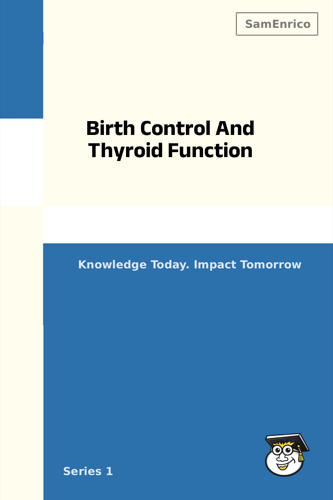
Birth Control And Thyroid Function eBook
Interaction between estrogen and thyroid binding g
by Eastman Nell
Interaction between estrogen and thyroid binding globulin levels.
Formats
Free sample
Chapter 1: The Silent Sabotage...– Sarah was twenty-four years old when she first realized her body had become a stranger to her.She had always been the reliable one—the friend who showed up early, the employee who stayed late, the daughter who remembered every birthday. She ran half-marathons for fun. She meal-prepped on Sundays. She had energy to spare. Then she started the pill.Not for contraception, initially.
She started it because her periods had become unbearable—cramping so severe that she had once fainted in a grocery store aisle, bleeding so heavy that she had to set alarms to change her super-plus tampons every ninety minutes. Her gynecologist had been sympathetic but rushed. "Classic dysmenorrhea and menorrhagia," she had said, scribbling a prescription for a popular combination oral contraceptive. "This should clear it right up."And it did. Within three months, Sarah's periods were light, predictable, and nearly pain-free.
She was thrilled.But by month four, something shifted.She wasn't just tired after work—she was exhausted. Not the kind of tired that a good night's sleep could fix, but a bone-deep, soul-crushing fatigue that made walking up the three flights to her apartment feel like climbing a mountain. She started drinking three cups of coffee just to function. Then four. Then she switched to espresso.By month six, her hair was falling out.
Not the normal fifty to a hundred strands in the shower—clumps of it. Her ponytail, once thick enough to require two hair ties, had thinned to half its original circumference. Her hairdresser asked if she had been sick. Sarah said no, because she hadn't been. Not with anything she could name, anyway.By month eight, she had gained eighteen pounds despite eating the same meals she had always eaten and running the same distances she had always run.
Her face looked puffy to her, though her friends said they couldn't see it. Her skin was dry. Her nails were brittle. She was constipated. She was cold all the time, even in July, even in her apartment with the heat turned up to seventy-four while her roommate walked around in shorts.By month ten, her primary care doctor ran a standard panel of bloodwork.
Everything came back "normal." Thyroid stimulating hormone—TSH—was 3.8 m IU/L. The reference range on the lab report said 0.4 to 4.5. The doctor told her she was fine. "Maybe you're just stressed," the doctor said. "Maybe you should try yoga."By month twelve, Sarah was a ghost of herself.
She had stopped running. She had stopped seeing friends. She had stopped believing that she would ever feel like herself again.And not once—not a single time, across three doctors, two gynecologists, and one therapist—did anyone ask her: "When did you start birth control?"The Thirty-Million-Woman Blind Spot Sarah's story is not a medical mystery. It is not a rare case study hidden away in a forgotten medical journal. It is, by conservative estimates, the story of millions of women around the world who have experienced the exact same sequence of events: start estrogen-containing birth control, feel better briefly, then watch as fatigue, weight gain, hair loss, and mood changes creep into their lives—often over the course of months, so gradually that they barely notice until the accumulation is undeniable.And then, when they finally ask for help, they are told they are "fine."The data tell a stark and underappreciated story.
Hypothyroidism—the condition in which the thyroid gland produces insufficient amounts of thyroid hormone—affects women approximately ten times more often than men. Depending on the population studied, the prevalence ranges from 4.6% in the United States to 5% in Qatar, with even higher rates in older women and in populations with higher iodine intake. One in eight women will develop a thyroid disorder in her lifetime. By age sixty, up to 20% of women have subclinical or overt hypothyroidism.At the same time, an estimated 100 million women worldwide use oral contraceptives. In the United States alone, approximately 25% of women aged fifteen to forty-four are currently on the pill, making it the second most common form of contraception after sterilization.
For younger women, the numbers are even higher: among women aged twenty to twenty-nine, more than 40% have used oral contraceptives at some point.The overlap between these two populations is massive. Millions of women are taking estrogen-containing birth control while also having—or being at risk for—thyroid dysfunction. And yet, the interaction between these two variables is rarely discussed in gynecological appointments, rarely screened for in endocrine clinics, and almost never mentioned in the informed consent process when a woman receives her first prescription for the pill.This is the thirty-million-woman blind spot. And this book exists to shine a light into it.Why Your Doctor Probably Hasn't Mentioned This If the estrogen-TBG interaction is so well-documented in the medical literature—and it is, with foundational studies dating back to the 1960s and continuing through the 2025 Qatar Biobank study—then why have you never heard about it?The answer is not conspiracy or malice. It is something far more mundane and, in some ways, more frustrating: fragmented care, outdated education, and the tyranny of "normal" lab ranges.Fragmented care is perhaps the biggest culprit.
Your gynecologist prescribes your birth control. Your endocrinologist (if you have one) manages your thyroid. Your primary care doctor might order your annual labs. These three clinicians rarely speak to one another. Electronic medical records have improved communication, but they have not solved the fundamental problem: no single provider is responsible for asking, "What happens when these two medications interact?"Your gynecologist is thinking about preventing pregnancy or managing period pain.
Your endocrinologist is thinking about optimizing your thyroid hormone levels. Your primary care doctor is thinking about a dozen other things—blood pressure, cholesterol, cancer screening, vaccines. The estrogen-TBG connection falls into a crack between these specialties, and patients are the ones who fall through.Outdated education is the second factor. Medical training covers thyroid physiology in depth, but the clinical application often lags behind the science. Many physicians learned that total T4 is a useful test—and for patients not on estrogen, it can be.
But the same physicians may not have learned that total T4 is essentially meaningless in a patient on oral contraceptives. They may not have learned that TBG rises by 30-50% on the pill. They may not have learned that a "normal" TSH of 3.8—like Sarah's—is actually abnormal for a young, symptomatic woman, regardless of what the lab's reference range says.The tyranny of "normal" lab ranges is the third factor. Laboratory reference ranges are typically set to include 95% of a healthy population. That means that 5% of healthy people will fall outside the range—and conversely, many people with early or mild disease will fall inside the range.
A TSH of 3.8 m IU/L might be "normal" by the lab's standards, but the American College of Endocrinology has recommended a narrower target range of 0.5 to 2.5 for most patients. When TSH creeps from 1.2 to 3.8 after starting birth control, that change matters—even if both numbers are technically "normal."Add these three factors together, and you have a…
This is the end of the free sample. Get the eBook to keep going. Buy now
About this book
Details
- Author
- Eastman Nell
- Publisher
- SamEnrico
- Language
- English
- Genre
- Non-Fiction, Health & Wellness, Endocrinology
- Released
- 2026-06-10
- Pages (approx.)
- 141
- Available as
- eBook, Audiobook

Read better in the ZLOADR app
Your eBooks on your phone or tablet. Sign in with your SamEnrico account and start reading.
More by Eastman Nell
 Narcissist Response GuideEastman Nell$11.99
 Dividing Assets FairlyEastman Nell$11.99
 Senior Comparison Trap GuideEastman Nell$11.99
 Breaking the Buy Button HabitEastman Nell$11.99
 Parental Guilt ManagementEastman Nell$11.99
 The Poet’s Gambit: The Lost Manuscripts of the Golden AgeEastman Nell$11.99
 Self Hypnosis for AngerEastman Nell$11.99
 Difficult Conversations about DivorceEastman Nell$11.99
 Shadows Over the Silk Road: The KGB's Hidden War in AfghanistanEastman Nell$11.99
 A Collector's Handbook to the Vauxhall CoupeEastman Nell$11.99
 Labradoodles: Designer DogEastman Nell$11.99
 How to Produce Patient LiftsEastman Nell$11.99
You may also like
 Iodine Cognitive Function GuideLunsford Hyon$11.99
 Dysthymia And Thyroid DisordersLinder Ashely$11.99
 Selenium Thyroid Health GuideGallo Kennith$11.99
 Micronutrients For Hormone Balance GuideWilloughby Twana$11.99
 Boron Hormone Regulation GuideKyle Hosea$11.99
 Vitamin D Complete Science PrimerRobert Collene$11.99
 The Hormonal ED GuideQuick Alyse$11.99
 Postpartum Hormone ShiftFrazer Lon$11.99
 Human Growth Hormone Decline GuideRagsdale Audrie$11.99
 Hormonal Muscle Preservation PlanDeal Donnetta$11.99
 Progestin Types In HRT HandbookMeyer Celia$11.99
 PCOS Diagnosis Rotterdam CriteriaFogle Fredric$11.99