
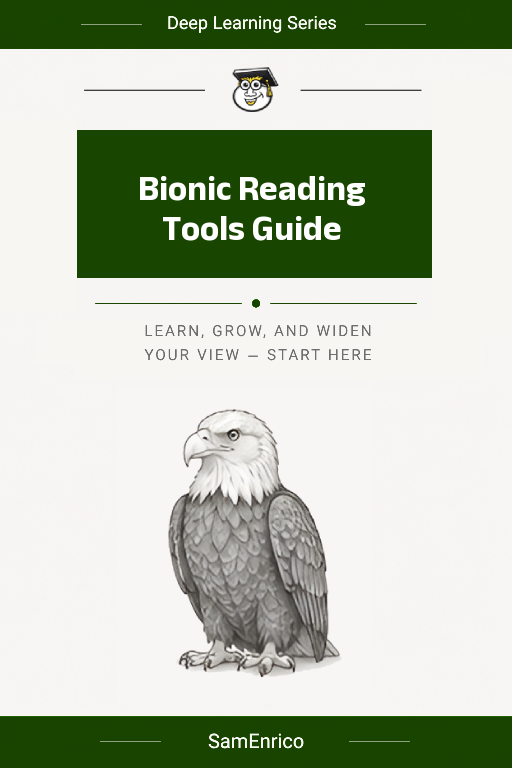
Non-FictionForecast & OutlookReading Tech
Bionic Reading Tools Guide eBook
Explore AI that highlights word beginnings to guid
Explore AI that highlights word beginnings to guide eye movement and improve reading speed.
Formats
Free sample
Chapter 1: The Attention Crash--–- The email arrived at 7:43 AM. By 7:45, Sarah had already forgotten what it said.Not because it wasn't important. It was. The quarterly performance report from her team of twelve had landed in her inbox, and somewhere in its dense, jargon-heavy paragraphs lay the answer to why their flagship product had missed its revenue target by eighteen percent. Her boss needed a summary by noon.
The board wanted a turnaround plan by Friday.But between 7:43 and 7:45, Sarah had done what most knowledge workers do when faced with a difficult cognitive task. She had checked her phone. She had glanced at Slack. She had opened a second email about a scheduling conflict. She had taken a sip of coffee that had gone cold.
And by the time she looked back at the report, the words had blurred into a gray smear of anxiety.She scrolled. Her eyes moved. Her brain did not.Five minutes later, she was on paragraph three, having re-read paragraph two four times. The sentence "Our customer acquisition cost increased by twelve percent quarter-over-quarter due to rising paid-channel inefficiencies" sat on the screen like a locked door. She knew every word individually.
She could not assemble them into meaning.This is not a story about laziness. It is not a story about poor work ethic or the failure of modern education. It is a story about a brain that was never designed for the volume of text that now demands its attention—and about a technology that promises to fix that mismatch by changing how words appear on the page.The average knowledge worker today encounters more text in a single week than a medieval scholar encountered in a lifetime. The math is staggering: the typical office worker receives over 120 emails per day, reads or skims dozens of internal documents, monitors multiple Slack channels, scrolls through industry news feeds, and reviews reports, spreadsheets, and presentations—all while fielding notifications from a half-dozen apps. A 2023 study from the University of California, Irvine, found that knowledge workers switch tasks every forty-five seconds on average, and it takes nearly twenty-three minutes to fully refocus after a single interruption.But the real problem is not the volume.
It is the texture.The Death of Deep Reading Before the internet, reading was a fundamentally different experience. When you picked up a book—a physical object with no hyperlinks, no notifications, no blinking cursor begging for your attention—you entered a state that the cognitive neuroscientist Maryanne Wolf has called "deep reading." This is not just understanding words on a page. It is a specific mode of cognition: linear, immersive, contemplative. The deep reader makes inferences. She draws connections to prior knowledge.
She questions the author's assumptions. She builds a mental model of the argument or narrative and holds it in working memory while turning the page.Deep reading activates brain regions associated with empathy, critical thinking, and long-term memory consolidation. It is, in many ways, the opposite of the cognitive state most of us occupy for the majority of our waking hours.The digital environment has not merely supplemented deep reading. It has replaced it with something else entirely: a rapid, non-linear, distraction-laced mode of text consumption that researchers call "skimming as default."Here is what that looks like in practice. You open an article.
You scan the first sentence of each paragraph. Your eyes dart to the pull quotes, the bolded statistics, the bullet points. You jump to the conclusion, then back up to find the one fact you need. You spend eight seconds on the page—just enough time to extract a single data point—and then you close the tab. You have "read" the article.
You have retained almost nothing.This is not a failure of will. This is a trained response. The internet has conditioned us to treat text as a resource to be mined, not a landscape to be explored. Every hyperlink is an invitation to leave. Every notification is a demand to switch contexts.
Every design choice—the infinite scroll, the autoplaying video, the recommended articles at the bottom—is optimized for engagement, not comprehension.And the consequences are measurable. A 2021 study from the University of Waterloo found that when readers were given the same text in print versus on a screen, the screen readers spent significantly less time on difficult passages, were more likely to misremember key details, and showed lower overall comprehension—even when they reported feeling equally confident in their understanding.The Phenomenon of Drifting There is a specific name for the experience Sarah had with her quarterly report. The researchers who study reading comprehension call it "drifting."Drifting occurs when the eyes continue to move across text, and the brain continues to process individual word meanings, but the higher-level construction of meaning—the integration of words into sentences, sentences into paragraphs, paragraphs into arguments—simply stops happening. You are reading without reading. Your visual system is functioning perfectly.
Your language-processing regions are firing. But the connective tissue that binds discrete pieces of information into a coherent whole has dissolved.Drifting is different from skimming. Skimming is a deliberate strategy: you choose to read quickly because you only need the gist. Drifting is an involuntary failure state. You want to comprehend.
You need to understand. But your brain, overwhelmed by the volume and fragmentation of modern text, has entered a kind of low-power mode.The symptoms are instantly recognizable to anyone who has spent time in front of a screen:You reach the bottom of a page and realize you remember nothing from the top.You re-read the same sentence three times without the meaning "landing."You find yourself scanning for keywords rather than following the argument.You close a document and cannot summarize what it said, even though you just "read" it.You feel tired after twenty minutes of reading—not because the material is dense, but because your brain has been fighting itself.Sarah experienced all of these. By 8:15 AM, she had scrolled through the quarterly report twice. She had highlighted three sentences. She had typed exactly zero words of her summary.
And she had checked her phone six more times.She was not lazy. She was drowning.The Skimming Economy The shift from deep reading to drifting is not an accident. It is a structural feature of what the media theorist Nicholas Carr has called "the shallows"—the cognitive environment created by the internet, where attention is the currency and distraction is the business model.Every major platform has a vested interest in keeping you moving. Facebook wants you to scroll. Twitter wants you to refresh.
Tik Tok wants you to swipe. And even "neutral" tools like email clients and document editors are embedded in a notification ecosystem that fragments attention as a matter of course.The result is what this book will call the Skimming Economy—an information landscape where speed is rewarded over depth, where "processing" text replaces "understanding" it, and where the ability to extract a single fact from a document is treated as equivalent to comprehending the document itself.In the Skimming Economy, reading has been transformed from an act of cognition into an act of…
This is the end of the free sample. Get the eBook to keep going. Buy now
About this book
Details
- Author
- Keefe Rosario
- Publisher
- SamEnrico
- Language
- English
- Genre
- Non-Fiction, Forecast & Outlook, Reading Tech
- Released
- 2026-06-01
- Pages (approx.)
- 128
- Available as
- eBook, Audiobook

Read better in the ZLOADR app
Your eBooks on your phone or tablet. Sign in with your SamEnrico account and start reading.
More by Keefe Rosario
 Snapchat Map Comparison GuideKeefe Rosario$11.99
 Lithuanian RES Incentive UpdateKeefe Rosario$11.99
 Benzo Withdrawal Insomnia SolutionKeefe Rosario$11.99
 Email Accessibility GuideKeefe Rosario$11.99
 The Day the Sky Fell: The Great Meteor Procession of 1860Keefe Rosario$11.99
 The Billionaire Who Gave It All Away: The Untold Story of Chuck FeeneyKeefe Rosario$11.99
 Understanding Hypotrichosis Mental Retardation Lopes TypeKeefe Rosario$17.99
 Home-Based Craft Product BusinessKeefe Rosario$11.99
 UK Green Incentives WorkbookKeefe Rosario$12.99
 How to Start a Hobby in Napoleonic war reenactmentKeefe Rosario$11.99
You may also like
 Hong Kong Handover 1997Dunn Johnnie$11.99
 Zumba For Postnatal Recovery CourseNeal Christian$11.99
 Zumba for BeginnersLadner Nikia$11.99
 YouTube Comment Mining GuideHumes Pandora$12.99
 Worry Box MeditationCarlin Rudy$11.99
 Workplace Stress MeditationNguyen Lynn$11.99
 Workplace Stress and Sleep RepairHawley Ivory$11.99
 Workplace Perfectionism CureDelaney Jeffry$11.99
 Workplace Injustice Anger GuideWallen Isabelle$11.99
 Work Addiction and Burnout LinkGreenwood Ester$11.99
 Women in Yoga and WellnessBeattie Galina$11.99
 Women in Stand Up ComedyChun Evangeline$11.99