
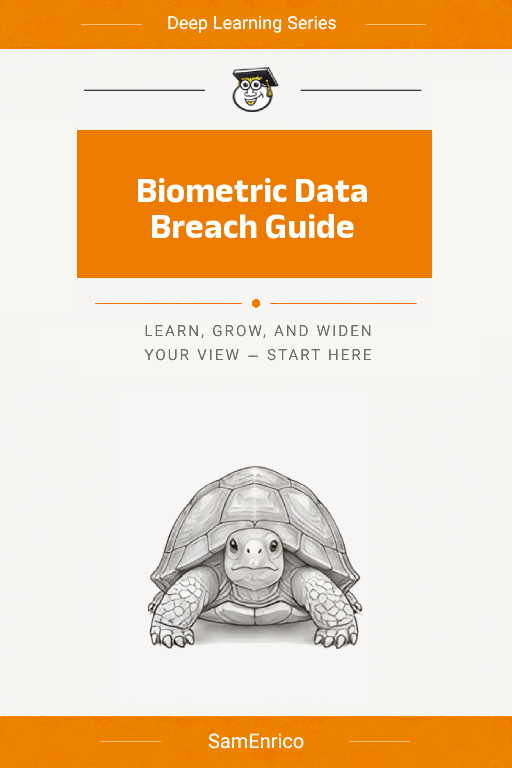
Non-FictionCompliance & Risk ArchiveBiometric Data
Biometric Data Breach Guide eBook
Special breach rules for fingerprints, facial reco
by Card Sherie
Special breach rules for fingerprints, facial recognition, and other biometric data under Illinois BIPA and GDPR.
Formats
Free sample
Chapter 1: The Permanent Credential–- On a Tuesday morning in March 2025, a facilities manager at a Midwestern manufacturing plant named Sarah did something she had done thousands of times before. She pressed her thumb against a small gray sensor next to the timeclock, heard a soft beep, and walked onto the factory floor to begin her shift. What Sarah did not know was that her fingerprint—mathematically translated into a digital template and stored on a server in a different state—had just become a permanent liability. She could change her password. She could cancel her credit card.
She could even get a new driver's license. But she could never get a new thumb. And neither could the 2,800 other employees whose biometric data sat on that same server, protected only by a vendor's standard encryption and a compliance officer's hope that nothing would go wrong.Six months later, something went wrong.The vendor, a small timeclock provider based in Texas, had left an administrative backdoor open to its central database. A ransomware group exploited it, exfiltrated 1.2 million fingerprint templates across forty-three clients, and demanded payment in cryptocurrency. The breach made headlines, but the real story emerged months later during discovery in the resulting class action lawsuit.
One plaintiff, a warehouse worker named Rodriguez who had clocked in and out four times daily for three years, had his fingerprint scanned approximately 2,900 times. Under the Illinois Biometric Information Privacy Act, as interpreted by the Illinois Supreme Court in Cothron v. White Castle, each scan was a separate violation. At 1,000pernegligentviolation—or1,000 per negligent violation—or 1,000pernegligentviolation—or5,000 per reckless violation, depending on what the jury found about the vendor's security practices—Rodriguez alone was owed between 2.9millionand2.9 million and 2.9millionand14.5 million. The proposed class included 1.2 million people.This is not a hypothetical.
This is the reality of biometric data in 2026.The Irreversibility Crisis: Why Your Fingerprint Is Worse Than Your Social Security Number For decades, information security professionals have operated under a simple paradigm: when credentials are compromised, you rotate them. Passwords get reset. Credit card numbers get reissued. Even Social Security numbers, despite their permanence, can be changed in extreme cases of identity theft. But biometrics break this paradigm entirely.
A fingerprint is not a secret you hold; it is a physical attribute you are. When a password is stolen, you choose a new one. When a fingerprint template is stolen, you cannot choose a new finger.This is what this book calls the irreversibility crisis, and it is the single most important concept for any legal or security professional working with biometric data. Understanding this crisis explains everything that follows: why BIPA imposes statutory damages of up to $5,000 per violation, why GDPR classifies biometrics as a "special category" of data requiring heightened protection, why courts consistently find standing for biometric breach plaintiffs even without proof of actual identity fraud, and why insurers are increasingly excluding biometric liability from standard cyber policies.Consider the mathematics of irreversibility. A typical strong password has approximately 100 bits of entropy—meaning an attacker would need to try 2^100 combinations to guess it, a computationally infeasible number.
A fingerprint, by contrast, has approximately 50 to 80 bits of entropy, depending on the fingerprint sensor's resolution and the matching algorithm. This lower entropy makes brute-force attacks more feasible, but that is not the primary problem. The primary problem is correlation. If an attacker steals a password hash from one database, that hash is useless against a different system using a different salt. But if an attacker steals a fingerprint template from System A, they can use that template to confirm that the same individual is enrolled in System B, even if System B uses a different hashing algorithm.
The underlying biometric is identical. The attacker may not be able to unlock System B directly, but they can track the individual across systems, build behavioral profiles, and potentially launch spear-phishing attacks personalized with information from multiple breached databases.The irreversibility crisis also has a temporal dimension that most organizations fail to appreciate. A password breach today is a problem for today. Even if the password is not changed immediately, its value depreciates over time as users rotate credentials. A fingerprint breach today is a problem for the next forty or fifty years—the remaining lifetime of every affected individual.
Courts and regulators have begun to recognize this extended timeline as a distinct form of harm. In Trans Union v. Ramirez (2021), the US Supreme Court held that plaintiffs must show concrete injury to establish Article III standing, rejecting claims based on mere statutory violations. But in biometric breach cases, courts have consistently distinguished the permanent, non-revocable nature of biometric data as creating a cognizable risk of future harm that satisfies Trans Union. As one federal judge put it in In re: Biometric Data Breach Litigation (ND Ill.
2025), "A compromised password is a key that can be recut. A compromised fingerprint is a key that can never be changed. That difference is not semantic; it is constitutional."The Two Regulatory Giants: BIPA and GDPRAgainst this backdrop of permanent risk, two regulatory regimes have emerged as the primary arbiters of biometric data protection. They operate on fundamentally different theories of liability, but both impose severe consequences for non-compliance.The Illinois Biometric Information Privacy Act (BIPA) is, for practical purposes, the national standard in the United States. Enacted in 2008, BIPA languished for nearly a decade before plaintiffs' lawyers discovered its potential.
The statute is elegantly simple and brutally strict. Section 15(a) requires written consent before collecting biometric data—not consent buried in an employee handbook, not implied consent through continued employment, but a separate, signed, dated disclosure form. Section 15(b) requires a publicly available retention schedule specifying how long biometric data will be kept and a policy for permanent destruction when the purpose ends. Section 15(c) prohibits selling, leasing, or trading biometric data. None of these requirements requires a data breach to trigger liability.
A company that collects fingerprints without written consent has violated BIPA the moment the first scan occurs, even if the data never leaves its servers.The damages provisions of BIPA have created a litigation industry. Section 20 provides for liquidated damages of 1,000pernegligentviolationor1,000 per negligent violation or 1,000pernegligentviolationor5,000 per reckless or intentional violation, plus reasonable attorneys' fees and costs. There is no requirement to prove actual harm. A company that recklessly collects biometric data without consent faces damages that can exceed its annual revenue. In Cothron v.
White Castle (2023), the Illinois Supreme Court held that each fingerprint scan constitutes a separate violation. An employee who clocks in twice daily for two years generates approximately 1,000 scans, or 1millionto1 million to 1millionto5 million in statutory damages—for that single employee alone. A class of 1,000 such employees generates 1billionto1 billion to 1billionto5 billion in exposure. The numbers are not theoretical. In 2024, a major restaurant chain settled a BIPA class action for 92million.In2025,ahealthcaresystempaid92 million.
In 2025, a healthcare system paid 92million.In2025,ahealthcaresystempaid74 million. In early 2026, a logistics company agreed to a $110 million settlement after a vendor breach exposed employee fingerprints.The General Data Protection Regulation (GDPR) approaches biometric data from a different angle. Rather than imposing per-scan damages, GDPR creates a regulatory enforcement regime…
This is the end of the free sample. Get the eBook to keep going. Buy now
About this book
Details
- Author
- Card Sherie
- Publisher
- SamEnrico
- Language
- English
- Genre
- Non-Fiction, Compliance & Risk Archive, Biometric Data
- Released
- 2026-06-01
- Pages (approx.)
- 159
- Available as
- eBook, Audiobook

Read better in the ZLOADR app
Your eBooks on your phone or tablet. Sign in with your SamEnrico account and start reading.
More by Card Sherie
 Personal Ing For Success Career ChangersCard Sherie$11.99
 Food Addiction Recovery Meal Planning GuideCard Sherie$11.99
 Bedtime Self Hypnosis Sleep GuideCard Sherie$11.99
 Cortisol Detox Evening RoutineCard Sherie$11.99
 ADHD Friendly Interruption GuideCard Sherie$11.99
 The Unseen Path: How Magellan's Crew Charted the Unknown in Central AsiaCard Sherie$11.99
 Boardroom Bloodbath: The Cutthroat Rise of the Monopoly TycoonCard Sherie$11.99
 Voiceover Feedback HandlingCard Sherie$12.99
 How to Start a Fat Splitting and Distilling Business (Beginners Guide)Card Sherie$11.99
 Understanding Ectrodactyly Dominant FormCard Sherie$17.99
 Editor In ChiefCard Sherie$11.99
You may also like
 Hong Kong Handover 1997Dunn Johnnie$11.99
 Zumba For Postnatal Recovery CourseNeal Christian$11.99
 Zumba for BeginnersLadner Nikia$11.99
 YouTube Comment Mining GuideHumes Pandora$12.99
 Worry Box MeditationCarlin Rudy$11.99
 Workplace Stress MeditationNguyen Lynn$11.99
 Workplace Stress and Sleep RepairHawley Ivory$11.99
 Workplace Perfectionism CureDelaney Jeffry$11.99
 Workplace Injustice Anger GuideWallen Isabelle$11.99
 Work Addiction and Burnout LinkGreenwood Ester$11.99
 Women in Yoga and WellnessBeattie Galina$11.99
 Women in Stand Up ComedyChun Evangeline$11.99