
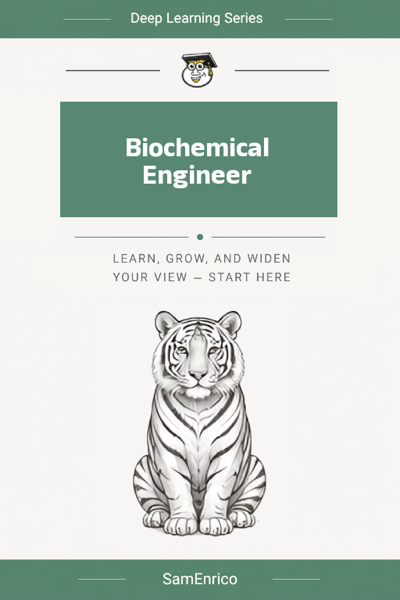
Non-FictionInformativeEducational
Biochemical Engineer
A Coursebook on Biochemical Engineer
by Shay Sid
A Coursebook on Biochemical Engineer
Formats
About this book
Free sample
Chapter 1: The Invisible Factory--–- Every day, billions of microscopic factories operate inside stainless steel vessels, converting sugar water into life-saving medicines, renewable fuels, and industrial enzymes. These factories have no smokestacks, no assembly lines, and no human workers inside them. Their machines are living cells—bacteria, yeast, or mammalian cells—genetically programmed to produce molecules that chemistry alone cannot economically manufacture. The biochemical engineer designs, operates, and optimizes these invisible factories. This book is your guide to becoming one.If you are reading this, you have likely already encountered the traditional chemical engineering curriculum: thermodynamics, transport phenomena, reaction kinetics, and process design—all applied to high-temperature, high-pressure systems cracking petroleum or synthesizing commodity chemicals.
Biochemical engineering shares the same foundational principles but applies them to a radically different set of constraints. Living systems operate at ambient temperatures (25–37°C), neutral p H (6.5–7.5), and low pressures (1–2 bar absolute). They are exquisitely sensitive to their environment: too hot, they die; too much shear, they rupture; too little oxygen, they suffocate; the wrong p H, they stop producing. Yet no chemical catalyst can match their specificity or their ability to synthesize complex chiral molecules like monoclonal antibodies, therapeutic proteins, or CRISPR nucleases.This chapter establishes your mental map of the biochemical engineering landscape. You will learn what biochemical engineers actually do, how the biotechnology industry is structured, and the standard bioprocess flow that will appear in every job you ever hold.
You will also learn how to think in terms of productivity, yield, and efficiency—the metrics that separate profitable processes from academic curiosities. By the end of this chapter, you will understand why biochemical engineering is not a niche specialization of chemical engineering but a distinct discipline with its own tools, constraints, and opportunities.What Biochemical Engineers Actually Do Let us dispel a common misconception immediately. Biochemical engineers do not spend their days peering into microscopes or pipetting tiny volumes of colored liquids into gel plates. Those are the tasks of molecular biologists and bench scientists. Biochemical engineers work at scale—thousands or tens of thousands of liters at a time.
They design the vessels where cells grow. They calculate how much oxygen must be sparged into a 50,000-liter bioreactor to…
This is the end of the free sample. Get the eBook to keep going. Buy now
Contents
- Chapter 1
- Chapter 2
- Chapter 3
- Chapter 4
- Chapter 5
- Chapter 6
- Chapter 7
- Chapter 8
- Chapter 9
- Chapter 10
- Chapter 11
- Chapter 12
Details
- Author
- Shay Sid
- Publisher
- SamEnrico
- Language
- English
- Genre
- Non-Fiction, Informative, Educational
- Released
- 2026-05-04
- Pages (approx.)
- 147
- Available as
- eBook, Audiobook

Read better in the ZLOADR app
Your eBooks on your phone or tablet. Sign in with your SamEnrico account and start reading.
More by Shay Sid
 Remote Entrepreneur GuideShay Sid$11.99
 London to Sydney OverlandShay Sid$11.99
 The Tai Chi Brain Health GuideShay Sid$11.99
 The Being Chased Dream PatternShay Sid$11.99
 JonBenét Burke Ramsey TheoryShay Sid$11.99
 The Stolen Trophies: How a Journalist Uncovered Africa’s Sports Heist of the CenturyShay Sid$11.99
 Pitch Competition JudgingShay Sid$12.99
 EE Application ChecklistShay Sid$12.99
 Learn to Play the D ClarinetShay Sid$11.99
 How to Start a Carbonate (barytes and Witherite) Mining Business (Beginners Guide)Shay Sid$11.99
You may also like
 Hong Kong Handover 1997Dunn Johnnie$11.99
 Zumba For Postnatal Recovery CourseNeal Christian$11.99
 Zumba for BeginnersLadner Nikia$11.99
 YouTube Comment Mining GuideHumes Pandora$12.99
 Worry Box MeditationCarlin Rudy$11.99
 Workplace Stress MeditationNguyen Lynn$11.99
 Workplace Stress and Sleep RepairHawley Ivory$11.99
 Workplace Perfectionism CureDelaney Jeffry$11.99
 Workplace Injustice Anger GuideWallen Isabelle$11.99
 Work Addiction and Burnout LinkGreenwood Ester$11.99
 Women in Yoga and WellnessBeattie Galina$11.99
 Women in Stand Up ComedyChun Evangeline$11.99