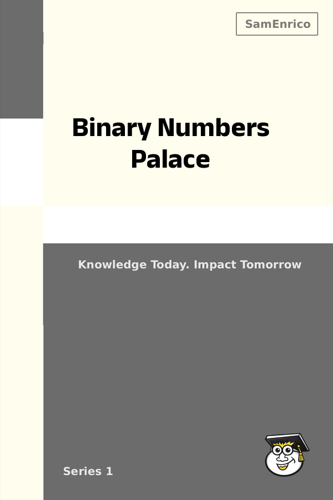
Binary Numbers Palace eBook
Convert binary to images and store in mental palac
by Linder Staci
Convert binary to images and store in mental palaces.
Formats
Free sample
Chapter 1: The 30-Second Collapse...--–- The confirmation code arrives on your phone. Six digits. You read it once. You look away for three seconds to type it. It's gone.
You check your phone again. Read it again. Type two digits. Forget the rest. Check your phone a third time.
Your heart rate increases. You feel stupid. You are not stupid. You are human.This is the single most expensive failure of the modern brain. Every day, the average person loses passwords, PINs, verification codes, locker combinations, phone numbers, addresses, and critical work data—not because they are careless, but because they are trying to store information in a format their brain was never designed to hold.
The cost of this failure is measured in wasted time, lost productivity, missed opportunities, and a quiet, persistent erosion of self-confidence. "I have a bad memory," people say, as if memory were a fixed trait like eye color or shoe size. It is not. You have a memory that speaks the wrong language.This book will teach you a new language. Specifically, it will teach you how to convert the most abstract, unforgiving, and machine-like data format ever invented—binary code—into vivid, spatial, emotional images that your brain will remember for years.
You will learn to look at a string of 1s and 0s and see, instead, a knight riding a flaming horse through a collapsing library. You will learn to store that image in a mental location so specific that you can return to it months later and retrieve every single bit perfectly. And you will learn to do this without computers, without apps, without writing anything down.But first, you must understand why your current memory strategy is failing. Not because you are doing it wrong, but because you are doing exactly what evolution trained you to do—and evolution never anticipated the digital age.The Evolutionary Mismatch Your brain is approximately 200,000 years old. Not your individual brain, of course, but the basic architecture of the human brain has changed remarkably little since the emergence of Homo sapiens on the savannas of Africa.
That brain was optimized for a world of predators, edible plants, social alliances, and geographical navigation. The brain that kept your ancestors alive was exceptional at one thing above all others: remembering where things were and whether they would kill you.Consider what your ancestral brain did not need to remember. It did not need to remember 16-digit credit card numbers. It did not need to remember 64-character Wi-Fi passwords. It did not need to remember binary code, hexadecimal color values, IPv6 addresses, or two-factor authentication codes.
These are not bugs in your memory. These are features of a world that changed faster than evolution could follow.The technical term for this is evolutionary mismatch. Your brain is running software designed for the Pleistocene on hardware that has been asked to process data from the 21st century. The result is not a failure of memory—it is a success of adaptation to an environment that no longer exists. The problem is not that your memory is bad.
The problem is that you are asking it to do something it was never built to do.Let me prove this to you with a simple experiment. Do not skip this. Actually do it.The 30-Second Test Below is a 16-digit binary string. Read it once. Just once.
Then cover it with your hand or look away for exactly 30 seconds. Do not rehearse it in your head more than once. Then try to write it down from memory.1011001011100101Did you get it? Almost certainly not. Even if you managed to capture 8 or 10 digits correctly, you almost certainly lost the order, flipped some 1s to 0s, or transposed entire segments.
This is not your fault. This is the normal behavior of a brain that treats abstract symbols as noise to be filtered out.Now try something different. Read the following sentence once, then cover it and write down everything you remember."A knight in rusted armor rides a flaming horse through a collapsing library, setting ancient scrolls on fire as the ceiling caves in."Write it down. I guarantee you got most of it, if not all of it. The knight.
The rusted armor. The flaming horse. The library collapsing. The scrolls burning. The ceiling caving in.
You might have missed one detail—perhaps the ancient scrolls became simply "scrolls" or the ceiling caving in became "walls falling"—but you remembered the core. You remembered images, actions, and spatial relationships. You remembered a story.Here is the astonishing truth: that sentence encodes exactly 16 bits of information. When converted to binary using the systems you will learn in this book, every detail of that sentence maps directly to the string 1011001011100101. The same 16 digits that your brain rejected as noise became a vivid, memorable scene that you can still visualize hours from now.
The information content is identical. Only the format changed.This is the Picture Superiority Effect, first rigorously demonstrated by Allan Paivio in the 1970s. Paivio showed that humans remember images and concrete words significantly better than abstract symbols. His dual-coding theory proposed that the brain has two separate but interconnected systems: one for verbal information and one for visual information. When you encode something in both systems simultaneously, recall improves dramatically.
When you encode something in neither—as with raw binary—recall plummets.But the Picture Superiority Effect is only half the story. The other half is the cognitive load imposed by abstract symbols. Cognitive load theory, developed by John Sweller in the 1980s, describes how the brain's working memory has severely limited capacity. The famous "magical number seven, plus or minus two" (George Miller, 1956) refers to the number of discrete items the average person can hold in working memory simultaneously. But those items must be meaningful chunks.
Raw binary digits are not meaningful chunks. Each 1 or 0 is a separate item, competing for space in a working memory that can hold only about seven items at once. A 16-digit binary string exceeds working memory capacity by more than double. Your brain is not designed to hold that much abstract data.A sentence, by contrast, is a single chunk. A vivid image is a single chunk.
A scene with a knight, a horse, a library, and fire—that is one chunk, not four. Your brain compresses it automatically because it recognizes the relationships. This is not magic. This is the difference between data and meaning.The Cost of Forgetting Before we go further, let us be honest about what forgetting costs you. Not in the abstract, but in the specific, grinding reality of daily life.How many times have you reset a password in the last year?
The average person spends 11 hours per year just resetting forgotten passwords. That is nearly half a day. Half a day of your life, every year, typing "forgot password," clicking a reset link, creating a new password, confirming it, and then forgetting it again two weeks later. Multiply that by 50 years of adult life, and you have spent nearly a month of your existence resetting passwords.How many times have you lost a confirmation…
This is the end of the free sample. Get the eBook to keep going. Buy now
About this book
Details
- Author
- Linder Staci
- Publisher
- SamEnrico
- Language
- English
- Genre
- Non-Fiction, Self-Help, Computer Science
- Released
- 2026-06-10
- Pages (approx.)
- 148
- Available as
- eBook, Audiobook

Read better in the ZLOADR app
Your eBooks on your phone or tablet. Sign in with your SamEnrico account and start reading.
More by Linder Staci
 The ED and AntidepressantsLinder Staci$11.99
 Safe Place Visualization TranceLinder Staci$11.99
 Data Center REIT BoomLinder Staci$11.99
 Nail Biting CessationLinder Staci$11.99
 ED and Spinal Cord InjuryLinder Staci$11.99
 The Validation JournalLinder Staci$11.99
 Stay At Home Parent StressLinder Staci$11.99
 The Red Sea Kings: Aksum’s Maritime Empire and the Golden Age of TradeLinder Staci$11.99
 The Tower of Babel: Ziggurat of the GodsLinder Staci$11.99
 Cyber Law: Digital Crimes, Privacy & Cyber RisksLinder Staci$11.99
 German Bachelor Admissions GuideLinder Staci$12.99
 Pinterest VA Upwork Profile OptimizationLinder Staci$12.99