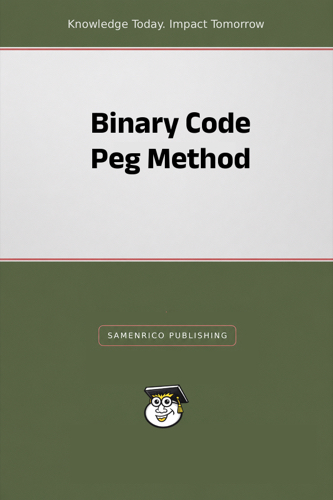
Binary Code Peg Method eBook
Convert binary digits to peg images for high densi
by Decker Tama
Convert binary digits to peg images for high density information storage.
Formats
Free sample
Chapter 1: The Cognitive Abyss--–- Imagine, for a moment, that I hand you a strip of paper with the following sequence printed on it: 01101001 00101110 01101101 00100000 01100001 00100000 01110000 01101001 01100111. You stare at it. Your eyes move across the digits. You read them aloud: "zero, one, one, zero, one, zero, zero, one..." By the time you reach the third group, you have already forgotten the first. By the time you reach the end, the beginning is a ghost.
If I asked you to recite the sequence from memory thirty seconds from now, you would fail. This is not a reflection of your intelligence, your education, or your effort. This is a reflection of how your brain was built.The human brain is a magnificent pattern-matching organ, honed over hundreds of thousands of years of evolution. It can recognize a familiar face in a crowd of strangers in less than two hundred milliseconds. It can navigate complex terrain, track social relationships across dozens of individuals, and remember the emotional sting of a childhood embarrassment for sixty years.
But the human brain did not evolve to process long strings of abstract digits. Binary code—the language of every computer, smartphone, and digital wallet on Earth—is cognitive white noise to the biological hardware between your ears.This chapter is called The Cognitive Abyss because that is exactly where binary digits fall. They do not stick. They do not hook. They do not trigger any of the brain's innate memory systems.
They enter working memory, linger for a few seconds, and then vanish as if they were never there. Understanding why this happens is the first step toward fixing it. And fixing it is not only possible—it is surprisingly straightforward once you understand the rules your brain actually follows.The Vanishing Act of Working Memory In 1956, the cognitive psychologist George Miller published a landmark paper titled "The Magical Number Seven, Plus or Minus Two." In it, he argued that the average human's working memory—the temporary scratchpad of consciousness—can hold only between five and nine discrete items at any given moment. Try to remember a ten-digit phone number long enough to dial it, and you will find yourself repeating it like a mantra. That repetition is your brain desperately trying to keep the digits from falling off the edge of the abyss.
Now try to remember a thirty-digit binary string without repetition. You cannot. It is not a matter of willpower or practice. It is a matter of architecture.Working memory is not a storage system. It is a processing system.
Think of it as a small desk where you lay out the pieces of a problem you are actively solving. You can only fit about seven pieces on that desk at once. When you try to add an eighth, one falls off. Binary digits—especially long strings of them—overwhelm this desk instantly. They are not chunked into meaningful units.
They have no inherent structure that your brain recognizes. They are just an endless stream of identical symbols with no rhythm, no melody, and no meaning.This is why a twelve-word seed phrase for a cryptocurrency wallet feels so impossible to memorize. At 132 bits of binary information (converted from the word indices), you are asking your working memory to hold more than fifteen times its natural capacity. You are not failing because you are lazy. You are failing because you are asking a bicycle to carry a freight train.The Picture Superiority Effect: Your Brain's Secret Weapon Here is where the story turns from despair to opportunity.
While your brain is terrible at abstract symbols, it is astonishingly good at images. This is not a minor difference—it is a factor of six or more. The Picture Superiority Effect, documented in dozens of peer-reviewed studies over the past fifty years, shows that people remember images approximately six times longer than they remember words or abstract symbols. Show someone a list of one hundred random words, and they will recall perhaps twenty of them an hour later. Show them one hundred images, and they will recall eighty or more.
The effect is so robust that it holds across cultures, ages, and even species.Why does this happen? The answer lies in the structure of your brain. The visual cortex occupies nearly thirty percent of your cerebral cortex—more than any other sensory system. When you see an image, you activate a vast network of neurons specialized for shape, color, motion, depth, and meaning. When you read an abstract symbol like "0" or "1", you activate a tiny fraction of that network.
The image gets encoded in parallel across multiple brain regions, creating redundant pathways for retrieval. The abstract symbol gets encoded in a single, fragile pathway. If that pathway degrades—and it degrades quickly—the symbol is gone.But not all images are created equal. A black-and-white photograph of a chair is forgettable. A neon-pink chair on fire, spinning through the air while a raccoon wearing a top hat rides it—that image will stay with you for years.
The most memorable images are bizarre, moving, emotionally charged, and personally relevant. They violate expectations. They trigger the amygdala, the brain's emotional alarm system, which flags them as "important" and instructs the hippocampus to store them permanently. This is the engine that will power everything you learn in this book.The Real-World Cost: Crypto's Billion-Dollar Problem Let me tell you about Stefan. I have changed his name, but his story is real.
In 2021, Stefan was an early cryptocurrency adopter who had accumulated approximately $2.3 million worth of Bitcoin and Ethereum over several years. He was careful—paranoid, even. He used a hardware wallet, kept his seed phrase on a steel plate in a fireproof safe, and never took photos of it with his phone. Then his house burned down in a wildfire. The safe survived, but the heat warped the steel plate just enough to make three of the twenty-four words unreadable.
Stefan had no backup. He had not written the seed phrase anywhere else. He had not memorized it because "no one can memorize twenty-four random words." His $2.3 million is still locked in an unrecoverable wallet today.Stefan's story is not an outlier. According to a 2022 study by the crypto analytics firm Chainalysis, approximately twenty percent of all existing Bitcoin—worth nearly $150 billion at the time—is sitting in wallets that have been inactive for more than five years. A significant portion of that is lost forever due to lost or forgotten seed phrases.
Every year, thousands of people contact wallet recovery services, begging for help to unlock their own money. Most of them never succeed.The binary peg method you are about to learn would have saved Stefan. It would have allowed him to convert his twenty-four-word seed phrase into a single, unforgettable movie in his mind—a movie that no fire, flood, or hardware failure could erase. Your memory, properly trained, is the only truly air-gapped storage system in existence. It has no physical attack surface.
It cannot be subpoenaed in the same way a paper wallet can. It cannot be hacked remotely. It is biology, and biology is the ultimate cold storage.Why Every Existing Solution Fails Before…
This is the end of the free sample. Get the eBook to keep going. Buy now
About this book
Details
- Author
- Decker Tama
- Publisher
- SamEnrico
- Language
- English
- Genre
- Non-Fiction, Self-Help, Computer Science
- Released
- 2026-06-10
- Pages (approx.)
- 122
- Available as
- eBook, Audiobook

Read better in the ZLOADR app
Your eBooks on your phone or tablet. Sign in with your SamEnrico account and start reading.
More by Decker Tama
 HGH Longevity Science ReviewDecker Tama$11.99
 Dream Journaling for CoachesDecker Tama$11.99
 Consent Based VotingDecker Tama$11.99
 Dyslexic Student Study GuideDecker Tama$11.99
 Cigarette Pack A Day RoutineDecker Tama$11.99
 TM for City LivingDecker Tama$11.99
 Amino Acids For HGHDecker Tama$11.99
 The Blood Tax of Chittor: How Money Fueled the Rajput ResistanceDecker Tama$11.99
 Shadows of the Shah: The Assassination That Shook a NationDecker Tama$11.99
 Merlin's Harp: The Enchanted Melodies of CamelotDecker Tama$11.99
 The Dancer's Guide to Latin DanceDecker Tama$11.99
 Growing Rubus (Raspberry)Decker Tama$11.99