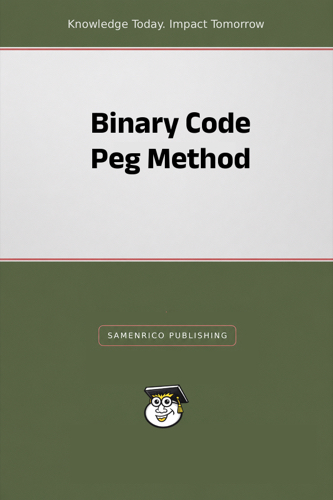
Binary Code Peg Method
Convert binary digits to peg images for high densi
by Decker Tama
Convert binary digits to peg images for high density information storage.
Formats
About this book
Free sample
Chapter 1: The Cognitive Abyss--–- Imagine, for a moment, that I hand you a strip of paper with the following sequence printed on it: 01101001 00101110 01101101 00100000 01100001 00100000 01110000 01101001 01100111. You stare at it. Your eyes move across the digits. You read them aloud: "zero, one, one, zero, one, zero, zero, one..." By the time you reach the third group, you have already forgotten the first. By the time you reach the end, the beginning is a ghost.
If I asked you to recite the sequence from memory thirty seconds from now, you would fail. This is not a reflection of your intelligence, your education, or your effort. This is a reflection of how your brain was built.The human brain is a magnificent pattern-matching organ, honed over hundreds of thousands of years of evolution. It can recognize a familiar face in a crowd of strangers in less than two hundred milliseconds. It can navigate complex terrain, track social relationships across dozens of individuals, and remember the emotional sting of a childhood embarrassment for sixty years.
But the human brain did not evolve to process long strings of abstract digits. Binary code—the language of every computer, smartphone, and digital wallet on Earth—is cognitive white noise to the biological hardware between your ears.This chapter is called The Cognitive Abyss because that is exactly where binary digits fall. They do not stick. They do not hook. They do not trigger any of the brain's innate memory systems.
They enter working memory, linger for a few seconds, and then vanish as if they were never there. Understanding why this happens is the first step toward fixing it. And fixing it is not only possible—it is surprisingly straightforward once you understand the rules your brain actually follows.The Vanishing Act of Working Memory In 1956, the cognitive psychologist George Miller published a landmark paper titled "The Magical Number Seven, Plus or Minus Two." In it, he argued that the average human's working memory—the temporary scratchpad of consciousness—can hold only between five and nine discrete items at any given moment. Try to remember a ten-digit phone number long enough…
This is the end of the free sample. Get the eBook to keep going. Buy now
Contents
- Chapter 1
- Chapter 2
- Chapter 3
- Chapter 4
- Chapter 5
- Chapter 6
- Chapter 7
- Chapter 8
- Chapter 9
- Chapter 10
- Chapter 11
- Chapter 12
Details
- Author
- Decker Tama
- Publisher
- SamEnrico
- Language
- English
- Genre
- Non-Fiction, Self-Help, Computer Science
- Released
- 2026-06-10
- Pages (approx.)
- 122
- Available as
- eBook, Audiobook

Read better in the ZLOADR app
Your eBooks on your phone or tablet. Sign in with your SamEnrico account and start reading.
More by Decker Tama
 HGH Longevity Science ReviewDecker Tama$11.99
 Dream Journaling for CoachesDecker Tama$11.99
 Consent Based VotingDecker Tama$11.99
 Dyslexic Student Study GuideDecker Tama$11.99
 Cigarette Pack A Day RoutineDecker Tama$11.99
 TM for City LivingDecker Tama$11.99
 Amino Acids For HGHDecker Tama$11.99
 The Blood Tax of Chittor: How Money Fueled the Rajput ResistanceDecker Tama$11.99
 Shadows of the Shah: The Assassination That Shook a NationDecker Tama$11.99
 Merlin's Harp: The Enchanted Melodies of CamelotDecker Tama$11.99
 The Dancer's Guide to Latin DanceDecker Tama$11.99
 Growing Rubus (Raspberry)Decker Tama$11.99