
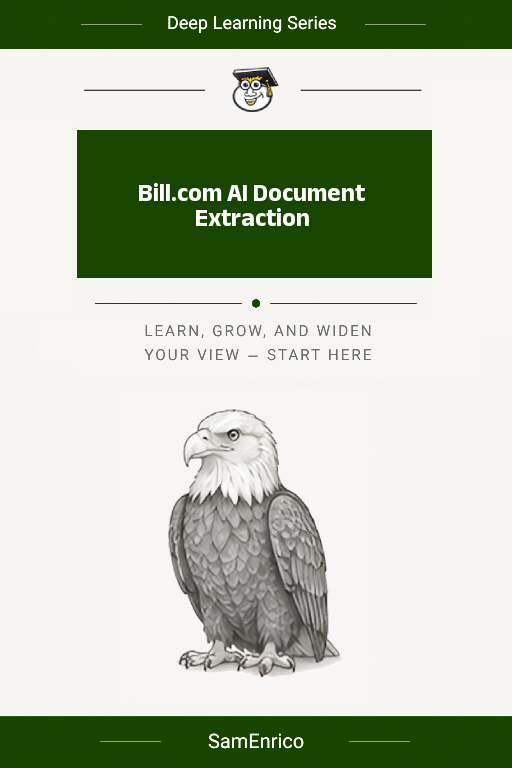
Bill.com AI Document Extraction eBook
Extract bill data from PDFs using Bill.com's AI, r
Extract bill data from PDFs using Bill.com's AI, reducing data entry for small business accounts payable teams.
Formats
Free sample
Chapter 1: The Sunday Night Reckoning--–- Maria had been an accounts payable specialist for eleven years. She knew every invoice template from every vendor her company used. She could spot a missing tax line from across the room. She had never missed a payment deadline—not once, not in eleven years.And yet, here she was. Sunday night.
9:47 PM. A glass of wine going warm beside her laptop. Spreadsheets open on two monitors. The television playing something she wasn't watching. And fifty-three invoices still waiting to be processed before Monday morning's payment run.Her husband had stopped asking when she would be done.
Their teenage daughter had stopped waiting for help with homework. The dog had given up on his evening walk entirely. Maria's life had become an endless loop of PDFs, typing, checking, approving, and the quiet, grinding exhaustion of knowing that Monday would bring another fifty invoices, and Tuesday another fifty after that, and that this Sunday night ritual would repeat itself until she retired or died, whichever came first.She was not alone.The Silent Epidemic of Manual APAcross the United States, millions of small business owners, bookkeepers, and AP clerks were doing exactly what Maria was doing on that Sunday night. They were typing numbers from PDFs into boxes. They were comparing invoice totals to purchase orders across three different browser tabs.
They were chasing vendors for missing W-9s. They were squinting at blurry scans of receipts that employees had photographed in dark restaurants.And they were losing.Not losing invoices, necessarily. They were losing time. They were losing weekends. They were losing the ability to grow their businesses because their AP departments were drowning in paper that had simply been digitized—not automated.The cruel irony of modern finance technology is this: most small businesses believe they have already solved this problem.
They bought Quick Books. They set up online bill pay. They started receiving invoices by email instead of by mail. Surely, they think, this is automation.It is not. It is digitization.
And the difference matters enormously.Digitization vs. Automation: The Critical Distinction Digitization means taking something analog (a paper invoice, a handwritten receipt, a typed PO) and converting it into a digital format. When your vendor emails you a PDF instead of mailing a paper invoice, that is digitization. When you scan a receipt instead of stuffing it into a shoebox, that is digitization. When you type an invoice number into a spreadsheet instead of writing it in a ledger book, that is digitization.Digitization is better than paper.
It is faster, more searchable, and less prone to being lost under a pile of mail. But digitization does not eliminate data entry. It simply changes the method of entry—from reading paper and typing into a ledger, to reading a screen and typing into a field. The human remains the central processing unit. The human remains the bottleneck.Automation, by contrast, means the machine does the work.
You feed a PDF into an AI-powered extraction system. The system reads the document, identifies the relevant fields (vendor name, invoice number, date, line items, taxes, total), and populates your accounting system without a single keystroke from you. Your role shifts from "typist" to "reviewer" — and eventually, as trust builds, from "reviewer" to "auditor."This is the promise of Bill.com's AI document extraction. It is not a faster way to type. It is a way to stop typing entirely.The Fortune 500 vs.
The Fortune 5 Million There is a reason large enterprises solved this problem years ago. Fortune 500 companies have dedicated IT departments, six-figure software budgets, and teams of integration specialists who can build custom OCR pipelines that connect directly to their SAP or Oracle ERP systems. They can afford to spend 500,000implementingasolutionthatsaves500,000 implementing a solution that saves 500,000implementingasolutionthatsaves200,000 annually in labor costs, because the strategic benefits—faster close, better compliance, real-time visibility—justify the expense.Small and medium-sized businesses cannot do this. They do not have an IT department. They do not have an integration specialist.
They have a bookkeeper who also handles payroll, a controller who also handles HR, and an owner who is lucky to find time to review the financials once a month, let alone architect a custom AI pipeline.This is the "Fortune 5 Million" problem. There are roughly five million small and medium-sized businesses in the United States that generate between 1millionand1 million and 1millionand100 million in annual revenue. They are the engine of the American economy. They create jobs. They innovate.
They serve their communities. And they are being crushed by manual AP processes that their larger competitors automated years ago.Bill.com was built for the Fortune 5 Million. Not for the Fortune 500. The platform assumes you do not have a developer on staff. It assumes your bookkeeper has twenty other responsibilities.
It assumes you need a solution that works in days, not months, and that pays for itself in weeks, not years.The $5 Invoice (And Why It Matters)To understand why manual AP is a crisis, you need to understand the math.Every invoice your business processes costs money. Not just the obvious costs—paper, envelopes, postage, software subscriptions—but the hidden costs of human labor. Someone has to receive the invoice (or download it from email). Someone has to review it for accuracy. Someone has to code it to the right general ledger accounts.
Someone has to match it to a purchase order. Someone has to get it approved. Someone has to schedule the payment. Someone has to reconcile the payment in the accounting system.According to industry benchmarks, the fully-loaded cost of processing a single invoice manually ranges from 5to5 to 5to15, depending on complexity, approval requirements, and labor rates. For a business processing 500 invoices per month, that is 30,000to30,000 to 30,000to90,000 annually in AP processing costs alone.But the real cost is not the direct labor.
The real cost is what you cannot do because your AP team is buried in data entry.A 2023 survey of small business owners found that AP teams spend an average of 60% of their time on manual data entry and exception handling. Only 40% remains for strategic work: analyzing spending patterns, negotiating with vendors, capturing early payment discounts, preventing duplicate payments, and managing cash flow.Think about that for a moment. Your AP professionals—some of the most financially savvy people in your organization—are spending the majority of their time doing work that a machine could do in seconds. They are typists, not analysts. And that is not their fault.
It is the fault of the systems you have given them.The Hidden Costs No One Talks About Direct labor is only the beginning. Manual AP creates four additional categories of hidden cost that rarely appear on any budget but silently drain your profitability.First: Late fees and missed discounts. When invoices sit in an email inbox for three days before someone processes them, or when approval workflows require three signatures that take a week to collect, you miss payment terms. Most vendors offer 2% discounts for payment within 10 days. That is an annualized return of 36%—better than almost any investment you can make.
Manual processing guarantees you leave that money on the table. Worse, when you pay late, you incur late fees that…
This is the end of the free sample. Get the eBook to keep going. Buy now
About this book
Details
- Author
- Cummins Billie
- Publisher
- SamEnrico
- Language
- English
- Genre
- Non-Fiction, Business Brief
- Released
- 2026-05-30
- Pages (approx.)
- 146
- Available as
- eBook, Audiobook

Read better in the ZLOADR app
Your eBooks on your phone or tablet. Sign in with your SamEnrico account and start reading.
More by Cummins Billie
 Step Three Decision To Turn Will Over GuideCummins Billie$11.99
 No Suicide Note LeftCummins Billie$11.99
 Recording Future PacingCummins Billie$11.99
 Forgiving Without ReconciliationCummins Billie$11.99
 Brian Greene BioCummins Billie$11.99
 Goal Setting for WritingCummins Billie$11.99
 Parent Loss and Anxiety GuideCummins Billie$11.99
 Equifax Web Portal Credential LeakCummins Billie$11.99
 The Maid of Orléans: Joan’s Fire Ignites France (1429)Cummins Billie$11.99
 Anansi the Spider: Weaver of Wisdom and MischiefCummins Billie$11.99
 How to Produce Writing and Drawing Instrument AccessoriesCummins Billie$11.99
 How to Produce Microscope AccessoriesCummins Billie$11.99
You may also like
 Hong Kong Handover 1997Dunn Johnnie$11.99
 Zumba For Postnatal Recovery CourseNeal Christian$11.99
 Zumba for BeginnersLadner Nikia$11.99
 YouTube Comment Mining GuideHumes Pandora$12.99
 Worry Box MeditationCarlin Rudy$11.99
 Workplace Stress MeditationNguyen Lynn$11.99
 Workplace Stress and Sleep RepairHawley Ivory$11.99
 Workplace Perfectionism CureDelaney Jeffry$11.99
 Workplace Injustice Anger GuideWallen Isabelle$11.99
 Work Addiction and Burnout LinkGreenwood Ester$11.99
 Women in Yoga and WellnessBeattie Galina$11.99
 Women in Stand Up ComedyChun Evangeline$11.99