
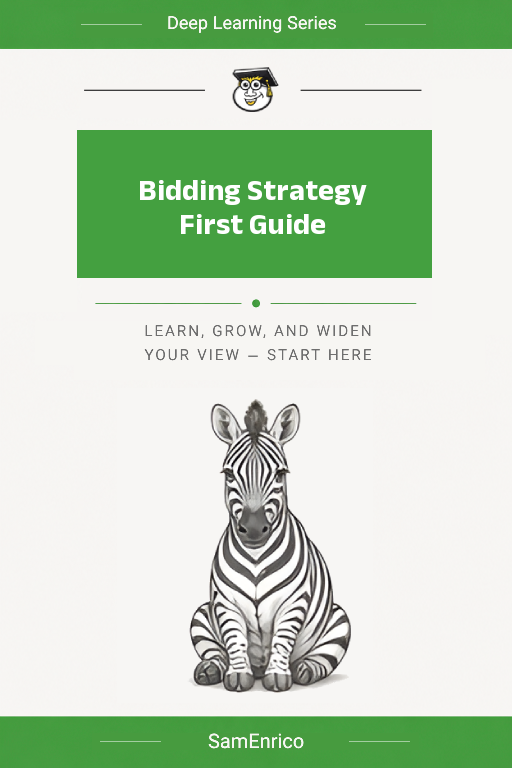
Non-FictionFirst 30 DaysBidding
Bidding Strategy First Guide eBook
Choose between lowest cost, cost cap, and bid cap.
by Steward Flo
Choose between lowest cost, cost cap, and bid cap. Set bid limits and understand auction dynamics.
Formats
Free sample
Chapter 1: The Invisible Tax--It was 11:47 PM on a Tuesday when I finally admitted the truth: I had no idea what I was doing with bidding strategy. Not because I was lazy or incompetent, but because every expert I followed gave contradictory advice. Trust the algorithm. Don't trust the algorithm. Use lowest cost.
Never use lowest cost. Set a bid cap at 2x your target CPA. Set a bid cap at 0.7x your target CPA. The noise was deafening, and buried beneath it, my ad budget was quietly bleeding out.The brand that broke me was a small sleepwear company called Cozy Nights. They had been running Facebook ads for eighteen months.
Their agency celebrated a 91% auction win rate. The account manager sent monthly reports with green upward arrows and triumphant language about "dominating the auction landscape." But when I dug into the actual numbers, something didn't add up. Their cost per purchase was 52.Theirproductcost52. Their product cost 52.Theirproductcost48 to make. Every single sale lost $4 before factoring in overhead, shipping, or returns.
They were paying for the privilege of losing money faster.This is the moment most bidding guides get wrong. They assume your only problem is inefficiency—that you're paying too much for conversions that are otherwise profitable. But the deeper problem is far more insidious. Most advertisers don't know they're losing money because they've never calculated their true break-even point. And even among those who have, few understand that the auction itself is structured to extract maximum spend, not maximum profit.The Cozy Nights situation was not a case of bad creative or poor targeting.
Their ads were delightful. Their product was high-quality. Their customer service was responsive. The problem was entirely, exclusively, and embarrassingly about bidding strategy. They had never adjusted their approach from the day they launched.
They used Lowest Cost for prospecting, Lowest Cost for retargeting, Lowest Cost for everything. The algorithm did exactly what it was designed to do: spend their entire budget every day. It succeeded brilliantly at their stated goal while failing catastrophically at their unstated one.Over the next ninety days, we rebuilt their bidding architecture from scratch. By the end, their cost per purchase had dropped to $31, their return on ad spend had more than doubled, and they were scaling profitably for the first time. The changes we made were not complicated.
They were not technologically advanced. They simply required understanding the three taxes that every advertiser pays and learning how to stop paying them.The Three Invisible Taxes After analyzing hundreds of accounts across Meta, Google, Amazon, and Tik Tok, I have identified three consistent sources of wasted ad spend. I call them the Invisible Taxes because they are nearly impossible to see without systematic analysis, yet they collectively consume 30-60% of most advertising budgets.The Desperation Tax is what you pay when performance dips and you react by increasing bids or loosening controls. It feels productive because you are doing something. In reality, you are teaching the algorithm that higher costs are acceptable, and the algorithm will happily oblige.The Comfort Tax is what you pay when you stick with Lowest Cost because it is easy and requires no decisions.
The algorithm spends your budget reliably, which feels safe. But reliability is not profitability, and the algorithm's definition of success is spending your budget, not growing your business.The Ego Tax is what you pay when you win auctions you should have lost. A 90% win rate sounds impressive. It feels good to beat competitors. But every auction you win at a price above your break-even point is a small loss compounded into a large one.Let me be clear about what I am not saying.
I am not saying that Lowest Cost has no place in your bidding strategy. I am not saying that algorithms are malicious or that platforms are trying to steal your money. I am saying that algorithms optimize for what you tell them to optimize for, and most advertisers tell them the wrong thing.The Desperation Tax: Why Panic Costs You Money The Desperation Tax is the most emotionally expensive of the three because it preys on your fear. Performance dips for a day. You check the dashboard.
CPA is up 40%. Your stomach drops. You start clicking things. You increase budgets. You loosen caps.
You launch new campaigns without proper testing.Here is what the algorithm sees when you do this: a sudden increase in acceptable bid prices. The algorithm does not know you are panicking. It does not know performance dipped because of a holiday weekend or a competitor's promotion or a creative that finally fatigued after six weeks. All it knows is that the constraints you previously set have been relaxed. It will immediately exploit this new freedom, often permanently raising your baseline costs.I worked with a supplement brand that fell into this trap repeatedly.
Every time their CPA crept above 45,theywouldraisetheir Cost Capto45, they would raise their Cost Cap to 45,theywouldraisetheir Cost Capto55 "temporarily" to get spending back on track. The problem was that temporary always became permanent. The algorithm learned that 55wasthenewnormal.Whentheytriedtolowerthecapbackto55 was the new normal. When they tried to lower the cap back to 55wasthenewnormal.Whentheytriedtolowerthecapbackto45, delivery would collapse. They had trained the algorithm to expect higher prices, and it refused to work for less.The solution to the Desperation Tax is counterintuitive: when performance dips, do not raise bids.
Lower them. Or pause entirely. Or do nothing and wait for the dip to pass. Most performance dips are temporary and self-correcting. The ones that are not require diagnosis, not panic.
Chapter 8 of this book provides the complete "Emergency Turnaround" protocol for exactly these situations, but the short version is this: before you change a single bid setting, spend one hour diagnosing the root cause. Ninety percent of the time, the root cause is not bidding-related at all. It is creative fatigue, audience saturation, or external factors like seasonality or competitive pressure.The Comfort Tax: Why Easy Is Expensive The Comfort Tax is the most insidious of the three because it feels responsible. You are not panicking. You are not making reckless changes.
You have a strategy that works reliably. But reliability is not the same as profitability, and Lowest Cost is the most reliable way to spend your entire budget every single day.The fundamental problem with Lowest Cost is that it optimizes for volume, not efficiency. The algorithm's objective function is to maximize the number of conversions within your budget. It does not care if those conversions come at 10or10 or 10or100, as long as the total number is as high as possible. If there are cheap conversions available, it will take them.
But if only expensive conversions remain, it will take those too, because any conversion is better than no conversion for an algorithm trying to maximize volume.This creates a dynamic where Lowest Cost consistently finds the floor of your profitability range but never finds the ceiling. It will spend your budget at the cheapest possible CPAs until those cheap options are exhausted, then it will spend your budget at increasingly expensive CPAs. By the end of the budget, your average CPA may still look…
This is the end of the free sample. Get the eBook to keep going. Buy now
About this book
Details
- Author
- Steward Flo
- Publisher
- SamEnrico
- Language
- English
- Genre
- Non-Fiction, First 30 Days, Bidding
- Released
- 2026-06-01
- Pages (approx.)
- 140
- Available as
- eBook, Audiobook

Read better in the ZLOADR app
Your eBooks on your phone or tablet. Sign in with your SamEnrico account and start reading.
More by Steward Flo
 PTSD Physical Health ImpactSteward Flo$11.99
 Greece Consumer RecoverySteward Flo$11.99
 Family Limited Partnership GuideSteward Flo$11.99
 Affirmations For Sleep HandbookSteward Flo$11.99
 The Problem Solving DBT WorkbookSteward Flo$11.99
 The Butcher of Beirut: Lebanon's Forgotten Cannibal KillerSteward Flo$11.99
 Understanding Pallister–hall SyndromeSteward Flo$17.99
 Chives HarvestingSteward Flo$11.99
 Walt Bettinger GuideSteward Flo$12.99
 How to Become a LeacherSteward Flo$11.99
You may also like
 Hong Kong Handover 1997Dunn Johnnie$11.99
 Zumba For Postnatal Recovery CourseNeal Christian$11.99
 Zumba for BeginnersLadner Nikia$11.99
 YouTube Comment Mining GuideHumes Pandora$12.99
 Worry Box MeditationCarlin Rudy$11.99
 Workplace Stress MeditationNguyen Lynn$11.99
 Workplace Stress and Sleep RepairHawley Ivory$11.99
 Workplace Perfectionism CureDelaney Jeffry$11.99
 Workplace Injustice Anger GuideWallen Isabelle$11.99
 Work Addiction and Burnout LinkGreenwood Ester$11.99
 Women in Yoga and WellnessBeattie Galina$11.99
 Women in Stand Up ComedyChun Evangeline$11.99