
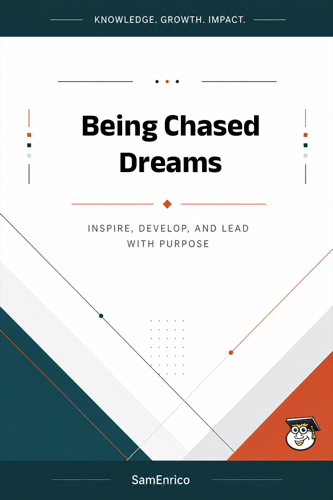
Non-FictionSelf-HelpChild Fears
Being Chased Dreams eBook
Identify what your child is avoiding or fearing th
by Rico Melida
Identify what your child is avoiding or fearing through chase dream patterns.
Formats
Free sample
Chapter 1: The Monster Translator...–- Every parent has heard the scream. It comes at 2:17 AM, a sound that bypasses the ears and drills directly into the primal core of the chest. You run down the hallway, heart pounding, already preparing for the worst—a broken bone, a burglar, a fire. But when you burst through the bedroom door, you find no blood, no intruder, no smoke. You find a small, trembling child, eyes wide with genuine terror, pointing at the closet or the darkness under the bed or the shadow on the wall that looks like it just moved.
“There was a monster,” they whisper. “It was chasing me.” And in that moment, every parent faces a choice. You can say the logical thing: “Monsters aren’t real. It was just a dream. Go back to sleep.” Or you can pause, kneel down, and realize that your child has just handed you a coded letter written in a language you do not yet speak.
This book is the decoder ring.For decades, parents have been told to dismiss nightmares. “It’s just a dream” is the standard refrain, delivered with exhausted certainty at 2 AM, again and again. But what if the opposite were true? What if the nightmare was not the problem, but the solution? What if the monster chasing your child through their dreamscape was not a random firing of neurons, but a meticulously crafted translation of a fear your child cannot otherwise express?
This chapter will overturn everything you think you know about childhood nightmares and introduce you to the single most important concept in this entire book: dream displacement—the brain’s remarkable ability to turn an unspeakable fear into a chase scene.The Problem with “It Was Just a Dream”Let us begin with a simple question: Why do children lie? Not about stealing cookies or breaking a lamp, but about their feelings. Ask a seven-year-old if they are worried about the divorce, and they will likely say, “I’m fine.” Ask a nine-year-old if something is bothering them at school, and they will shrug and ask for a snack. Ask a five-year-old if they are scared of the dark, and they will insist they are brave. This is not deception in the adult sense.
This is the natural limitation of a developing brain. Children lack the vocabulary, the emotional abstraction, and the self-awareness to name complex fears. A child cannot say, “I am experiencing generalized anxiety disorder secondary to parental conflict.” But that same child can tell you, in vivid detail, about the wolf that chased them through the forest last night.Here is the neurobiology of that experience. During REM sleep—the stage where most dreaming occurs—the amygdala, which is the brain’s fear and threat detection center, becomes highly active. In fact, it is often more active during REM sleep than during wakefulness.
Meanwhile, the prefrontal cortex, which is responsible for logic, reasoning, and self-awareness, goes offline. This means that your child, while dreaming, literally cannot tell themselves, “This is just a dream, and I am safe.” The fear they feel is neurologically real. Their heart races. Their palms sweat. Their body releases cortisol and adrenaline.
When they wake up, the physiological experience of terror is indistinguishable from the physiological experience of being chased by an actual predator.Now add to this the developmental reality of childhood. A preschooler cannot reliably distinguish between dreams and reality until around age four or five. Even an older child, up to age eight or nine, may struggle to understand that the dream ended when they opened their eyes. When you say, “It was just a dream,” you are making a logical statement that your child’s developing brain may not fully accept. But more importantly, you are dismissing the feeling as invalid.
You are telling a child whose body is flooded with stress hormones that their experience does not matter. This does not comfort them. It teaches them that their internal world is not a reliable source of information and that you, the parent, are not a safe person to bring their fears to.The alternative is radical but simple: treat the nightmare as real communication. Not real in the sense of a literal monster under the bed, but real in the sense of genuine fear that deserves acknowledgment. This shift—from dismissal to curiosity—is the foundation of everything that follows.Dream Displacement: The Brain’s Translation Machine Sigmund Freud, despite the controversy surrounding many of his theories, identified a psychological mechanism that has held up remarkably well under modern scrutiny: dream displacement.
In simple terms, displacement occurs when the brain takes an emotion or conflict that is too dangerous, too abstract, or too painful to face directly and attaches it to a safer, more concrete image. You are not afraid of your father’s anger—that would be too scary to admit. Instead, you dream of a lion chasing you. The lion is the displacement. The father’s anger is the source.Modern neuroscience has refined this concept.
Researchers have found that the brain uses the same neural circuits to process metaphors as it does to process literal events. When a child dreams of a monster, the brain is not inventing a fiction. It is creating a metaphor. And that metaphor is always, without exception, about something real in the child’s waking life.Consider a case study from the research of Harvard dream researcher Dr. Deirdre Barrett.
A seven-year-old girl began having recurring nightmares about a giant spider that would crawl into her bed and wrap her in webs. Her parents, following standard advice, reassured her that spiders were not in her room and that she was safe. The nightmares continued for months. Finally, a child psychologist asked a different question: “What does the spider feel like?” The girl replied, “It feels sticky and tight, like I can’t move.” Further gentle questioning revealed that the girl’s older brother had been holding her down and tickling her until she cried—not abusive in a violent sense, but a daily violation of her bodily autonomy. The spider was not a spider.
The spider was the feeling of being trapped by someone she loved. Once the parents addressed the sibling dynamic, the spider dreams stopped within two weeks.This is dream displacement in action. The child could not say, “My brother overwhelms me and I feel powerless.” Those words were not available to her. But her brain could construct a spider—a classic symbol of entrapment and invasion—and place it in her bed, the very location where the tickling occurred. The dream was not a malfunction.
It was a masterpiece of psychological translation.Why the Chase, Specifically?Of all the nightmare themes—falling, being lost, being naked in public, teeth falling out—the chase dream is by far the most common among children. According to sleep research cited in the Popular Science archives and child psychology literature, approximately 70% of childhood nightmares involve being chased by something. This is not a coincidence. The chase dream taps into the oldest, most evolutionarily preserved circuit in the mammalian brain: the predator-prey response.Long before humans had language, long before…
This is the end of the free sample. Get the eBook to keep going. Buy now
About this book
Details
- Author
- Rico Melida
- Publisher
- SamEnrico
- Language
- English
- Genre
- Non-Fiction, Self-Help, Child Fears
- Released
- 2026-06-05
- Pages (approx.)
- 150
- Available as
- eBook, Audiobook

Read better in the ZLOADR app
Your eBooks on your phone or tablet. Sign in with your SamEnrico account and start reading.
More by Rico Melida
 The Beginner's Group MeditationRico Melida$11.99
 Countdown Method Self Hypnosis GuideRico Melida$11.99
 Bulgarian Real Estate InvestmentRico Melida$11.99
 Canned Food Recall GuideRico Melida$11.99
 Breast Cancer Body EsteemRico Melida$11.99
 Low Carb Insulin FixRico Melida$11.99
 Counter Reformation Holy League Battle CourseRico Melida$11.99
 AI Presentation AssessmentRico Melida$11.99
 Luxury and the Lost: The Billionaire’s Quest for AtlantisRico Melida$11.99
 The Forgotten Navigator: The Uncharted Journey of Wey Yuansu Across Australia's Unknown HeartRico Melida$11.99
 Echoes of the Infinite: The AI That Wrote Its Own FateRico Melida$11.99
 Understanding Acropectoral SyndromeRico Melida$17.99
You may also like
 Hong Kong Handover 1997Dunn Johnnie$11.99
 Zumba For Postnatal Recovery CourseNeal Christian$11.99
 Zumba for BeginnersLadner Nikia$11.99
 YouTube Comment Mining GuideHumes Pandora$12.99
 Worry Box MeditationCarlin Rudy$11.99
 Workplace Stress MeditationNguyen Lynn$11.99
 Workplace Stress and Sleep RepairHawley Ivory$11.99
 Workplace Perfectionism CureDelaney Jeffry$11.99
 Workplace Injustice Anger GuideWallen Isabelle$11.99
 Work Addiction and Burnout LinkGreenwood Ester$11.99
 Women in Yoga and WellnessBeattie Galina$11.99
 Women in Stand Up ComedyChun Evangeline$11.99