

Non-FictionHealth & WellnessWorkbook
Behavioral Weight Workbook eBook
Exercises to change eating and activity patterns.
Exercises to change eating and activity patterns.
Formats
Free sample
Chapter 1: Beyond Willpower's Lie--–- You are standing in front of an open refrigerator at 11:37 PM. The light spills out like a cold confession. You are not hungry. Your stomach is not growling. In fact, you had a perfectly adequate dinner less than three hours ago.
And yet, your hand is already reaching for the leftover container from Tuesday night. You can almost taste the cheese before you have touched it.This is not a failure of character. This is not a lack of discipline. This is not evidence that you are "weak" or "lazy" or "broken." This is the sound of your brain running on autopilot. And autopilot, as you are about to learn, has nothing to do with willpower.Welcome to the single most important insight in behavioral weight management: most of your eating has nothing to do with hunger, and everything to do with habit.
If you have ever wondered why you can spend an hour researching healthy recipes, make a grocery list with the best intentions, pack a gym bag in the morning, and still find yourself eating stale crackers from the breakroom while standing up—this chapter is for you. The problem is not your motivation. The problem is that motivation lives in one part of your brain, and eating behavior lives in another. By the time your logical mind wakes up, your emotional brain has already driven the car into the ditch.This chapter will teach you how to separate hunger from habit, how to recognize the four distinct drivers of eating, and how to practice a skill called "urge surfing" that will fundamentally change your relationship with cravings. By the end of this chapter, you will never look at a late-night snack the same way again.
More importantly, you will stop blaming yourself for something that was never your fault to begin with.The Myth of the Rational Eater Let us begin with a humbling truth that the diet industry does not want you to hear: humans are not rational creatures who occasionally act emotionally. We are emotional creatures who occasionally act rationally. This is not a philosophical opinion plucked from a self-help seminar. It is a description of brain anatomy, confirmed by decades of neuroscience research.Your brain has two primary systems that matter for eating. The first is the limbic system, which includes the amygdala, the nucleus accumbens, and the hypothalamus.
This is your emotional, impulsive, automatic brain. It evolved to keep you alive on the savanna, where high-calorie food was scarce and danger lurked behind every bush. The amygdala does not care about your cholesterol, your jeans size, or your five-year health plan. It cares about one thing and one thing only: immediate reward. When it sees sugar, fat, and salt—especially in combination—it lights up like a Christmas tree and screams "EAT THAT NOW" with the urgency of a fire alarm.The second system is your prefrontal cortex.
This is the logical, planning, future-oriented part of your brain. It understands calories, macros, portion sizes, and long-term consequences. It knows that the cookie will provide a few seconds of pleasure followed by hours of regret. The prefrontal cortex is the part of you that made a New Year's resolution to lose weight. It is the part that reads diet books and meal preps on Sundays.
It is also, unfortunately, the slower part.Here is the problem: the limbic system responds to food cues in milliseconds. The prefrontal cortex takes several seconds longer to engage. By the time your logical brain realizes what is happening, your hand is already holding the food, and in some cases, half of it is already gone. Psychologists call this the "amygdala hijack," and it is responsible for more failed diets than any other single factor.Let me repeat this because it matters: you are not weak. You are not broken.
You are simply human, operating with a brain that was designed for a world that no longer exists. In that world, the urge to eat high-calorie food was a survival advantage. Every time you felt that urge, it meant you were staying alive. In this world, surrounded by hyper-palatable processed foods engineered by food scientists to hit every bliss point in your brain, that same urge is a liability. Your brain is not malfunctioning.
It is doing exactly what evolution designed it to do. The world changed faster than your brain could keep up.The good news is that you can retrain your brain. But you cannot retrain what you do not first observe. You cannot fix what you refuse to see. And you certainly cannot shame yourself into a different neural pathway.The Four Hungers: A Diagnostic Tool Before you can change your eating behavior, you need a reliable way to understand why you are eating in the first place.
Most people use one word—"hungry"—to describe at least four completely different experiences. This is like using the same word for rain, snow, hail, and fog. Technically, they are all precipitation. Practically, they require completely different responses. If you treat hail like rain, you are going to have a bad time.We have identified four distinct types of hunger.
Learning to distinguish between them is the single most important skill you will develop in this workbook. It matters more than calorie counting, more than macro tracking, more than any diet plan you have ever tried. Because if you do not know why you are eating, you cannot possibly know how to stop.Stomach Hunger (Biological)This is real hunger. Your stomach has been empty for several hours. You may feel a hollow sensation, a growling sound, lightheadedness, difficulty concentrating, or irritability—the infamous "hangry" state that has ended more than a few relationships.
Stomach hunger builds gradually over time. It is not sudden. It does not appear out of nowhere. And here is the most important feature: stomach hunger can be satisfied by almost any food. It is not picky.
It does not demand chocolate chip cookies specifically. It does not need to be a particular texture or temperature. It just wants energy. When you eat in response to stomach hunger, you feel satisfied and stop naturally. You do not need to use willpower to push away the plate.
Your body sends a signal that says "enough," and you listen.Mouth Hunger (Sensory)This is craving for a specific taste, texture, temperature, or mouthfeel. You do not want "food." You want something crunchy. Or creamy. Or salty. Or cold.
Or warm. Or carbonated. Mouth hunger is driven by sensory pleasure, not biological need. It is the reason you can eat an entire meal, feel physically full to the point of discomfort, and still want dessert. Your stomach is satisfied, but your mouth is bored.
Mouth hunger is not a sign that you need nutrition. It is a sign that your brain is seeking stimulation, and it has learned that food is a very reliable source of that stimulation. This type of hunger can often be satisfied by non-food sensory experiences: a hot shower, a cold glass of sparkling water, a crunchy vegetable like cucumber or bell pepper, or even chewing gum. Sometimes…
This is the end of the free sample. Get the eBook to keep going. Buy now
About this book
Details
- Author
- Adamson Anthony
- Publisher
- SamEnrico
- Language
- English
- Genre
- Non-Fiction, Health & Wellness, Workbook
- Released
- 2026-06-11
- Pages (approx.)
- 143
- Available as
- eBook, Audiobook

Read better in the ZLOADR app
Your eBooks on your phone or tablet. Sign in with your SamEnrico account and start reading.
More by Adamson Anthony
 Yakuza Retirement ProblemsAdamson Anthony$11.99
 Anki For Chemistry ElementsAdamson Anthony$11.99
 Spouse Loss Adult ChildrenAdamson Anthony$11.99
 Self Hypnosis For Emetophobia GuideAdamson Anthony$11.99
 NYC Bodega Pop Up HybridAdamson Anthony$11.99
 Planet Dream Jungian ViewAdamson Anthony$11.99
 Loving Kindness for a Demanding ClientAdamson Anthony$11.99
 Bedbound Mindfulness RoutineAdamson Anthony$11.99
 The Green Alchemists: How Black Botanists Transformed MedicineAdamson Anthony$11.99
 The Ghost of the Kremlin: How a CIA Operative Outsmarted the Soviet Union in Plain SightAdamson Anthony$11.99
 The Germ Hunters: Billionaires, Bacteria, and the Race to Save the WorldAdamson Anthony$11.99
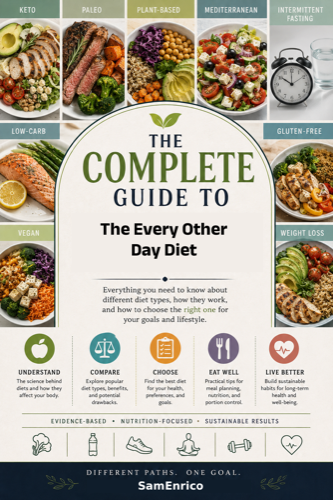 The Complete Guide to the Every Other Day DietAdamson Anthony$11.99
You may also like
 Hong Kong Handover 1997Dunn Johnnie$11.99
 Zumba For Postnatal Recovery CourseNeal Christian$11.99
 Zumba for BeginnersLadner Nikia$11.99
 YouTube Comment Mining GuideHumes Pandora$12.99
 Worry Box MeditationCarlin Rudy$11.99
 Workplace Stress MeditationNguyen Lynn$11.99
 Workplace Stress and Sleep RepairHawley Ivory$11.99
 Workplace Perfectionism CureDelaney Jeffry$11.99
 Workplace Injustice Anger GuideWallen Isabelle$11.99
 Work Addiction and Burnout LinkGreenwood Ester$11.99
 Women in Yoga and WellnessBeattie Galina$11.99
 Women in Stand Up ComedyChun Evangeline$11.99