
Non-FictionHealth & WellnessStretching
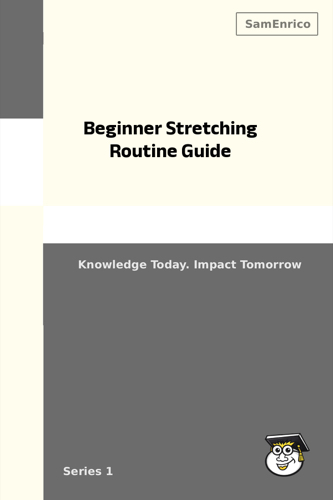
Beginner Stretching Routine Guide eBook
Improve flexibility and reduce soreness with daily
Improve flexibility and reduce soreness with daily full body stretches.
Formats
Free sample
Chapter 1: The Hidden Epidemic--–- You wake up. Before your feet touch the floor, you feel it — a dull ache in your lower back, a tightness across your shoulders, a stiffness in your hips that makes the first three steps to the bathroom feel like wading through shallow water. You are not old. You are not injured. You are not broken.
And yet, every morning begins with a quiet negotiation with your own body.This is not normal. But for millions of people, it has become normal.The average adult spends nine and a half hours per day sitting. That is more time than they spend sleeping. Between desk jobs, commuting, eating meals, and scrolling through phones on the couch, the human body has been placed in a position that evolution never designed it for: a flexed, slumped, narrowed posture with the hips bent, the spine rounded, and the shoulders rolled forward. And then we wake up the next morning and wonder why everything hurts.This chapter is not a collection of stretches.
You will not be asked to touch your toes or hold a pose. This chapter is about one thing only: understanding why you hurt, why stiffness is not a life sentence, and how a completely different approach to stretching — one that has nothing to do with being "flexible" — can fundamentally change the way you move, sleep, and feel. By the end of this chapter, you will have a new framework for thinking about your body, a realistic goal to measure your progress, and the single most important tool for staying safe as you begin: the 0–10 Pain Scale.The Myth of Aging Let us start with a lie you have been told, implicitly or explicitly, your entire adult life. The lie is this: stiffness is a natural and unavoidable consequence of getting older.It is not.If stiffness were purely a function of age, then every sixty-five-year-old would be equally stiff, and every twenty-five-year-old would be equally limber. That is not what we see.
Walk into any senior yoga class, and you will find eighty-year-olds who can fold forward and place their palms flat on the floor. Walk into any corporate office, and you will find twenty-eight-year-old software engineers who cannot reach past their own knees. Age is a factor, yes — connective tissue does change over decades — but it is a minor factor. The major factor is something far more immediate and reversible: the shape your body has been held in for the past several years.Consider the following thought experiment. If you took a healthy, active twenty-five-year-old and locked them in a small room with a desk, a chair, and a phone for twelve hours a day, five days a week, for three years — what would happen to their body?
Their hip flexors would shorten. Their glutes would weaken from disuse. Their chest muscles would tighten. Their upper back would round. Their hamstrings would adapt to a seated position by becoming either tight or lengthened and weak, depending on how they sat.
They would not become "old." They would become shaped by their environment. And then, if you released them back into the world, their body would slowly, over months, reshape itself again — provided they gave it the right inputs.That is what this book is. Those are the right inputs.Stiffness is not a disease. It is an adaptation. And adaptations can be reversed.Tight Versus Weak: The Crucial Distinction No One Tells You About Here is where most stretching guides get it wrong.
They treat all tightness as the same problem requiring the same solution: stretch the muscle that feels tight. But this approach fails for a simple reason. Sometimes the muscle that feels tight is actually tight. Other times, it is weak. And stretching a weak muscle is like pulling on a frayed rope — it will only make things worse.Let me explain with two examples.First, the hip flexors.
These are the muscles that run from your lower spine down to the front of your thighs. When you sit for long periods, your hip flexors are in a shortened position. Over time, they adapt by becoming shorter and tighter. This is true tightness. The solution is to lengthen them through stretching.
That works.Second, the glutes. When you sit for long periods, your gluteal muscles are placed in a lengthened, inactive position. They are not being used. Over time, they adapt by becoming inhibited — neurologically "forgotten" — and weak. But here is the trick.
If your glutes are weak, your lower back muscles will try to compensate. They will tighten up to do the job your glutes should be doing. So you feel tightness in your lower back. If you stretch your lower back — the muscle that feels tight — you are stretching a muscle that is already overworked and possibly strained. You are treating the symptom, not the cause.
The real solution is to strengthen the glutes, not stretch the back.This is the tight-versus-weak distinction. It is the single most important concept in this entire book. Most back and neck pain does not come from being "inflexible." It comes from imbalances: certain muscles that are too tight and certain muscles that are too weak, pulling your skeleton out of its natural alignment.Throughout this book, you will learn not just how to stretch, but how to identify which muscles need lengthening and which need strengthening. For now, simply understand this: when you feel tightness, do not automatically assume the tight muscle is the problem. It might be a neighbor.The Nervous System Is the Boss of Your Flexibility If you have ever tried to stretch and felt like you hit a wall — a point where your muscles simply refuse to go further — you have experienced the protective intelligence of your own nervous system.
And that is exactly what it is: protection.Inside your muscles are tiny sensory receptors called muscle spindles. Their job is to detect changes in muscle length and speed of stretch. If a muscle is lengthened too quickly or too far, the muscle spindle fires an urgent signal: "Danger! This muscle is about to tear!" In response, your nervous system orders that muscle to contract — to tighten up — to resist the stretch. This is called the stretch reflex.
It is why bouncing into a stretch (ballistic stretching) often backfires and can even cause injury.But there is another receptor, deep in the tendons where muscle meets bone, called the Golgi tendon organ. Its job is to monitor tension, not length. When you hold a stretch gently and persistently for fifteen seconds or more, the Golgi tendon organ eventually signals the spinal cord: "The tension is sustained but not dangerous. You can relax the muscle now." This triggers a reflexive relaxation of the muscle, allowing it to lengthen further. This is why static stretching — holding a pose without bouncing — works.Understanding these two systems unlocks everything.
The muscle spindle resists sudden change. The Golgi tendon organ permits sustained release. Your nervous system is not your enemy. It is a cautious gatekeeper. And you can learn to work with it by stretching slowly, gently, and patiently.This is also why the breathing technique…
This is the end of the free sample. Get the eBook to keep going. Buy now
About this book
Details
- Author
- Sneed Maryellen
- Publisher
- SamEnrico
- Language
- English
- Genre
- Non-Fiction, Health & Wellness, Stretching
- Released
- 2026-06-12
- Pages (approx.)
- 150
- Available as
- eBook, Audiobook

Read better in the ZLOADR app
Your eBooks on your phone or tablet. Sign in with your SamEnrico account and start reading.
More by Sneed Maryellen
 Affirmations for MenSneed Maryellen$11.99
 Metta for Imposter Syndrome GuideSneed Maryellen$11.99
 Erotic Transference HandbookSneed Maryellen$11.99
 Mindfulness for Beginner ChefsSneed Maryellen$11.99
 The Silent Revolution: Wilder Penfield and the Mapping of the Human BrainSneed Maryellen$11.99
 The Crown of Shadows: How a 19th-Century Queen’s Secret Changed the WorldSneed Maryellen$11.99
 Payment Systems and Checkout OptimizationSneed Maryellen$11.99
 Understanding DemodicidosisSneed Maryellen$17.99
 FCRA Compliance For FintechSneed Maryellen$12.99
 Sabancı University GuideSneed Maryellen$12.99
 A Beginners Guide to Badminton (Volume 1)Sneed Maryellen$11.99
You may also like
 Hong Kong Handover 1997Dunn Johnnie$11.99
 Zumba For Postnatal Recovery CourseNeal Christian$11.99
 Zumba for BeginnersLadner Nikia$11.99
 YouTube Comment Mining GuideHumes Pandora$12.99
 Worry Box MeditationCarlin Rudy$11.99
 Workplace Stress MeditationNguyen Lynn$11.99
 Workplace Stress and Sleep RepairHawley Ivory$11.99
 Workplace Perfectionism CureDelaney Jeffry$11.99
 Workplace Injustice Anger GuideWallen Isabelle$11.99
 Work Addiction and Burnout LinkGreenwood Ester$11.99
 Women in Yoga and WellnessBeattie Galina$11.99
 Women in Stand Up ComedyChun Evangeline$11.99