
Non-FictionSelf-HelpSales Ethics
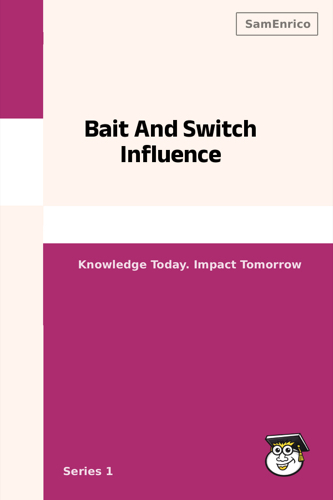
Bait And Switch Influence eBook
Attract with desirable offer then present alternat
by Lytle Miss
Attract with desirable offer then present alternative.
Formats
Free sample
Chapter 1: The Invisible Hook--–- You are about to be manipulated today. You probably already have been, and you didn't even notice.The average person encounters somewhere between 6,000 and 10,000 marketing messages every single day. That number comes from a 2014 study by Red Crow Marketing, and if anything, it has grown more aggressive with the rise of Tik Tok shops, Instagram Reels ads, and AI-powered email sequences. Ten thousand pitches. Ten thousand attempts to get you to say yes.
And yet, by dinner time, you will have actively agreed to only a handful of them.Here is the question this book exists to answer: How do those few succeed where the other 9,995 fail?The answer is not better products, lower prices, or more honest slogans. The answer is a psychological architecture so subtle that you have probably fallen for it hundreds of times without ever recognizing the pattern. That architecture is what this book calls the bait-and-switch influence loop. And before you recoil at the phrase—assuming this is a book about deception, fraud, or the dark arts of used car salesmen—let me stop you. The mechanism itself is morally neutral.
A knife can perform surgery or commit a crime. A psychological trigger can trap a vulnerable customer or help a hesitant client make a life-changing decision. The difference is not the tool. The difference is the hand that holds it.This chapter introduces the first and most foundational of the four bait types: the Commitment Bait. If you understand nothing else in this book, understand this.
A small yes is the most powerful lever in human persuasion. Once someone gives you even a token of agreement—a click, a signature, a nod, a few minutes of their time—their brain rewires itself to resist walking away. That is not a metaphor. That is neuroscience.Let me show you how it works, how it has been used against you, and how you can deploy it ethically to build rather than break trust.The Moment Your Brain Betrays You Imagine you are walking through a car dealership. Not because you want to, but because your old sedan has finally decided that fourth gear is optional.
A salesperson approaches. You brace yourself for the hard sell. But instead of shoving you toward a lease agreement, they smile and ask a simple question: "Would you like to just sit in the new model? No pressure. Just see how it feels."That seems harmless.
It costs you nothing. You say yes.You sit in the driver's seat. The leather is soft. The dashboard lights glow like a spaceship. The salesperson points out the heated steering wheel.
"Nice, right?" you say. You have just made a second small commitment. Then they hand you the keys. "Go ahead, start the engine. Just listen to it." You turn the key.
The engine purrs. You have now invested three small yeses. And here is the kicker: your brain has already begun the process of treating that car as yours.This is not a metaphor. This is the Sunk Cost Fallacy operating in real time. The Sunk Cost Fallacy is a cognitive bias that causes humans to continue an endeavor once they have invested time, effort, or money—even when continuing is objectively worse than walking away.
Economists call it irrational. Behavioral psychologists call it inevitable. And car dealerships call it Tuesday.The term was first systematically studied by Richard Thaler, the Nobel Prize-winning behavioral economist, who noticed that people who paid more for a gym membership attended more often—not because they valued fitness more, but because they were trying to "get their money's worth." The investment had already been made. Walking away felt like a loss, even though the money was gone regardless. This is the same force that makes you finish a terrible book because you are already a hundred pages in.
The same force that keeps you in a dying relationship because you have been together for five years. The same force that makes you accept the dealer's add-on fees after you have already sat in the car.The car dealership example is not hypothetical. In a famous study published in the Journal of Applied Psychology, researchers found that customers who were asked to test-drive a vehicle before discussing price were significantly more likely to purchase add-ons and accept higher out-the-door prices than customers who discussed price first. The test drive was the small yes. The add-ons were the switch.
And the customer walked away feeling like they had made a free choice.They had not. They had been guided by a hook they never saw.The Low-Ball Technique: A Masterclass in the Invisible Hook The most notorious application of Commitment Bait is a persuasion strategy called the low-ball technique. Robert Cialdini, the godfather of influence research, documented this in his seminal work Influence: The Psychology of Persuasion. Here is how it works.You make an attractive initial offer that the target is likely to accept. Once they have committed—often in writing or with a handshake—you change the terms.
The price goes up. The delivery date slips. The features shrink. But here is the chilling part: the target usually accepts the worse deal anyway. Why?
Because they have already made a decision. Changing their mind would require admitting that their initial judgment was flawed. The human ego would rather overpay than feel foolish.The classic study on the low-ball technique was conducted by Cialdini and his colleagues in the 1970s. They asked college students to participate in a psychology study at 7:00 AM. Only a handful agreed.
Then they changed the terms: the study would actually be at 7:00 AM, but the students had already said yes. When the researchers called back to confirm, the vast majority still showed up. The initial commitment—the small yes—had locked them in.This same technique explains how timeshare presentations work. You are offered a free weekend at a resort (the bait). You say yes.
You pack your bags. You drive three hours. Then, when you arrive, the "free weekend" requires a ninety-minute presentation. That is the first switch. Then, during the presentation, the $20,000 timeshare becomes a "special offer" at $25,000 because of "fees." That is the second switch.
And most people still sign. They have already invested the drive. They have already told their spouse they were going to relax. The small yes to the free weekend has become a golden handcuff.The Commitment Consistency Bias: Why Your Past Self Haunts Your Future Self The Sunk Cost Fallacy is one engine. But there is a second, even deeper psychological drive at work here.
It is called the Commitment Consistency Bias. Humans have an almost pathological need to appear consistent. We want our actions to align with our words. We want our future choices to align with our past choices. Inconsistency is socially punished.
Flip-floppers lose elections. Liars lose friends. And your brain, desperate to avoid the social pain of being seen as unreliable, will bend reality to make your past commitments seem wise.This bias was demonstrated in a now-famous study by Jonathan Freedman and Scott Fraser in 1966. Researchers went door to door in a California neighborhood and…
This is the end of the free sample. Get the eBook to keep going. Buy now
About this book
Details
- Author
- Lytle Miss
- Publisher
- SamEnrico
- Language
- English
- Genre
- Non-Fiction, Self-Help, Sales Ethics
- Released
- 2026-06-10
- Pages (approx.)
- 138
- Available as
- eBook, Audiobook

Read better in the ZLOADR app
Your eBooks on your phone or tablet. Sign in with your SamEnrico account and start reading.
More by Lytle Miss
 Hardware Engineering CreativityLytle Miss$11.99
 Overcoming Fantasy and Compulsive ThoughtsLytle Miss$11.99
 Mediterranean JournalLytle Miss$11.99
 The France Interview Questions GuideLytle Miss$11.99
 The Bone Orchard: Where the Wendigo FeedsLytle Miss$11.99
 How to Become a Pit StewardLytle Miss$11.99
 African AgriTech YC GuideLytle Miss$12.99
 EU VAT Zone Compliance GuideLytle Miss$12.99
 Collecting GunsLytle Miss$11.99
 Understanding Trisomy 14 MosaicismLytle Miss$17.99
You may also like
 Hong Kong Handover 1997Dunn Johnnie$11.99
 Zumba For Postnatal Recovery CourseNeal Christian$11.99
 Zumba for BeginnersLadner Nikia$11.99
 YouTube Comment Mining GuideHumes Pandora$12.99
 Worry Box MeditationCarlin Rudy$11.99
 Workplace Stress MeditationNguyen Lynn$11.99
 Workplace Stress and Sleep RepairHawley Ivory$11.99
 Workplace Perfectionism CureDelaney Jeffry$11.99
 Workplace Injustice Anger GuideWallen Isabelle$11.99
 Work Addiction and Burnout LinkGreenwood Ester$11.99
 Women in Yoga and WellnessBeattie Galina$11.99
 Women in Stand Up ComedyChun Evangeline$11.99