
Non-FictionBusiness BriefBackground Checks
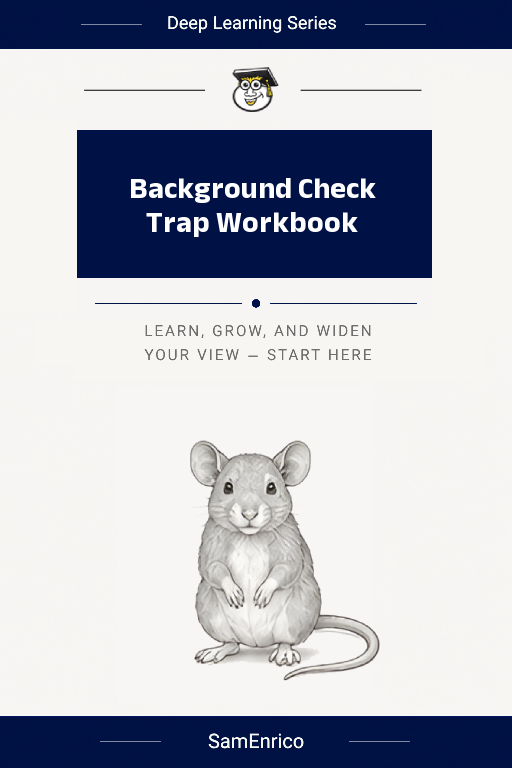
Background Check Trap Workbook eBook
Run compliant background checks including FCRA dis
Run compliant background checks including FCRA disclosure forms, adverse action letters, and ban the box laws for startup first hires.
Formats
Free sample
Chapter 1: The Policy Gap--You just made your first offer to a candidate. They accepted. You’re excited. And now, in the back of your mind, a question starts itching: Should I run a background check?Maybe you’ve already Googled the candidate’s name. Maybe you scrolled through their social media profiles.
Maybe you asked a friend who knows a friend if they’ve “heard anything.” Or maybe you did nothing at all—because you’re a startup founder with no HR department, no legal budget, and no idea where to even start.Here is the truth that no one tells you until it’s too late: Informal background checks carry higher legal risk than doing nothing at all.That’s not a typo. Running a Google search, scrolling through Instagram, or asking an old colleague for “the dirt” on a candidate can expose you to the same liability—sometimes worse—as a formal background check, but without any of the legal protections. And doing nothing at all? That’s a negligence lawsuit waiting to happen.This chapter is not a gentle introduction. It is a call to action.
By the time you finish reading these pages, you will understand exactly why your startup needs a written background check policy, why “just Googling it” is a trap, and how to make the foundational decision that will determine whether your first hire becomes your greatest asset or your most expensive mistake.Let’s start with a story. It’s a true story, though the names have been changed to protect the founder who now wishes they had read this chapter first.The $90,000 Lesson Three years ago, a founder we’ll call Marcus launched a meal delivery startup. He had five employees: himself, two drivers, one kitchen manager, and one customer service lead. Marcus was lean, smart, and moving fast. When he hired his first driver, he didn’t bother with a background check.
The guy had a clean driving record—at least according to his resume—and he seemed trustworthy during the interview.Six months later, that driver ran a red light while delivering $2,000 worth of catering. He hit a family of four. The driver had a suspended license that he had failed to disclose. He also had two previous DUIs that never appeared on his resume or his Linked In profile. The family sued the driver, but the driver had no assets.
So they sued Marcus’s company for negligent hiring.The settlement: $90,000. Marcus’s insurance covered some of it, but his premiums tripled. His reputation took a hit. And he learned the hard way that “trust but verify” is not just a cliché—it’s a legal defense.Now imagine the opposite scenario. Another founder we’ll call Priya ran a background check on every candidate through a legitimate Consumer Reporting Agency (CRA).
She had all the forms: disclosure, authorization, the whole package. But she made a different mistake. When a candidate’s report showed a minor offense from six years ago, Priya sent a one-line email: “Sorry, we’re going with another candidate.” She never sent a pre-adverse action letter. She never gave the candidate a chance to respond. She didn’t know she had to.That candidate sued for FCRA violations.
Statutory damages: 1,000perviolation.Butbecause Priya’semailwasconsidered“willfulnoncompliance”(sheshouldhaveknowntherules),thecourtalsoawardedattorney’sfees:1,000 per violation. But because Priya’s email was considered “willful noncompliance” (she should have known the rules), the court also awarded attorney’s fees: 1,000perviolation.Butbecause Priya’semailwasconsidered“willfulnoncompliance”(sheshouldhaveknowntherules),thecourtalsoawardedattorney’sfees:25,000. Priya lost a quarter of her operating budget on a single hire.These stories share a common thread. In both cases, the founders didn’t have a written policy. They were making decisions on the fly, based on what felt right or what seemed efficient.
And in both cases, the absence of a policy became the centerpiece of the lawsuit.This is why Chapter 1 exists. Before you run a single background check, before you fill out a single form, you need a policy. Not a 50-page legal document. Not something written by a law firm you can’t afford. A practical, one-page decision framework that tells you what to check, when to check it, and how to document your reasoning.Why “Just Googling” Is a Trap Let’s be specific about why Google, social media, and back-channel reference checks are dangerous.
You might think you’re being thorough. You might think you’re saving money. But here’s what the law actually says.When you run a search on Google or scroll through a candidate’s public Instagram feed, you are conducting what the FCRA technically calls “a consumer report” if that information is used to make an employment decision. However—and this is where founders get confused—the FCRA only fully applies if you use a third-party agency. If you do the search yourself, you are not subject to the disclosure and adverse action requirements of the FCRA.
But you are also not protected from negligent hiring lawsuits.Here is the trap: If you find something negative on Google and reject the candidate based on that information, you have no legal defense. You cannot point to a compliant disclosure form. You cannot show that you gave the candidate an opportunity to dispute the information. You cannot demonstrate that you followed “reasonable procedures” as required by law. You are simply a founder who made a decision based on unverified, potentially inaccurate, and possibly discriminatory information.And the information on Google is often wrong.
A 2021 study by the CFPB found that nearly 25% of background reports contained inaccuracies. But at least those reports come with a dispute process. Google search results come with nothing. If you reject a candidate because an old news article popped up—an article that might be outdated, misleading, or completely false—you have no mechanism to correct it. The candidate never knows why they were rejected.
You never document the reason. And if that candidate files a complaint with the EEOC, you have no paper trail to defend yourself.The same logic applies to social media. Did you know that viewing a candidate’s Facebook or Instagram profile can inadvertently expose you to information about their race, religion, disability, or family status? Even if you don’t intend to discriminate, simply knowing that information can be used against you in a disparate treatment claim. A plaintiff’s attorney will ask: “You saw that the candidate was pregnant on her Instagram, and then you rejected her—coincidence?” Without a policy that prohibits reviewing social media, you have no answer.And then there is the friend-of-a-friend back channel.
You ask someone in your network: “Hey, do you know anything about this candidate?” That person tells you a rumor—unverified, maybe even malicious. You rely on that rumor to reject the candidate. That is not a background check. That is hearsay. And it is a lawsuit waiting to happen.The only safe path—the only path that provides both legal protection and accurate information—is to adopt a written policy that specifies exactly how you will conduct background checks, when you will conduct them, and which sources you will use.Negligent Hiring: The Legal Theory That Keeps Founders Up…
This is the end of the free sample. Get the eBook to keep going. Buy now
About this book
Details
- Author
- Culpepper Juli
- Publisher
- SamEnrico
- Language
- English
- Genre
- Non-Fiction, Business Brief, Background Checks
- Released
- 2026-05-30
- Pages (approx.)
- 145
- Available as
- eBook, Audiobook

Read better in the ZLOADR app
Your eBooks on your phone or tablet. Sign in with your SamEnrico account and start reading.
More by Culpepper Juli
 Resistance Band Workout HandbookCulpepper Juli$11.99
 Paleo On A Food Stamp BudgetCulpepper Juli$11.99
 Genetic Testing for Nail DisordersCulpepper Juli$11.99
 The Swingset at DuskCulpepper Juli$11.99
 The Last Breath of a Queen: The Funeral of Cleopatra Selene IICulpepper Juli$11.99
 Frozen Silk: The Lost Medieval Voyagers of AntarcticaCulpepper Juli$11.99
 Ultimate Handbook Guide to Winnipeg : (Canada) Travel GuideCulpepper Juli$11.99
 Understanding Glomerulonephritis Sparse Hair TelangiectasesCulpepper Juli$17.99
 Japanese Chin BreedingCulpepper Juli$11.99
 Fiscal Policy ExcelCulpepper Juli$12.99
You may also like
 Hong Kong Handover 1997Dunn Johnnie$11.99
 Zumba For Postnatal Recovery CourseNeal Christian$11.99
 Zumba for BeginnersLadner Nikia$11.99
 YouTube Comment Mining GuideHumes Pandora$12.99
 Worry Box MeditationCarlin Rudy$11.99
 Workplace Stress MeditationNguyen Lynn$11.99
 Workplace Stress and Sleep RepairHawley Ivory$11.99
 Workplace Perfectionism CureDelaney Jeffry$11.99
 Workplace Injustice Anger GuideWallen Isabelle$11.99
 Work Addiction and Burnout LinkGreenwood Ester$11.99
 Women in Yoga and WellnessBeattie Galina$11.99
 Women in Stand Up ComedyChun Evangeline$11.99