
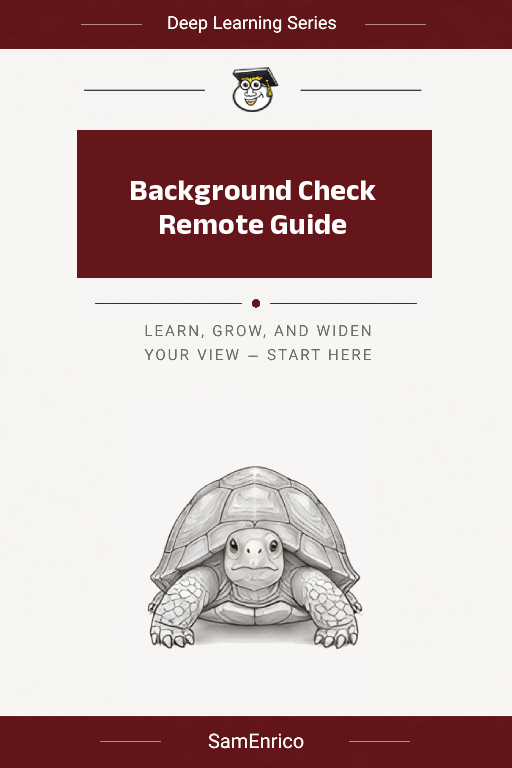
Background Check Remote Guide eBook
Run background checks on remote hires from Kenya,
Run background checks on remote hires from Kenya, Philippines, and Poland. Legal compliance.
Formats
Free sample
Chapter 1: The Broken Promise...--The email arrived on a Tuesday morning, and it changed everything."Dear Client," it began, in the bland, soothing tones that corporate lawyers have perfected over decades of delivering bad news. "Following our recent background check on Candidate #4872 (Poland), we regret to inform you that the report you received on March 15th contained information that may have been incomplete. Specifically, a criminal matter from 2019 in a neighboring jurisdiction was not captured by our global database. We are investigating the root cause and have credited your account $49.95."Forty-nine dollars and ninety-five cents.That was the compensation offered for a mistake that would cost the company over two hundred thousand dollars in legal fees, regulatory fines, and reputational damage over the next eighteen months. The candidate—a seemingly perfect Polish software engineer with impeccable references and a reassuringly clean background check—had been convicted of cyber fraud in a district court outside Warsaw.
The conviction was never recorded in the national register because of a clerical error. But it existed. And it was discoverable. Just not by the "global" background check provider that had promised, in bold letters on their website, "100% Coverage of European Criminal Records."The company had believed that promise. Why wouldn't they?
The provider was accredited. They had logos on their homepage. They charged a premium for their "Global Preferred Plus" package. And they had failed, completely and catastrophically, because they had made the same mistake that thousands of remote-first employers make every single day: they assumed that background checks work the same way everywhere.They do not.This book exists because that assumption—reasonable, intuitive, and absolutely wrong—is quietly bankrupting companies, exposing them to lawsuits they cannot predict, and causing them to reject outstanding candidates while unknowingly hiring serious risks. The tragedy is that almost all of this damage is preventable.
You just need to understand one fundamental truth that the background check industry does not want you to know.The One Truth Your Vendor Will Never Tell You There is no such thing as a global background check.Read that sentence again. Commit it to memory. Write it on a sticky note and attach it to your monitor. Because every single mistake, every lawsuit, every regulatory fine, and every bad hire documented in the pages that follow traces back to a belief in this fictional product category."Global background check" is a marketing term, not a legal or technical reality. It is the background check equivalent of "gluten-free water"—technically true in the narrowest sense, but fundamentally meaningless.
What vendors actually deliver when you purchase a "global check" is one of three things, none of which is what you think you are buying:Option One: The Database Scrape. The vendor maintains a proprietary database of criminal records that they have purchased or aggregated from various sources. They run your candidate's name through this database and return any matches. The problem? No database contains all records.
Poland's national criminal register, for example, is not for sale to commercial vendors. Neither is the Philippines' NBI clearance database. Kenya's DCI records are entirely offline. What vendors sell instead are partial snapshots, often years out of date, from secondary sources.Option Two: The Partner Network. The vendor has a list of local providers in various countries—a freelance researcher in Warsaw, a former police officer in Manila, a data entry clerk in Nairobi.
When you order a check, they email your request to this person, who then manually searches local records. The quality depends entirely on that individual's competence, honesty, and workload on that particular Tuesday afternoon.Option Three: The Good-Faith Effort. The vendor does nothing. They send you a report that says "No records found" based on absolutely no search at all, hoping that nothing will ever surface. This is fraud, plain and simple, but it is distressingly common in the low-cost end of the market.None of these options constitutes a reliable background check.
None of them would satisfy legal requirements in Poland, the Philippines, or Kenya. And yet, thousands of companies rely on these products every single day because the alternative—learning how to actually verify someone in a foreign country—seems impossibly complex.It is not impossible. It is detailed. It is specific. And it is entirely learnable.
But first, you must unlearn everything the "global check" vendors have taught you.The Geography of Information: Why Records Live Where They Live To understand why background checks fail across borders, you need to understand a concept I call the Geography of Information. Simply put: every country decides, through its laws and administrative systems, where criminal, educational, and employment records will be stored, who can access them, and for how long they will be retained. These decisions are not technical. They are political, historical, and cultural. And they vary wildly.Consider three countries that represent the spectrum of record-keeping systems: Poland, the Philippines, and Kenya.Poland operates what I call a Centralized Vault.
The Krajowy Rejestr Karny (National Criminal Register) is a unified, digital database maintained by the Ministry of Justice. If a conviction occurs anywhere in Poland, it is supposed to be recorded in this system. Access is restricted—you cannot simply query it directly—but the existence of a single source of truth means that, in theory, a complete criminal record is knowable. Poland's system reflects its legal tradition: civil law, with a strong state role in maintaining official records, heavily influenced by its membership in the European Union and compliance with GDPR.The Philippines operates a Hybrid Fragmented System. The NBI Clearance provides national-level criminal records, drawing from the National Bureau of Investigation's database.
But this database is not comprehensive. Local police departments maintain their own records at the city and municipal level. And beneath that, the barangay—the smallest administrative unit, sometimes just a single neighborhood—maintains informal records of disputes, mediations, and minor infractions that never reach any national database. The Philippines' system reflects its history: a blend of Spanish civil law, American common law influences, and deeply local governance structures that predate both.Kenya operates a Centralized-but-Opaque System. The Certificate of Good Conduct (CGo C) is issued by the Directorate of Criminal Investigations (DCI) through the Forensic Science Laboratory.
In theory, this is a single national source. In practice, the system is under-resourced, backlogged, and vulnerable to fraud. Unofficial "brokers" offer expedited certificates for a fee, often issuing entirely fabricated documents. The DCI does not maintain a public database or an API for commercial verification. Kenya's system reflects the reality of a rapidly digitizing economy where formal systems exist but informal practices often dominate.These three systems have almost nothing in common.
A background check process that works for a Polish candidate will fail completely for a Filipino candidate, and vice versa. Yet most "global" providers apply the same methodology to all three countries: run a name through a database, return a result, collect a fee.This is not background checking. This is gambling with other people's money.The Resume Gap: When Work History Becomes a Black Hole There is a second problem that compounds the Geography of Information, and it is one that few employers anticipate. I call it…
This is the end of the free sample. Get the eBook to keep going. Buy now
About this book
Details
- Author
- Mahaffey Lupe
- Publisher
- SamEnrico
- Language
- English
- Genre
- Non-Fiction, Business Brief, Global Talent Guide
- Released
- 2026-05-29
- Pages (approx.)
- 160
- Available as
- eBook, Audiobook

Read better in the ZLOADR app
Your eBooks on your phone or tablet. Sign in with your SamEnrico account and start reading.
More by Mahaffey Lupe
 Stair Climbing LongevityMahaffey Lupe$11.99
 Mindful Walking For Weight LossMahaffey Lupe$11.99
 ABCDE For Remote WorkersMahaffey Lupe$11.99
 Coros Apex 2 Sleep GuideMahaffey Lupe$11.99
 The Black Dahlia Lesley Dillon TheoryMahaffey Lupe$11.99
 The Ghosts of Shiroyama: Saigō Takamori's Last StandMahaffey Lupe$11.99
 How to Become a Ornamental-metal-worker HelperMahaffey Lupe$11.99
 Understanding Rhabdomyosarcoma, AlveolarMahaffey Lupe$17.99
 Maintenance Team LeadMahaffey Lupe$11.99
 Emergency Services for StudentsMahaffey Lupe$12.99
You may also like
 Poland Remote Hiring PlatformsHimes Velva$12.99
 Time Zone Management GuideRickman Kandi$12.99
 Tech Talent Comparison GuideEarle Rudolf$12.99
 Salary Comparison Kenya Philippines PolandVanwinkle Shin$12.99
 Remote Turnover Prevention GuideCulpepper Jeniffer$12.99
 Remote Scaling Strategy GuideLavoie Freeman$12.99
 Remote Hiring in Kenya Philippines Poland GuideForman Sharika$12.99
 Poland Remote Talent GuideCordes Deandre$12.99
 Performance Management GuideMccray Lecia$12.99
 NDA Remote Hiring GuideDuarte Felisa$12.99
 Legal Hiring Guide ComparisonBolden Gabriel$12.99
 Kenya Remote Hiring PlatformsWilloughby Cortney$12.99