
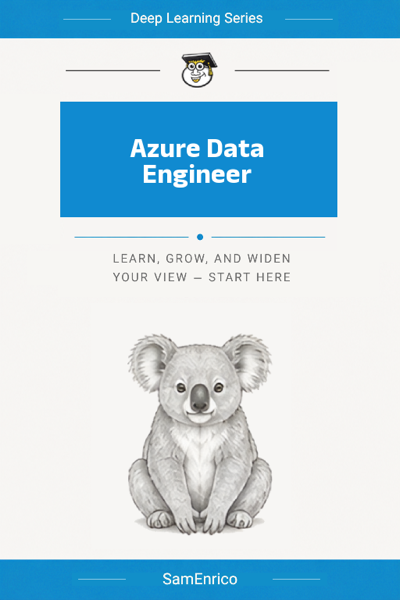
Azure Data Engineer eBook
A Coursebook on Azure Data Engineer
A Coursebook on Azure Data Engineer
Formats
Free sample
Chapter 1: The Mapping of The Unseen--The first time you hear the title “Azure Data Engineer,” you might imagine someone hunched over a terminal, typing cryptic commands into a black screen while blinking cursors promise power and mystery. That image isn’t entirely wrong, but it misses something far more important. Data engineering is not about the tools. It is not about the certifications, the cloud providers, or even the code. Data engineering is the discipline of making the invisible visible.
It is the craft of taking raw, chaotic, and often ugly information—log files from a failing server, clickstreams from a confused user, sensor readings from a factory floor—and transforming that chaos into something a business can trust, a dashboard can render, and a decision-maker can act upon.This book is not a dry reference manual. It is a field guide. It assumes you are smart, ambitious, and perhaps a little impatient. You want to understand not just what an Azure Data Engineer does, but why the role exists, why it has become one of the most sought‑after positions in technology, and why you—yes, you—can master it even if you are starting with nothing more than curiosity and a free Azure account.Before we touch a single service, before we write a line of code, we must answer three foundational questions. First, what exactly is data engineering, and how does it differ from the more glamorous roles of data scientist and data analyst?
Second, why did the industry abandon the old ways of moving data—those fragile, expensive ETL pipelines of the past—and embrace a radically different approach in the cloud? And third, what are the essential pieces of the Azure data platform, and how do they fit together to form something greater than the sum of their parts?By the end of this chapter, you will not only be able to answer those questions in an interview, but you will also have built your first tiny piece of Azure infrastructure. You will have created something real. And along the way, you will internalize a truth that separates junior engineers from those who get promoted: technology is only ever a means to an end. The end is always the same—trustworthy data, delivered reliably, at the right time.The Great Confusion: Data Engineer vs.
Data Scientist vs. Data Analyst Walk into any technology company, and you will hear these three titles thrown around as if they were interchangeable. They are not. The confusion is understandable; the boundaries blur in practice, especially in smaller organizations where one person wears multiple hats. But for your career, and for passing certification exams, you need crisp mental models.Let us start with the simplest role: the Data Analyst.A data analyst answers known questions.
The business already understands what it wants to measure—monthly sales by region, customer churn rate, inventory turnover—and the analyst writes SQL queries, builds dashboards in Power BI or Tableau, and produces reports. The analyst works with data that has already been cleaned, aggregated, and stored. Their primary tools are query languages and visualization platforms. They rarely touch raw logs or build pipelines from scratch. Their value comes from speed and clarity: turning data into insight as quickly as possible.Now consider the Data Scientist.A data scientist answers unknown questions.
The business might not even know what to ask. The scientist explores data looking for patterns, builds predictive models, runs A/B tests, and deploys machine learning algorithms. The scientist uses Python or R, works with libraries like scikit‑learn, Tensor Flow, or Py Torch, and cares deeply about statistical significance and model accuracy. A data scientist can work with messy data—in fact, they often spend 80% of their time cleaning it—but that is not their primary skill. Their primary skill is inference: drawing conclusions from data that are both novel and reliable.And then there is the Data Engineer.The data engineer builds and maintains the infrastructure that makes both of the above roles possible.
Without the engineer, the analyst has nothing to query, and the scientist has nothing to model. The engineer ingests data from dozens or hundreds of source systems: relational databases, Saa S applications, Io T devices, flat files on FTP servers, APIs that change without warning. The engineer cleans, validates, and transforms that data at scale, handling terabytes or petabytes. The engineer ensures that the data is fresh—whether that means every minute or every day—and that it is secure, compliant with regulations like GDPR or HIPAA, and available when promised.The data engineer’s primary tools include cloud services (Azure Data Factory, Databricks, Synapse Analytics), programming languages (SQL, Python, Scala), and a deep understanding of distributed systems. The data engineer worries about partitions, watermarks, and idempotency.
The data engineer loses sleep over late‑arriving data and schema drift.Here is the simplest way to remember the difference:Analyst: “What happened last quarter?”Data Scientist: “What will happen next quarter?”Data Engineer: “How do we make sure the data is there so both of you can answer your questions?”In an interview, if someone asks you the difference, do not just recite definitions. Tell a story. Say this: “The Data Engineer builds the kitchen, installs the ovens, and manages the supply chain. The Data Scientist is the head chef who creates new recipes. The Data Analyst is the line cook who prepares the daily specials.
All three are essential. But without the kitchen, no one eats.”The Shift That Changed Everything: From ETL to ELTIf you have been anywhere near data engineering for more than a few months, you have heard the acronyms ETL and ELT. They sound similar, but the difference is not academic—it represents one of the most fundamental shifts in how we process data, and understanding it will explain almost every design decision you will make in Azure.ETL stands for Extract, Transform, Load. It was the dominant pattern in the on‑premise era. Here is how it worked: you extracted data from a source system (say, an Oracle database), transformed it on a separate server (often an expensive ETL appliance from Informatica or Data Stage), and then loaded the transformed result into a data warehouse.
The transformation step happened before loading.Why? Because storage was expensive. On‑premise storage arrays cost thousands of dollars per terabyte. You could not afford to store raw data in your warehouse; you only stored aggregated, cleaned, ready‑to‑use data. Transforming before loading also reduced the processing load on the warehouse, which was itself expensive hardware.But ETL had a fatal flaw: the transformation logic was fixed at design time.
If you forgot a column, mis‑understood a field, or the business asked a new question, you had to re‑engineer the entire pipeline. Worse, you had to re‑extract and re‑transform everything, which could take days. ETL was rigid, slow to change, and punishingly expensive for large volumes.ELT flips the script. Extract, Load, Transform. You extract data from the source, you load it immediately into a data lake or warehouse, and then you transform it.
The transformation happens after loading, directly on the target system.ELT became possible because of two trends that define the cloud…
This is the end of the free sample. Get the eBook to keep going. Buy now
About this book
Details
- Author
- Boatwright Tilda
- Publisher
- SamEnrico
- Language
- English
- Genre
- Non-Fiction, Informative, Educational
- Released
- 2026-05-09
- Pages (approx.)
- 148
- Available as
- eBook, Audiobook

Read better in the ZLOADR app
Your eBooks on your phone or tablet. Sign in with your SamEnrico account and start reading.
More by Boatwright Tilda
 The Not-To-Do List for InterruptionsBoatwright Tilda$11.99
 Self Esteem For IntrovertsBoatwright Tilda$11.99
 Pattern Recognition DrillsBoatwright Tilda$11.99
 Geo Arbitrage for FreelancersBoatwright Tilda$11.99
 Napoleonic Wars Complete GuideBoatwright Tilda$11.99
 Anger in Parenting GuideBoatwright Tilda$11.99
 Stress Incontinence GuideBoatwright Tilda$11.99
 Postpartum Anxiety Relief GuideBoatwright Tilda$11.99
 Divorce Wars Child Survival GuideBoatwright Tilda$11.99
 The Blood of the Warring States: Sun Tzu's Shadow and the Birth of StrategyBoatwright Tilda$11.99
 The Whispering Harp of the SelkiesBoatwright Tilda$11.99
 The Vanishing Hitchhiker: A Modern Myth RebornBoatwright Tilda$11.99