
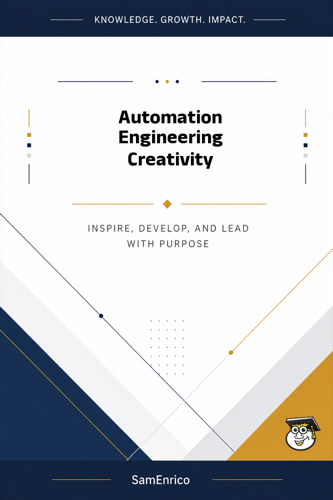
Automation Engineering Creativity eBook
Generate novel control systems and process automat
by Battle Kirby
Generate novel control systems and process automation solutions.
Formats
Free sample
Chapter 1: The Automation Paradox--–- In 2019, a chemical plant in Louisiana experienced a $47 million unplanned shutdown. The root cause was not a failed valve, a cyberattack, or an operator error. The root cause was a perfectly functioning PID controller that did exactly what it was told to do. The problem was what the engineers had not told it to do.The plant manufactured a specialty polymer used in medical devices. For fifteen years, the process had run smoothly.
Then, gradually, a quality problem emerged: intermittent off-spec batches that passed initial testing but failed in the field. The investigation took nine months. Eventually, the team discovered that a small temperature oscillation in a reactor jacket—well within specification, never triggering an alarm—was causing a subtle change in polymer chain length. The PID controller was doing its job perfectly. It was maintaining temperature at setpoint within ±0.5 degrees.
The problem was that the setpoint itself was wrong for certain raw material batches, and the controller had no way of knowing that because no one had thought to feed it batch-specific setpoint targets.The engineers had solved the wrong problem. They had optimized for temperature stability when they should have optimized for batch consistency.This is the Automation Paradox: The safer and more reliable an industrial process becomes, the more difficult it becomes to recognize when safety and reliability are being achieved at the expense of something more important. The very tools that make automation robust—standards, proven loops, legacy code, conservative engineering practices—are the same tools that calcify thinking. They create a cognitive cage. Inside that cage, engineers become exquisitely skilled at solving the wrong problems faster and more precisely than anyone else in the world.This book exists to break you out of that cage.What This Chapter Will Do For You By the end of this chapter, you will:Understand five hidden assumptions buried in every control textbook you have ever read Learn the "Reframing Funnel"—a four-step method for questioning those assumptions Complete a Creativity Audit that diagnoses where your own thinking has become mechanically repetitive Recognize the difference between first-order problems (improving the existing solution) and second-order problems (questioning whether the problem itself is correct)You will not need any special software, hardware, or mathematical background for this chapter.
You will need only a willingness to question things you have been trained to accept as true.The Seduction of Technical Excellence Let us begin with an uncomfortable truth: You are very good at being told what to do. This is not an insult. It is the result of rigorous engineering education and professional practice. Every control system textbook, every training course, every mentor has taught you the same implicit workflow:Given a process with certain characteristics, design a controller that meets specified performance criteria.The problem is given. The criteria are given.
Your job is to execute.This workflow produces excellent engineers. It produces reliable, safe, cost-effective automation. It also produces something else: a gradual atrophy of the muscle that asks "Is this the right problem in the first place?"Consider the typical career trajectory of an automation engineer. In your first year, you are assigned to tune loops that someone else designed. You learn to interpret step tests, calculate gains, and apply rules of thumb.
In years two through five, you design new loops for unit operations that have been built the same way for decades. You become proficient at cascade control, feedforward, ratio control, and perhaps basic MPC. By year ten, you are leading projects. You specify control narratives, select instrumentation, and supervise commissioning. At every stage, the fundamental structure of the problems you solve remains the same: a process, a desired outcome, a controller.But when did anyone last ask you: "What would this process look like if we eliminated the variable you are trying to control?"Almost never.
Because that question is not part of standard engineering practice. It is part of creative engineering practice—and creative engineering practice is not taught.The Five Hidden Assumptions of Standard Control Textbooks Every control textbook you have ever studied rests on five hidden assumptions. These assumptions are rarely stated explicitly, but they shape every design decision you make. To become a creative automation engineer, you must learn to see these assumptions for what they are: choices that can be questioned, challenged, and sometimes rejected.Assumption 1: Linearity Most control theory assumes that cause and effect are proportional. Double the input, double the output.
Halve the input, halve the output. This assumption is so deeply embedded that PID controllers are literally built around it (the "P" stands for proportional).But real processes are rarely linear. Valves have deadbands and saturation. Reactions have thresholds and tipping points. Temperature-dependent properties change with operating conditions.
The assumption of linearity is a convenience, not a truth.The reframing question: What would happen if I deliberately designed for nonlinearity instead of fighting it?Assumption 2: Stationarity Stationarity means that the process behaves the same way today as it will tomorrow and next week. The transfer function is fixed. The time constants are constant. The gains are gains.In reality, processes drift. Heat exchangers foul.
Catalysts deactivate. Sensors age. Raw material properties vary. The assumption of stationarity allows you to tune a controller once and forget it—but it also blinds you to the possibility of controllers that adapt, learn, or anticipate drift.The reframing question: What would this controller look like if it expected the process to change?Assumption 3: Known Disturbances Standard control theory assumes that you know what disturbances will affect your process. You measure them or you model them.
Feedforward control, in particular, depends on measuring disturbances before they affect the process.But the most damaging disturbances are often the ones you did not anticipate. The subtle temperature oscillation in the Louisiana plant. The batch of raw material with slightly different viscosity. The maintenance technician who replaced a sensor with a different model. Unknown unknowns dominate real-world failures.The reframing question: How can I design for disturbances I cannot predict?Assumption 4: Perfect Measurement Every control loop assumes that the sensor reading corresponds to the actual process variable.
This is never true. Sensors have accuracy limits, drift, noise, and lag. Transmitters introduce scaling errors. Analog-to-digital converters quantize. Yet the entire edifice of feedback control rests on the assumption that you know where you are.The reframing question: What if I treated sensor error as a signal rather than noise?
(We will devote an entire chapter—Chapter 4—to this question.)Assumption 5: Fixed Objectives Perhaps the most consequential hidden assumption is that the control objective is fixed. You are told to maintain level, temperature, pressure, or flow at a setpoint. You design for that setpoint. But what if the setpoint itself is wrong? What if the objective should change based on upstream conditions, downstream demand, or economic factors?The reframing question: What is the actual goal behind the setpoint, and could it be achieved differently?The Reframing Funnel: A Four-Step Method Reframing is the core creative skill for automation engineers.
It is the ability to step back from a given problem and ask whether it is the right problem to solve. The Reframing Funnel…
This is the end of the free sample. Get the eBook to keep going. Buy now
About this book
Details
- Author
- Battle Kirby
- Publisher
- SamEnrico
- Language
- English
- Genre
- Non-Fiction, Self-Help, Automation Engineering
- Released
- 2026-06-10
- Pages (approx.)
- 159
- Available as
- eBook, Audiobook

Read better in the ZLOADR app
Your eBooks on your phone or tablet. Sign in with your SamEnrico account and start reading.
More by Battle Kirby
 Nutrition for Brain RecoveryBattle Kirby$11.99
 The Struggle Is Data GuideBattle Kirby$11.99
 Fluency Persuasion TechniqueBattle Kirby$11.99
 The Italian Longevity DietBattle Kirby$11.99
 The Silent Senator: The Untold Story of Hiram Rhodes RevelsBattle Kirby$11.99
 Customer Engagement ManagerBattle Kirby$11.99
 YC African Startup Pitch DeckBattle Kirby$12.99
 VAT Automation ToolsBattle Kirby$12.99
 Understanding Tuberculous MeningitisBattle Kirby$17.99
 How to Start a Camels (dromedary) Raising and Breeding Business (Beginners Guide)Battle Kirby$11.99