
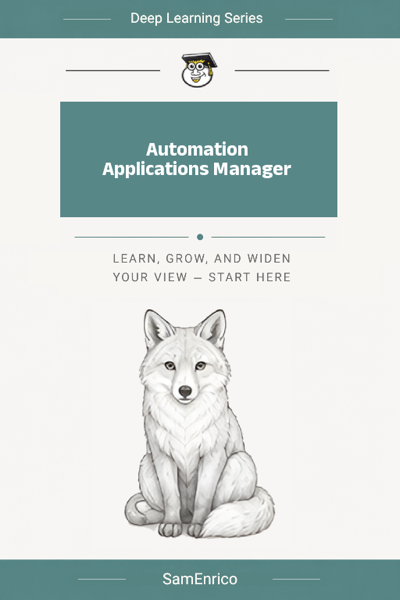
Non-FictionInformativeEducational
Automation Applications Manager eBook
A Coursebook on Automation Applications Manager
by Case Paulina
A Coursebook on Automation Applications Manager
Formats
Free sample
Chapter 1: The Broken Bridge--–- Every morning, Maria—a fifteen-year veteran of operations at a mid-sized logistics firm—would open seventeen different browser tabs, log into four separate systems, copy customer addresses from an email, paste them into a shipping portal, verify billing codes against a spreadsheet she maintained manually, and then repeat the entire process for the next order. She was good at her job. Fast, even. But by 10:00 AM, she was already exhausted.Across the building, in a windowless room filled with humming servers, David—a senior IT administrator—was troubleshooting a database deadlock that had slowed down the company’s ERP system. He had never met Maria.
He did not know her workflow existed. And when someone from operations emailed him asking for “a script to make things faster,” he usually replied with a link to the IT request portal, where requests aged quietly for six months before being rejected due to “insufficient business justification.”This scene, repeated in thousands of organizations worldwide, captures the fundamental problem that this book exists to solve. The gap between operations (who understand the work) and IT (who control the systems) has become the single largest barrier to effective automation. And bridging that gap is the job of the Automation Applications Manager.The Collapse of Two Worlds For decades, the division of labor was clear and, for the most part, functional. Operations managers focused on people, processes, and productivity.
They managed training schedules, shift rotations, quality metrics, and customer satisfaction scores. Technology was something they used—spreadsheets, email clients, maybe a CRM—but not something they built or owned.IT departments, meanwhile, owned the infrastructure, the applications, and the security. They managed servers, databases, network switches, and help desk tickets. They wrote code, applied patches, and occasionally—when business priorities aligned—delivered a new system after an eighteen-month development cycle.This separation worked reasonably well in an era of monolithic systems and waterfall software delivery. Operations would request a feature.
IT would spend a year building it. Operations would complain it didn’t quite work. IT would spend another six months fixing bugs. Everyone accepted this as normal.Then everything changed.The Rise of RPAAround 2015, robotic process automation (RPA) emerged as a disruptive force—not because the technology was particularly sophisticated, but because it broke the IT monopoly on automation. For the first time, a business user could record a series of clicks, generate a script, and automate a repetitive task without writing a single line of code or submitting a formal IT request.RPA tools worked at the user interface level.
They mimicked human interactions: typing into fields, clicking buttons, reading screens, copying data. They did not require APIs, database access, or IT approval in many cases. An operations analyst could build a bot on their own workstation and schedule it to run overnight.This democratization of automation was both a liberation and a menace. The liberation was obvious: automation finally became accessible to the people who understood the work. The menace was equally obvious: without governance, without standards, without coordination, these grassroots automations became a sprawling, unmanageable mess.The Shadow Automation Crisis In one financial services company I studied, a junior analyst built a script that automated a daily reconciliation report.
It worked beautifully. He named it “recon_final_v3_FINAL.xlsm” and set it to run every morning at 6 AM. Two years later, that same script was still running—but nobody remembered exactly what it did, why it needed access to customer account numbers, or who was responsible if it failed. When an auditor asked for documentation, the company could not produce any. The script was summarily shut down, and three downstream processes broke simultaneously.This is shadow automation.
It is the automation equivalent of shadow IT—unapproved, undocumented, ungoverned, and dangerously pervasive. In many organizations, the number of unauthorized automations exceeds authorized ones by a factor of three or more.The problem is not that these automations are malicious. They are not. They are almost always built by well-intentioned employees trying to do their jobs more efficiently. The problem is that they are built in isolation, without regard for security, compliance, maintainability, or integration with other systems.The Automation Applications Manager as Bridge Enter the Automation Applications Manager.
This role—still emerging, still poorly defined in many organizations—represents a fundamental shift in how companies organize for automation. The Automation Applications Manager is neither purely an operations role nor purely an IT role. It is a hybrid position that sits at the intersection of business process, technology infrastructure, and human change management.What does an Automation Applications Manager actually do? The short answer is everything across the full lifecycle of an automated process: identifying opportunities, building business cases, selecting tools, designing workflows, overseeing development, managing exceptions, ensuring compliance, training users, and retiring automations when they outlive their usefulness.The longer answer requires the entirety of this book. But the core idea is simple: someone must own the end-to-end responsibility for automation assets, treating them not as one-off scripts but as a portfolio of digital workers that require the same discipline as human employees—recruitment, training, performance management, and eventual retirement.A Day in the Life To make this concrete, consider a typical day for Priya, an Automation Applications Manager at a mid-sized insurance company.8:00 AM: Priya checks the bot monitoring dashboard.
Overnight, three unattended bots processed 1,200 claims. Two bots failed—one due to a UI change in the legacy claims system (the vendor pushed an update without notice), and one due to an invalid data format in an incoming file. Priya triages the failures: the UI change requires a code fix (escalated to a developer); the invalid data requires the sender to correct their file (escalated to operations).9:30 AM: She facilitates the weekly Demand Review Board meeting. Operations leaders present five potential new automations. Using a prioritization scorecard (value, complexity, risk, strategic alignment), the board approves two, rejects one, and asks for more data on two others.11:00 AM: Priya meets with the compliance officer to review audit logs.
A bot that accesses customer addresses has been flagged because its credential rotation is overdue. She initiates the rotation process and updates the bot’s runbook.1:00 PM: She conducts a training session for operations staff on how to monitor bots and handle simple failures. The goal is to shift Level 1 support from IT to operations, reducing mean time to resolution.3:00 PM: A capacity planning review. The claims bots are approaching their concurrent execution limit. Priya models two scenarios: adding more licenses (short-term) vs.
refactoring the process to be more efficient (long-term). She presents both to leadership with cost projections.5:00 PM: She reviews a post-mortem from last week’s major outage, where a database lock caused 47 bot failures. The root cause was a missing retry mechanism. The fix has been implemented and tested. Priya closes the incident.This is not a job about writing code.
It is a job about orchestration, governance, strategy, and resilience. Technical skills help, but they are secondary to systems thinking, communication, and risk management.The Automation Maturity Curve Not every organization is ready for a dedicated Automation Applications Manager. The right time depends on where the…
This is the end of the free sample. Get the eBook to keep going. Buy now
About this book
Details
- Author
- Case Paulina
- Publisher
- SamEnrico
- Language
- English
- Genre
- Non-Fiction, Informative, Educational
- Released
- 2026-05-09
- Pages (approx.)
- 142
- Available as
- eBook, Audiobook

Read better in the ZLOADR app
Your eBooks on your phone or tablet. Sign in with your SamEnrico account and start reading.
More by Case Paulina
 Hybrid India Jamaica Support PlanCase Paulina$11.99
 Interruption Logging And Analysis CourseCase Paulina$11.99
 Chemistry Essay Prompt GuideCase Paulina$11.99
 Divorce and Mediation GuideCase Paulina$11.99
 The Baal Shem Tov Mystical LifeCase Paulina$11.99
 The Shadow Over Nairobi: The Psychological Profile of a Presidential AssassinCase Paulina$11.99
 Understanding Platelet DisorderCase Paulina$17.99
 Wave Reconciliation GuideCase Paulina$12.99
 Healthcare IT M&A GuideCase Paulina$12.99
 How to Start a Telephone Answering Service BusinessCase Paulina$11.99
You may also like
 Hong Kong Handover 1997Dunn Johnnie$11.99
 Zumba For Postnatal Recovery CourseNeal Christian$11.99
 Zumba for BeginnersLadner Nikia$11.99
 YouTube Comment Mining GuideHumes Pandora$12.99
 Worry Box MeditationCarlin Rudy$11.99
 Workplace Stress MeditationNguyen Lynn$11.99
 Workplace Stress and Sleep RepairHawley Ivory$11.99
 Workplace Perfectionism CureDelaney Jeffry$11.99
 Workplace Injustice Anger GuideWallen Isabelle$11.99
 Work Addiction and Burnout LinkGreenwood Ester$11.99
 Women in Yoga and WellnessBeattie Galina$11.99
 Women in Stand Up ComedyChun Evangeline$11.99