
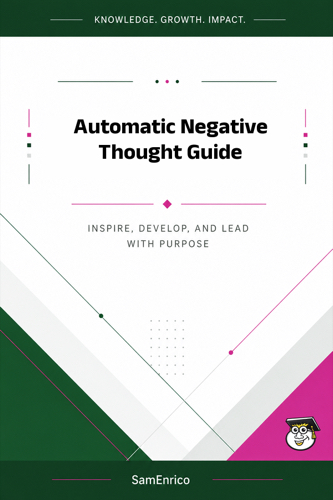
Automatic Negative Thought Guide eBook
Catch the rapid angry thoughts that flare before y
Catch the rapid angry thoughts that flare before you can stop them.
Formats
Free sample
Chapter 1: The 0.3 Second Betrayal--You are not a hothead. You are not a rage addict. You are not a bad person who loses control because of a character flaw.You are someone whose brain is doing exactly what it evolved to do—except it is doing it too fast, in the wrong situations, and with consequences that leave you bewildered and ashamed. The anger that explodes out of you before you can catch it is not a moral failure. It is a neurobiological event.
And once you understand that, everything changes.This chapter is called The 0.3 Second Betrayal because that is what is happening inside your skull. In less time than it takes to blink, your brain decides that a threat is present, floods your body with survival chemicals, and prepares you to fight—all before your conscious mind even knows something happened. Your own brain betrays you by acting on information it hasn't fully processed. And by the time you realize you are angry, you may have already said something you cannot take back.Let me tell you about Jen.Jen is a forty-two-year-old marketing director, married for fifteen years, mother of two children aged nine and twelve. By every external measure, she has a good life.
She is successful, loved, and competent. But Jen has a problem that she has spent years trying to hide and fix and pray away. Several times a week—sometimes several times a day—something small happens, and within one second, she is shouting. The shouting lasts maybe ten seconds. Then comes the shame, which lasts for hours.Last month, her twelve-year-old daughter asked for help with a math problem while Jen was trying to finish a work email.
Jen snapped: "Can't you see I'm working? Why do you always interrupt me?" Her daughter's face crumpled. Jen felt the familiar hot flush of regret spreading across her chest. She apologized. But the damage was done—not because one sentence destroys a relationship, but because this was the thirty-seventh time this year.Jen came to therapy saying, "I don't recognize myself.
I'm not an angry person. So why do I keep acting like one?"The answer is not that Jen has an "anger problem." The answer is that Jen has a flare problem. And a flare is very different from chronic anger.What a Flare Is (And What It Is Not)Let me draw a sharp line between two experiences that most people confuse.A simmering resentment is a slow-burn grievance that lasts hours or days. It involves rumination, storytelling, and a gradual buildup. You replay the offense in your mind.
You imagine what you should have said. You text a friend to get validation. Simmering resentment is uncomfortable, but it gives you time to think. You can feel it coming. You can choose to walk away, talk it out, or let it go—not easily, but possible.A flare is different.
A flare is sudden, hot, and explosive. It lasts seconds to a few minutes. It happens before you have time to think. It is not preceded by a buildup. It arrives like a thunderclap.
And it is responsible for almost all of the impulsive damage in relationships—the sentence spoken that you would give anything to unsay, the door slammed that cracks the frame, the look of confusion on a child's face when they do not understand why Mommy is yelling about juice.Jen does not have a simmering resentment problem. She has a flare problem. And the tools that work for chronic anger—journaling, communication skills, couples therapy—often fail for flares because they assume you have time to use them. When a flare hits, you have no time.This book is for people with flare problems. It will not teach you to never feel anger again.
That is impossible and undesirable. It will teach you to catch the flare in the three seconds after it starts—and to rewire your brain so flares happen less often and end more quickly.The Neuroscience of the 0.3 Second Betrayal To understand why flares happen, you need to understand a small almond-shaped cluster of neurons deep inside your brain called the amygdala.The amygdala is your brain's threat-detection system. It is ancient, fast, and dumb. It does not think. It reacts.
Millions of years ago, the amygdala kept your ancestors alive by detecting a rustle in the bushes and triggering a full fight-or-flight response before the conscious brain finished asking, "Is that a predator or just the wind?" The ones who waited to think got eaten. The ones who reacted first survived.Here is the problem. Your amygdala cannot tell the difference between a saber-toothed tiger and your spouse rolling their eyes. It cannot distinguish between a physical threat to your body and a social threat to your reputation. It reacts to disrespect the same way it reacts to a falling rock—with a massive release of cortisol, adrenaline, and norepinephrine.The timeline is brutal.
From the moment the trigger occurs to the moment your body is flooded with stress hormones: less than 300 milliseconds. That is 0.3 seconds. That is faster than conscious thought. That is faster than you can say the word "calm."By the time you become aware that you are angry—by the time you feel the heat in your face or the tightness in your jaw—the amygdala has already hijacked your nervous system. Your prefrontal cortex, the rational part of your brain that makes plans and considers consequences, is completely offline for three to six seconds.
It does not get a vote. It does not even get a seat at the table.This is the betrayal. Your brain acts on incomplete information. It assumes the worst. It prepares for war.
And by the time your prefrontal cortex comes back online, you may have already declared war on someone who did not deserve it.Why Positive Thinking Fails During a Flare There is a popular myth that if you just think positive thoughts, you will not get angry. This myth has ruined countless lives.Positive thinking works for low-stakes, low-speed emotional events. If you are feeling mildly anxious about a presentation, telling yourself "I am prepared and capable" can help. If you are feeling lonely on a Sunday afternoon, reminding yourself of your friendships can shift your mood.But during a flare, telling yourself "just be calm" or "look on the bright side" is like trying to reason with a fire alarm. The alarm is not listening.
It is doing its job—screaming. And screaming at the alarm to be quiet only makes things worse.Here is what actually happens when you try positive thinking during a flare. Your amygdala is already firing. Your body is already flooded with cortisol. Your rational brain is offline.
And then you add a layer of self-criticism: "Why can't I just calm down? What's wrong with me? Everyone else can handle this. I'm broken." This self-criticism is processed by the amygdala as another threat—a threat from yourself. So the amygdala fires again.
The flare gets worse.This is why so many people with flare problems also have shame problems. They try to use positive thinking, it…
This is the end of the free sample. Get the eBook to keep going. Buy now
About this book
Details
- Author
- Mercado Janell
- Publisher
- SamEnrico
- Language
- English
- Genre
- Non-Fiction, Self-Help, Automatic Thoughts
- Released
- 2026-06-08
- Pages (approx.)
- 125
- Available as
- eBook, Audiobook

Read better in the ZLOADR app
Your eBooks on your phone or tablet. Sign in with your SamEnrico account and start reading.
More by Mercado Janell
 Body Scan For DialysisMercado Janell$11.99
 Blue Collar Work AddictionMercado Janell$11.99
 Sumatra Jungle Survival LeaderMercado Janell$11.99
 Domestic Violence Advocate StressMercado Janell$11.99
 Self Esteem For Post Burn Scar RecoveryMercado Janell$11.99
 Creative Block Breaking GuideMercado Janell$11.99
 Real World ImpactMercado Janell$11.99
 Charlemagne's Dream: The Carolingian Renaissance AwakensMercado Janell$11.99
 The Forgotten Philanthropist: How a 19th-Century Tea Merchant Secretly Funded a RevolutionMercado Janell$11.99
 The Smiths: Romance and ResistanceMercado Janell$11.99
 Growing CyathodesMercado Janell$11.99
 Appointment Booking Systems for BusinessesMercado Janell$11.99