
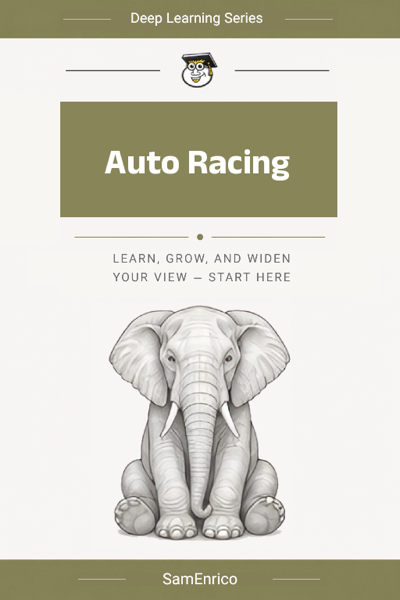
Non-FictionInformativeEducational
Auto Racing eBook
A Coursebook on Auto Racing
by Serna Lera
A Coursebook on Auto Racing
Formats
Free sample
Chapter 1: Two Births, One Sport...--Two origin stories compete for the soul of auto racing. One begins in champagne-soaked drawing rooms, where aristocrats wagered entire fortunes on which French automobile could survive a public road from Paris to Rouen. The other begins in moonlit Appalachian hollows, where bootleggers in modified Fords outran federal agents with whiskey in the trunk and terror in their throats. These two births could not be more different. One is a story of leisure, privilege, and the pursuit of glory.
The other is a story of necessity, rebellion, and the pursuit of survival. Yet together, they created the most contradictory, thrilling, and brutally honest sport on earth.The question this chapter answers is deceptively simple: Why does auto racing exist? Not how—the mechanics of engines and tires belong to later chapters. But why? What human impulse, what cultural pressure, what economic force pushed the first two cars to line up next to each other and agree to see which was faster?
The answer, it turns out, is not one thing. Racing was not invented. It was birthed twice, in two different places, for two different reasons, by two different classes of people who would have despised each other if they had ever met. And that contradiction—the tension between the gentleman driver and the outlaw mechanic—has never left the sport.Understanding this duality is the first step to understanding everything else. The driver who risks everything for a corner, the engineer who stays awake for thirty-six hours chasing a tenth of a second, the team principal who begs a sponsor for one more season, the fan who paints their face in colors that mean nothing outside the track gates—all of them are acting out scripts written in those two origin stories.
This chapter tells both stories, shows how they collided, and reveals why the outlaw spirit still survives in modern racing's most unexpected places.The European Birth: Aristocrats, Wagers, and the Pursuit of Glory The first organized automobile race in history took place on July 22, 1894, between Paris and Rouen, a distance of approximately 126 kilometers. But to understand why that race happened, we must go back further—to the culture of the French Belle Époque, the "Beautiful Era" between the Franco-Prussian War and World War I, when industrial progress was worshipped like a religion and the automobile was its most sacred idol.In the 1880s and early 1890s, automobiles were not machines. They were experiments. Wealthy Frenchmen—counts, barons, and industrial heirs—competed to build the most reliable "horseless carriage." These vehicles were absurdly primitive by modern standards: tiller steering, solid rubber tires, engines that shook violently and overheated after twenty minutes. But to the aristocrats who built them, each car was a statement of personal genius.
They were not engineers by training. They were romantics who believed that French engineering could conquer any frontier.The Paris-Rouen race was not originally called a race. The organizing newspaper, Le Petit Journal, described it as a "competition for horseless carriages" with the stated goal of proving that automobiles were "safe, convenient, and economical." The subtext, of course, was competition. The newspaper offered a prize of 5,000 francs—enough money to buy a small house—to the driver whose car best combined speed, safety, and low operating cost. One hundred two vehicles registered.
Only twenty-one actually started. The winner, a Peugeot driven by Albert Lemaître, completed the course in just under seven hours, averaging about 12 miles per hour.What made Paris-Rouen significant was not the speed. It was the culture that produced it. The drivers were almost all wealthy amateurs—men who raced for honor, not income. They wore suits and ties under their driving goggles.
They brought their wives and mistresses to the starting line. They treated mechanical breakdowns as character tests, not engineering failures. This was the birth of the "Gentleman Driver," a figure who would dominate European racing for its first three decades.The Gentleman Driver Ethos The Gentleman Driver operated on a simple set of unspoken rules. First, racing was a hobby, not a profession. To accept money for driving was to admit that you were not truly a gentleman.
This created a bizarre class dynamic: the best drivers in Europe were often the richest men, not the most talented. They could afford to buy the best cars, hire the best mechanics, and spend entire summers traveling from race to race while their estates were managed by others.Second, danger was not something to be managed but something to be endured with stoic grace. Early races were brutally lethal. Crashes were common. Fires were frequent.
Spectators were routinely killed by cars that left the road. But the Gentleman Driver did not complain. He did not demand safety improvements. He accepted death as the price of admission to a sport that proved his courage. This is a theme that will reappear throughout this book—the strange romance of mortal risk—and it begins here, with men who believed that dying behind the wheel was nobler than dying in bed.Third, national pride was everything.
The early Grand Prix races, which began in 1906, were not just sporting events. They were proxy wars. France versus Germany versus Italy versus Britain, each nation convinced that its engineering embodied its national character. French cars were elegant and fast. German cars were methodical and indestructible.
Italian cars were passionate and temperamental. These stereotypes were nonsense, of course, but they mattered deeply to the men who raced and the crowds who cheered them.The First Golden Era: 1920s-1930s The period between the World Wars was the first true golden era of European racing—what this book calls the First Golden Era of Innovation and Danger, to distinguish it from the more famous Second Golden Era (1960s-1980s) covered in Chapter 2. The rivalries between Alfa Romeo, Auto Union, Mercedes-Benz, and Bugatti defined what racing could be: a fusion of technological ambition, national propaganda, and individual heroism.Alfa Romeo, based in Milan, represented the Italian ideal of sprezzatura—effortless mastery achieved through natural talent rather than obsessive practice. Their drivers, men like Tazio Nuvolari and Achille Varzi, were rock stars before rock stars existed. Nuvolari in particular was legendary for his willingness to drive through pain, exhaustion, and mechanical failure.
In the 1935 German Grand Prix, driving an outdated Alfa Romeo against the fearsome Silver Arrows of Mercedes and Auto Union, he won by sheer willpower, collapsing after the finish line with blood seeping through his driving suit. Asked later how he did it, he reportedly said, "I did not think about winning. I thought only about not losing."Auto Union and Mercedes-Benz represented the opposite philosophy: German engineering as total system optimization. Their cars were designed by men like Ferdinand Porsche (Auto Union) and Rudolf Uhlenhaut (Mercedes), who treated racing as an engineering problem rather than an artistic expression. The famous Silver Arrows were stripped of their white paint to save weight—hence the name—and dominated European racing throughout the 1930s.
They were so superior that races became predictable. But the Nazis, who poured millions of Reichsmarks into racing as propaganda, did not care about drama. They cared about victory.The…
This is the end of the free sample. Get the eBook to keep going. Buy now
About this book
Details
- Author
- Serna Lera
- Publisher
- SamEnrico
- Language
- English
- Genre
- Non-Fiction, Informative, Educational
- Released
- 2026-05-18
- Pages (approx.)
- 133
- Available as
- eBook, Audiobook

Read better in the ZLOADR app
Your eBooks on your phone or tablet. Sign in with your SamEnrico account and start reading.
More by Serna Lera
 Workaholism in MilitarySerna Lera$11.99
 Submarine War Diving TourismSerna Lera$11.99
 Anger for MusiciansSerna Lera$11.99
 FODMAP Stacking GuideSerna Lera$11.99
 The Identity Based Habits GuideSerna Lera$11.99
 The Swiss Pikes of Marignano: The Last Stand of the Mercenary KingsSerna Lera$11.99
 How to Become a Lead-burner SupervisorSerna Lera$11.99
 Trauma Informed Micro BreaksSerna Lera$12.99
 Cooperative Success StoriesSerna Lera$12.99Cooperative Success StoriesSerna Lera$12.99
 Understanding Spontaneous Periodic HypothermiaSerna Lera$17.99
You may also like
 Hong Kong Handover 1997Dunn Johnnie$11.99
 Zumba For Postnatal Recovery CourseNeal Christian$11.99
 Zumba for BeginnersLadner Nikia$11.99
 YouTube Comment Mining GuideHumes Pandora$12.99
 Worry Box MeditationCarlin Rudy$11.99
 Workplace Stress MeditationNguyen Lynn$11.99
 Workplace Stress and Sleep RepairHawley Ivory$11.99
 Workplace Perfectionism CureDelaney Jeffry$11.99
 Workplace Injustice Anger GuideWallen Isabelle$11.99
 Work Addiction and Burnout LinkGreenwood Ester$11.99
 Women in Yoga and WellnessBeattie Galina$11.99
 Women in Stand Up ComedyChun Evangeline$11.99