
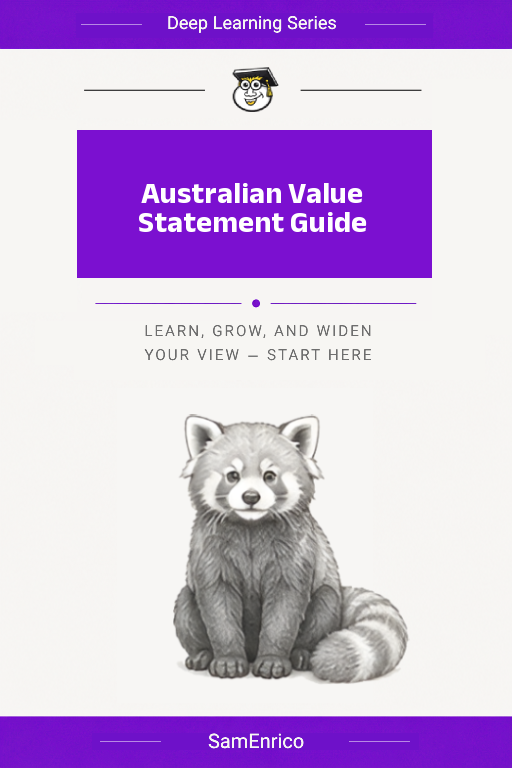
Non-FictionStudent's ShortcutValues StatementCitizenship Prep
Australian Value Statement Guide eBook
Sign Australian values statement confirming unders
by Clarke Joan
Sign Australian values statement confirming understanding of democracy freedom and rule of law for PR applicants.
Formats
Free sample
Chapter 1: Beyond the Checkbox...--The email arrived on a Tuesday, but it might as well have been a thunderbolt. After four years of paying taxes, coaching his daughter's weekend soccer team, and finally understanding the difference between a "flat white" and a "long black," Ahmed was packing his family's belongings into cardboard boxes. His permanent residency had been refused. Not because of a criminal conviction, not because of a failed medical exam, not because of a missing birth certificate. He had been refused because of what he posted on Facebook.Ahmed had signed the Australian Values Statement, as required.
He clicked the box, typed his name, and submitted his application. But on his private social media account, he continued to share memes mocking women in leadership. He joked about his wife's "proper place" in the kitchen. When a colleague reported his posts to the Department of Home Affairs, an officer reviewed his file. The signature was real.
The commitment, the officer concluded, was not. Public Interest Criterion 4019 was triggered, and Ahmed's Australian dream ended not with a dramatic courtroom showdown, but with a quiet administrative decision buried in a government portal.This is not a horror story designed to frighten you into silence. It is a true case, anonymized to protect the family's privacy, and it illustrates the single most dangerous misconception about the Australian Values Statement: that it is just a checkbox.The 150 Words That Weigh a Ton The Australian Values Statement looks deceptively ordinary. It appears as a block of text in your Immi Account, sandwiched between requests for your passport details and your employment history. You have probably scrolled past it without reading it.
If you did read it, the language seemed simple, almost bland. "I accept Australian values including freedom of speech, freedom of religion, equality of opportunity, and the rule of law." What could be controversial about that?Everything. Because those 150 words are not a description of how you feel on a Tuesday afternoon. They are a legally binding representation of your state of mind, past, present, and future. When you sign the Australian Values Statement, you are not just telling the Department what you believe today.
You are swearing that you have always believed these things, that you believe them now, and that you will continue to believe them for as long as you remain in Australia. Any evidence to the contrary—a social media post from five years ago, a complaint from a neighbor, a overheard comment at a family gathering—can be used to argue that your signature was never genuine.This is the trap that catches thousands of applicants every year. They treat the statement as a bureaucratic hoop to jump through, not as the philosophical foundation of their entire migration journey. They sign without reflection, without preparation, and without any intention of changing their behavior. And then they are shocked when the Department holds them accountable for the contradiction between their signature and their actions.The Legal Hammer You Have Never Heard Of Hidden in Schedule 4 of the Migration Regulations 1994 lies Public Interest Criterion 4019.
It is one of the most powerful legal tools in the Department's arsenal, and almost no applicant has ever heard of it.Here is what PIC 4019 says, stripped of its dense legal language: before the Minister (or a delegated case officer) can grant a visa, they must be satisfied that the applicant "accepts the values of Australian society." If the Minister is not satisfied, the visa must be refused. There is no appeal on the merits of the values themselves. You cannot argue to a tribunal that gender equality is wrong or that the rule of law is overrated. The values are non-negotiable. The only question is whether you accept them.This is what lawyers call a "discretionary criterion." Unlike a health check, where you either pass the tuberculosis screening or you do not, PIC 4019 asks a subjective question.
The case officer does not need to prove that you have violated any specific law. They only need to be unconvinced of your genuine acceptance. A single ambiguous social media post, a second-hand complaint from a disgruntled coworker, even a pattern of jokes that seem to mock Australian values—any of these can tip the scales from "satisfied" to "not satisfied."Most applicants never see the evidence used against them. The Department is not required to notify you before investigating your online presence. They can, and do, review public social media profiles, workplace complaints, and even private messages that have been reported by others.
By the time you receive a refusal letter, the investigation is complete, the evidence is gathered, and your only remaining option is an expensive and uncertain appeal to the Administrative Appeals Tribunal.The 2025 Earthquake: Why This Book Matters Now More Than Ever Until 2025, the Australian Values Statement applied primarily to permanent visa applicants. If you were on a temporary visa—a student visa, a working holiday visa, or a temporary skill shortage visa—you could live and work in Australia for years without ever signing the statement. Only when you applied for permanent residency would you first encounter the AVS.The Migration Amendment (2025 Visa Simplification) Instrument changed everything. Under the new rules, any onshore visa application that can lead to permanent residency now requires the applicant to sign the AVS at the temporary stage. This includes partner visas, humanitarian visas, and even some bridging visa applications.
In practical terms, millions of applicants who previously ignored the statement are now forced to confront it much earlier in their migration journey.Why did the government make this change? The official explanation, buried in the Regulatory Impact Statement, focuses on "early socialization." The government wants newcomers to understand Australian values before they have spent years building lives that could later be disrupted by a refusal. The cynical interpretation, offered by migration lawyers who have seen the system up close, is that the government wants more opportunities to refuse applicants before they accrue the rights that come with long-term residency.Regardless of the motivation, the effect is clear: you cannot afford to treat the AVS as an afterthought. If you are on any pathway that leads to PR, you will encounter the statement. And once you sign it, the clock starts ticking on an ongoing obligation to behave consistently with the values you have pledged.The Legal Requirement Versus the Social Contract To understand why the Australian Values Statement is so dangerous, you need to understand the distinction between two concepts that most applicants never consider: the Legal Requirement and the Social Contract.The Legal Requirement is simple.
It is the act of signing the form. You open your Immi Account, you read the statement (or pretend to read it), you click a button or type your name. From a purely administrative perspective, this is a binary act. You either sign or you do not. If you sign, the Department checks a box in your file indicating that you have satisfied the procedural requirement for your visa subclass.
This takes approximately three seconds.The Social Contract is everything else. It is the ongoing, unspoken expectation that you will behave in ways consistent with the values you have pledged.…
This is the end of the free sample. Get the eBook to keep going. Buy now
About this book
Details
- Author
- Clarke Joan
- Publisher
- SamEnrico
- Language
- English
- Genre
- Non-Fiction, Student's Shortcut, Values Statement, Citizenship Prep
- Released
- 2026-05-30
- Pages (approx.)
- 141
- Available as
- eBook, Audiobook

Read better in the ZLOADR app
Your eBooks on your phone or tablet. Sign in with your SamEnrico account and start reading.
More by Clarke Joan
 Kigali Smart City Startup ManualClarke Joan$11.99
 Pain Isolation MeditationClarke Joan$11.99
 The Fertility Body ScanClarke Joan$11.99
 Neurodivergent Stress Management at WorkClarke Joan$11.99
 Testosterone and Metabolic SyndromeClarke Joan$11.99
 The Unlikely Alliance: How a Spy and a Rockstar Outsmarted the KGBClarke Joan$11.99
 Understanding Charcot–Marie–tooth Disease Deafness Dominant TypeClarke Joan$17.99
 Proposal Sample Database GuideClarke Joan$12.99
 How to Start a Hobby in JoustingClarke Joan$11.99
 Distribution Over Production StrategyClarke Joan$11.99
You may also like
 Hong Kong Handover 1997Dunn Johnnie$11.99
 Zumba For Postnatal Recovery CourseNeal Christian$11.99
 Zumba for BeginnersLadner Nikia$11.99
 YouTube Comment Mining GuideHumes Pandora$12.99
 Worry Box MeditationCarlin Rudy$11.99
 Workplace Stress MeditationNguyen Lynn$11.99
 Workplace Stress and Sleep RepairHawley Ivory$11.99
 Workplace Perfectionism CureDelaney Jeffry$11.99
 Workplace Injustice Anger GuideWallen Isabelle$11.99
 Work Addiction and Burnout LinkGreenwood Ester$11.99
 Women in Yoga and WellnessBeattie Galina$11.99
 Women in Stand Up ComedyChun Evangeline$11.99