
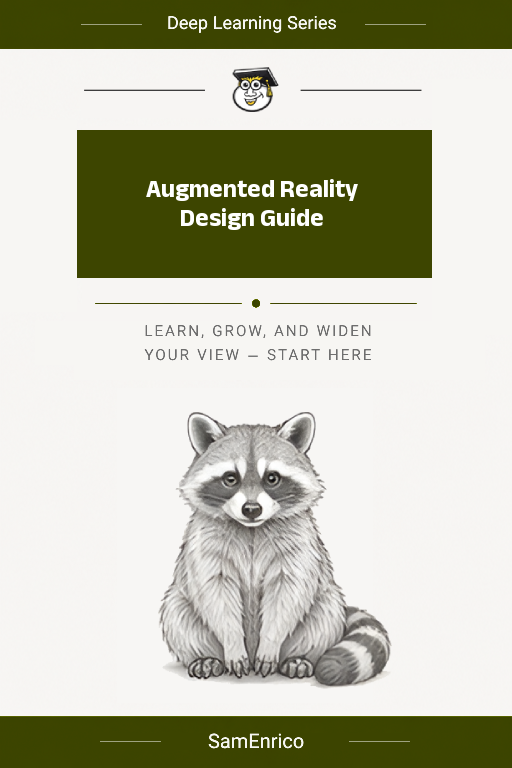
Non-FictionForecast & OutlookAR Skills
Augmented Reality Design Guide eBook
Project AR/VR content creation, spatial computing,
by Ward Kelly
Project AR/VR content creation, spatial computing, and 3D modeling demand for training and retail.
Formats
Free sample
Chapter 1: The Screen’s Last Decade--The smartphone in your pocket is the most successful technology in human history. More people have access to a mobile device than have access to clean running water. You wake up with it, eat with it, work with it, fall asleep next to it. And within the next ten years, you will begin to put it away.Not because something better will replace it. But because the interface itself is going to disappear.Think about how many times you have looked at a screen today.
Your phone, your laptop, your watch, the television in your waiting room, the checkout display at the grocery store. Now imagine a world where you never look at a screen again. Instead, information lives in the world. The directions to your meeting float on the sidewalk ahead of you. The nutritional information for the apple in your hand appears above it.
The instruction manual for the broken appliance hovers next to each component, animated, showing you exactly where to turn the screwdriver.This is not science fiction. This is spatial computing. And it is the last time you will read a chapter like this on a flat, rectangular screen.Every major shift in human-computer interaction follows a predictable pattern. First, we invent a new way to communicate with machines. Then, we spend a decade arguing that it is a niche toy.
Then, it becomes invisible. The command line seemed arcane until we all learned to type. The graphical user interface seemed slow until we could not imagine clicking a folder. The touchscreen seemed fragile until a two-year-old could navigate an i Pad. Spatial computing is the same arc, compressed into half the time.The difference this time is that spatial computing does not ask you to learn a new language or a new gesture vocabulary.
It asks you to be human. You will point at things. You will walk around them. You will pick them up with your hands. You will speak to them as if they could hear you.
Because in spatial computing, they can.This chapter is not a history lesson. It is a declaration of urgency. If you are building products, training programs, or retail experiences, you have approximately thirty-six months before your competitors figure out what you are about to learn in the next forty pages. The screen's decade is ending. The spatial decade has begun.The Three Definitions You Cannot Afford to Confuse Before we go any further, we need to get the vocabulary right.
Most people use "augmented reality," "virtual reality," and "mixed reality" as if they were interchangeable. They are not. And confusing them is the fastest way to build the wrong thing.Augmented reality (AR) overlays digital content onto the physical world, seen through a transparent display or a camera view. The key word is overlays. The digital object sits on top of the real world.
It does not interact with it. When you point your phone at a street and see a virtual arrow pointing to the nearest coffee shop, that is AR. The arrow does not cast a shadow. It does not bounce when it hits a building. It is a sticker on a window.Virtual reality (VR) replaces the physical world entirely.
You put on a headset that covers your eyes, and everything you see is digital. This is the most immersive option and the most isolating. Training simulations that require full focus and the absence of real-world distraction belong here. So do games, architectural walkthroughs, and any experience where the physical room does not matter.Mixed reality (MR) is the most powerful and the most misunderstood. In mixed reality, digital objects coexist with physical objects and interact with them.
A virtual ball bounces off your real floor. A virtual lamp sits behind your real table, partially hidden. A virtual character walks around your real chair. Mixed reality requires the device to understand the geometry of the physical world—where the floor is, where the walls are, where the furniture is. This is exponentially harder than AR or VR, and it is exactly where the industry is heading.Here is the rule of thumb that will save you from building the wrong thing: if the user needs to be fully present in a different world, build VR.
If the user needs a quick piece of information overlaid on their current view, build AR. If the user needs to interact with digital objects as if they were real, build MR. Most of the high-value applications in retail and training fall into the MR category. Your customer wants to see if the sofa fits in their living room, not just a floating image of a sofa. Your trainee wants to practice fixing a machine that responds to their hands, not a video of someone else fixing one.The Two Killer Apps That Justify Everything Technology for its own sake is a hobby.
Technology that solves an expensive, painful, recurring problem is a business. Spatial computing has two such problems in its crosshairs.Problem One: The Uncertainty of Online Shopping Every e-commerce company on earth has the same nightmare: the customer who buys a product, receives it, and returns it because "it didn't look like the picture" or "I thought it would fit." Returns cost retailers an estimated $800 billion annually. For furniture, return rates can exceed thirty percent. For apparel bought online, twenty-four to forty percent of items go back. Most of these returns are not because the product is defective.
They are because the customer could not visualize the product in their space or on their body.Spatial computing solves this with what I call the "Try-Out vs. Try-On" framework.Try-Out applies to products that occupy physical space: furniture, appliances, home decor, industrial equipment, art. The customer needs to know if it fits, if the color works with their existing decor, if the scale overwhelms the room. Try-Out experiences use room scanning, occlusion, and realistic shadows to place a virtual object in the customer's real environment. IKEA Place was an early example.
Today, the technology is good enough that customers who use Try-Out AR are sixty-five percent less likely to return furniture.Try-On applies to products that go on the body: clothing, shoes, accessories, makeup, jewelry, glasses. The customer needs to know if it looks good, if the size is right, if the color complements their skin tone. Try-On experiences use face tracking, body mesh reconstruction, and realistic texture mapping. Sephora's Virtual Artist and Gucci's sneaker try-on are the gold standards. Customers who use Try-On AR are three times more likely to purchase and half as likely to return.If you sell physical products and you do not have a Try-Out or Try-On strategy, you are leaving money on the table.
It is that simple.Problem Two: The Cost of Learning by Doing Every training organization on earth has the same nightmare: the employee who makes a mistake because they only read about the procedure, never practiced it. The cost of this mistake ranges from a few hundred dollars (a cashier who cannot find the void button) to a few million dollars (a refinery operator who opens the wrong valve) to a…
This is the end of the free sample. Get the eBook to keep going. Buy now
About this book
Details
- Author
- Ward Kelly
- Publisher
- SamEnrico
- Language
- English
- Genre
- Non-Fiction, Forecast & Outlook, AR Skills
- Released
- 2026-06-01
- Pages (approx.)
- 152
- Available as
- eBook, Audiobook

Read better in the ZLOADR app
Your eBooks on your phone or tablet. Sign in with your SamEnrico account and start reading.
More by Ward Kelly
 Norwood Scale Hair Loss ChartWard Kelly$11.99
 Authentic Networking ApproachWard Kelly$11.99
 Student Exam Prep PriorityWard Kelly$11.99
 Call of Duty Dopamine LoopWard Kelly$11.99
 DoorDash Dasher Rating RecoveryWard Kelly$11.99
 Quetzalcoatl's Fall: The Feathered Serpent's ExileWard Kelly$11.99
 Asana Advanced Features GuideWard Kelly$12.99
 Ultimate Handbook Guide to Yaren (de facto) : (Nauru) Travel GuideWard Kelly$11.99
 Renovation LabourerWard Kelly$11.99
 Understanding Mendelian Susceptibility to Atypical MycobacteriaWard Kelly$17.99
You may also like
 Hong Kong Handover 1997Dunn Johnnie$11.99
 Zumba For Postnatal Recovery CourseNeal Christian$11.99
 Zumba for BeginnersLadner Nikia$11.99
 YouTube Comment Mining GuideHumes Pandora$12.99
 Worry Box MeditationCarlin Rudy$11.99
 Workplace Stress MeditationNguyen Lynn$11.99
 Workplace Stress and Sleep RepairHawley Ivory$11.99
 Workplace Perfectionism CureDelaney Jeffry$11.99
 Workplace Injustice Anger GuideWallen Isabelle$11.99
 Work Addiction and Burnout LinkGreenwood Ester$11.99
 Women in Yoga and WellnessBeattie Galina$11.99
 Women in Stand Up ComedyChun Evangeline$11.99