
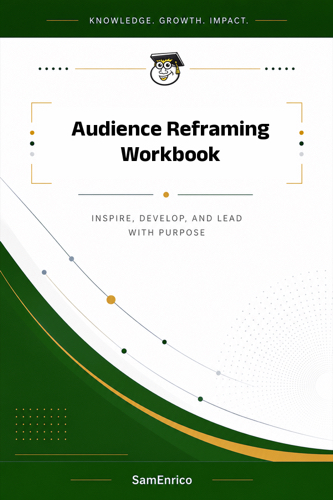
Non-FictionMental WealthPerspective Taking
Audience Reframing Workbook eBook
Visualize listeners as friends or colleagues inste
Visualize listeners as friends or colleagues instead of judges using compassion exercises.
Formats
Free sample
Chapter 1: The Saber-Toothed Boardroom--–- You are not broken. Your body is not betraying you. The racing heart, the dry mouth, the trembling hands, the sudden urge to flee—these are not signs of weakness. They are signs that your ancient survival hardware is working exactly as designed. The problem is not your fear.
The problem is that your brain cannot tell the difference between a saber-toothed tiger and a conference room full of neutral listeners. This chapter will show you why the audience is not a jury, why your worst-case fantasies are almost certainly lies, and how to begin separating the feeling of judgment from the fact of judgment. By the end of these pages, you will have completed two exercises that will permanently change how you see every room you enter.The Evolutionary Mismatch That Ruins Your Mornings Let us begin with a thought experiment. Imagine you are a prehistoric human walking across the savanna approximately 100,000 years ago. You are alone.
The grass is tall. The sun is hot. Suddenly, you hear a rustling behind you. You spin around and find yourself staring into the yellow eyes of a large predator—a saber-toothed tiger, let us say, though the exact species matters less than the feeling it produces in your body.What happens next is not a choice. Your amygdala, an almond-shaped cluster of neurons deep within your brain, sounds an alarm.
This alarm does not pass through your conscious reasoning centers. It does not ask for your opinion. It simply floods your system with cortisol and adrenaline. Your heart rate jumps from seventy beats per minute to one hundred and forty beats per minute in less than three seconds. Blood rushes away from your digestive system and toward your large muscle groups.
Your pupils dilate. Your hearing sharpens. Your throat tightens. Your palms sweat—not because you are nervous, but because sweat makes your grip more secure on a spear or a tree branch. Every single physiological change happening inside your body is designed for one purpose: survival.Now, here is the problem.
Your amygdala cannot read. It cannot tell time. It does not know that you are standing in a brightly lit conference room on the fifteenth floor of an office building in the twenty-first century. It does not understand that the twenty pairs of eyes looking at you belong to colleagues who drink the same coffee, sit in the same traffic, and worry about the same mortgage payments. All your amygdala knows is that multiple large creatures are staring at you in silence, and in the environment where your brain evolved, multiple large creatures staring at you in silence meant one thing: you were about to be eaten.This is not a metaphor.
This is evolutionary biology. The human brain has existed in its current form for approximately 200,000 years. For 199,900 of those years, humans lived in small tribal groups, and being stared at by a group of outsiders was a genuine threat to life and limb. The modern conference room, the classroom, the wedding reception, the stage—these environments are approximately two hundred years old. That is not enough time for evolution to catch up.
You are not afraid of public speaking. You are afraid of being eaten. Your body just has not gotten the memo.This reframe is not meant to trivialize your fear. If anything, it should dignify it. You are not a coward.
You are a human being with a properly functioning nervous system responding to a mislabeled threat. The goal of this book is not to eliminate that response—that would be like asking you to stop breathing. The goal is to teach your brain a new categorization: this room is not the savanna, and these people are not predators.The Projection Problem: Why You See Judges Everywhere If the audience is not inherently judging you, then why does it feel so much like they are? The answer lies in a psychological phenomenon called projection. Projection is the mind's tendency to take an internal feeling or belief and attribute it to the external world.
When you are deeply afraid of being judged, your brain scans the environment for evidence of judgment—and because your brain is extraordinarily good at finding what it is looking for, it will find it even when it is not there.Here is how projection works in practice. Imagine you walk into a room to give a presentation. You are already nervous. You have been nervous for three days. Your internal state is one of anticipated rejection.
As you begin speaking, you notice a woman in the third row. She is not smiling. Her arms are crossed. She is looking down at her phone. Your brain instantly tags her: She hates this.
She thinks I am incompetent. She wishes she were somewhere else.Now consider the alternative explanations. Perhaps she is not smiling because she just received a text message about her sick child. Perhaps her arms are crossed because the air conditioning is set to sixty-eight degrees and she forgot her jacket. Perhaps she is looking at her phone because she is checking the time to make sure the meeting ends on schedule so she can pick up her daughter from daycare.
None of these explanations have anything to do with you. But your brain does not consider alternative explanations when it is in threat-detection mode. Threat-detection mode prioritizes speed over accuracy. It is better to mistake a stick for a snake than a snake for a stick. The same logic applies here: it is better to assume someone is judging you and be wrong than to assume they are not judging you and be wrong.
Your brain is playing the percentages, and the percentages are calibrated for a world that no longer exists.The projection problem is compounded by what psychologists call the spotlight effect. In a series of famous studies conducted by Thomas Gilovich and Kenneth Savitsky at Cornell University, researchers asked college students to walk into a room wearing a embarrassing T-shirt featuring a picture of the singer Barry Manilow. The students were then asked to estimate how many people in the room would notice the shirt. The students estimated that approximately 50 percent of people would notice. In reality, only 23 percent noticed.
The gap between what we believe others see and what they actually see is massive and consistent. We are all walking around believing we are standing under a spotlight when in fact we are standing in the dark.The spotlight effect is not vanity. It is not narcissism. It is a cognitive bias born of the simple fact that you are the center of your own experience. You wake up in your body.
You go to sleep in your body. Every sensation, every thought, every emotion passes through the filter of your own consciousness. It is therefore almost impossible for you to imagine that other people are not paying as much attention to you as you pay to yourself. But they are not. They are paying attention to themselves.
They are worried about their own stains, their own forgotten lines, their own sweaty palms. The audience is not a panel of…
This is the end of the free sample. Get the eBook to keep going. Buy now
About this book
Details
- Author
- Macias Rueben
- Publisher
- SamEnrico
- Language
- English
- Genre
- Non-Fiction, Mental Wealth, Perspective Taking
- Released
- 2026-06-08
- Pages (approx.)
- 127
- Available as
- eBook, Audiobook

Read better in the ZLOADR app
Your eBooks on your phone or tablet. Sign in with your SamEnrico account and start reading.
More by Macias Rueben
 Senior Motivation HandbookMacias Rueben$11.99
 Body Language AnimationMacias Rueben$11.99
 Overcoming Vocal Fry and FillersMacias Rueben$11.99
 The Phantom Heist: Australia's Unsolved Armored Car Robberies and the UFO ConnectionMacias Rueben$11.99
 How to Produce Cardio EquipmentMacias Rueben$11.99
 Price Increase Grandfathering PolicyMacias Rueben$12.99
 How to Start a Oil Trading (commodity Broking) (commission Agent) Business (Beginners Guide)Macias Rueben$11.99
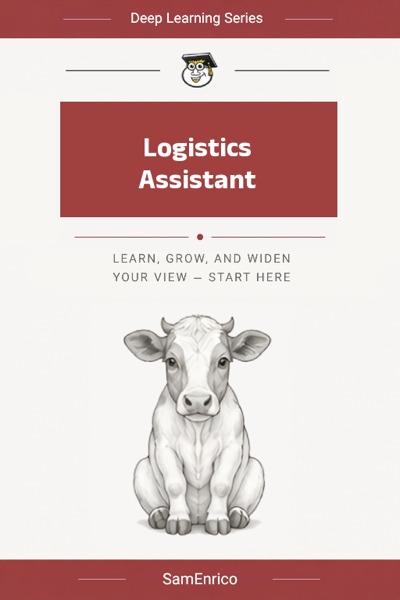 Logistics AssistantMacias Rueben$11.99
You may also like
 Hong Kong Handover 1997Dunn Johnnie$11.99
 Zumba For Postnatal Recovery CourseNeal Christian$11.99
 Zumba for BeginnersLadner Nikia$11.99
 YouTube Comment Mining GuideHumes Pandora$12.99
 Worry Box MeditationCarlin Rudy$11.99
 Workplace Stress MeditationNguyen Lynn$11.99
 Workplace Stress and Sleep RepairHawley Ivory$11.99
 Workplace Perfectionism CureDelaney Jeffry$11.99
 Workplace Injustice Anger GuideWallen Isabelle$11.99
 Work Addiction and Burnout LinkGreenwood Ester$11.99
 Women in Yoga and WellnessBeattie Galina$11.99
 Women in Stand Up ComedyChun Evangeline$11.99