
Non-FictionInformativeEducational
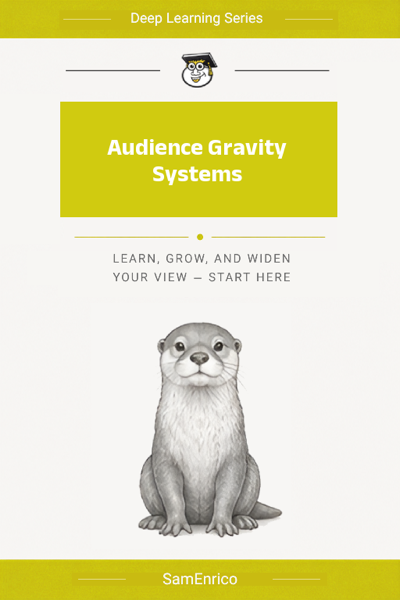
Audience Gravity Systems eBook
A Coursebook on Audience Gravity Systems
by Land Lavina
A Coursebook on Audience Gravity Systems
Formats
Free sample
Chapter 1: The Broken Funnel...--–- Every morning, Sarah opens her laptop to check the marketing dashboards for her mid-sized software company. She sees the same story she has seen for eighteen months: traffic is up 15% year over year, her team is sending more emails than ever, they have launched three new ad campaigns, and yet… revenue per visitor is down 22%. The funnel is leaking. Not at the bottom, not at the top, but everywhere, all at once. She has more leads than ever before, but they slip through her fingers like water.
Her cost to acquire a customer has doubled. Her team is exhausted from "feeding the funnel." And somewhere in the back of her mind, she knows the truth that most marketers are afraid to say out loud: the funnel is broken.This is not a new observation. Marketers have been complaining about funnel inefficiency for years. But the diagnosis has always been wrong. Most experts say the solution is more data, better targeting, or fancier automation.
They are mistaken. The problem is not a lack of precision. The problem is that the funnel was designed for a world that no longer exists.The funnel—Awareness, Interest, Desire, Action—was invented in 1898 by Elias St. Elmo Lewis. It worked beautifully for most of the twentieth century.
In a world of limited media channels, captive audiences, and minimal competition, you could pour prospects into the wide top and count on a predictable percentage dripping out the bottom as customers. The funnel was a gravity system of its own: prospects fell downward through stages, and all you had to do was keep the top full.That world is dead.The Four Horsemen of the Funnel Apocalypse Four fundamental shifts have rendered the linear funnel obsolete. Understanding them is not optional. If you ignore these forces, you will continue to pour money into a container that cannot hold water.First: Ad-blockers and the attention wall. In 2024, over 42% of internet users globally run ad-blocking software.
Among users under thirty-five, that number exceeds 60%. When you run a display ad campaign, you are not paying for attention. You are paying for the privilege of being ignored by a majority of your target audience. The old funnel assumed that awareness was simply a matter of reach. Today, reach is cheap.
Attention is expensive. And attention cannot be bought at scale—it must be earned.Second: The spam filters won. Email open rates have been declining for a decade. The average open rate for B2B marketing emails hovers around 20%. Click-through rates average 2-3%.
That means 97% of your carefully crafted email sequences are digital litter. Gmail's Promotions tab, Outlook's Focused Inbox, and Apple's Mail Privacy Protection have turned email from a reliable push channel into a lottery ticket. You are not emailing people. You are emailing their filters.Third: AI curation changed the game. Social media algorithms no longer show your content to your followers in chronological order.
They show content that keeps people on the platform. That means your organic reach on Instagram, Facebook, Linked In, and Tik Tok has collapsed. In 2012, a brand page could reach 16% of its followers organically. Today, that number is often below 2%. You do not own your audience on social platforms.
You rent a chance to be seen, and the rent increases every year.Fourth: Consumer skepticism is at an all-time high. Trust in advertising has fallen to historic lows. According to Edelman's Trust Barometer, only 48% of consumers trust brands "to do what is right." The old funnel assumed that once a prospect became aware of your product, they would naturally progress toward desire. But modern consumers do not believe your claims. They check reviews.
They ask friends. They watch You Tube unboxings. They compare three competitors while standing in the aisle. The funnel's assumption of linear, trusting progression is a fantasy.These four forces have not merely reduced funnel efficiency. They have fundamentally altered the physics of customer acquisition.
The funnel was a push system. You pushed prospects from stage to stage with ads, emails, and calls to action. Push worked when channels were scarce and attention was abundant. Today, attention is scarce and channels are infinite. Push still works, but only at a cost that most businesses cannot sustain.The Mass Defect of Marketing To understand why push is dying, we need to borrow a concept from nuclear physics: the mass defect.In physics, the mass defect is the difference between the mass of an atomic nucleus and the sum of the masses of its individual protons and neutrons.
That missing mass is converted into energy. In marketing, the mass defect is the difference between the energy you put into pushing messages and the actual value that reaches your audience. That wasted energy is your defect.Consider a typical marketing push campaign. You spend $10,000 on a display ad buy. That campaign generates 100,000 impressions.
Of those impressions, 99,000 are ignored or blocked. Of the 1,000 that generate clicks, 900 bounce immediately. Of the 100 who land on your site, 95 leave without taking action. Five become leads. Maybe one becomes a customer.You spent $10,000 to acquire one customer.
Your mass defect is $9,999 worth of wasted energy.This is not a failure of execution. It is a failure of physics. You are trying to push a heavy object up a hill with a spoon. The funnel is not designed for the world you live in. The funnel was designed for a world where you could broadcast a message and people would gather around to listen.
That world is gone.The Gravity Alternative There is another way. It is not new—the principles have existed for as long as humans have traded with one another—but it has been buried under decades of advertising orthodoxy. That alternative is gravitational marketing.Gravitational marketing does not push. It pulls. Instead of chasing customers, you become something that customers want to orbit.
Instead of interrupting their day with messages they did not ask for, you create value so dense that they seek you out. Instead of measuring reach and impressions, you measure the strength of your gravitational field.Think about the difference between a carnival barker and a black hole. The barker stands on the street corner, shouting at passersby, trying to yank them into the tent. The black hole does nothing. It simply sits in space, dense with mass, bending light and matter toward it.
The barker exhausts himself. The black hole never tires.Most businesses are carnival barkers. They shout. They interrupt. They push.
And they wonder why their voices are hoarse and their tents are empty.The businesses that win in the attention economy are black holes. They have compressed so much value into such a small space that customers cannot help but fall toward them. They do not chase. They attract.The Physics of Pull Gravitational pull is determined by two factors: mass and distance. In marketing terms, mass is the total value you provide to your audience.
Distance is the friction between you and your customers. Reduce distance (friction) and increase mass (value), and your gravitational pull strengthens automatically.This is not metaphor. It is a practical framework that will guide every chapter of this…
This is the end of the free sample. Get the eBook to keep going. Buy now
About this book
Details
- Author
- Land Lavina
- Publisher
- SamEnrico
- Language
- English
- Genre
- Non-Fiction, Informative, Educational
- Released
- 2026-06-02
- Pages (approx.)
- 146
- Available as
- eBook, Audiobook

Read better in the ZLOADR app
Your eBooks on your phone or tablet. Sign in with your SamEnrico account and start reading.
More by Land Lavina
 Multitasking Illusion Recovery HandbookLand Lavina$11.99
 The Musical Memory Sleep GuideLand Lavina$11.99
 India Support Center Cost AnalysisLand Lavina$11.99
 Business School Essay PromptsLand Lavina$11.99
 Divorce and InheritanceLand Lavina$11.99
 The Battle of Changping: Sun Tzu’s Shadow Over the Warring StatesLand Lavina$11.99
 Understanding Plague, MeningealLand Lavina$17.99
 QuickBooks Project ProfitabilityLand Lavina$12.99
 Cybersecurity Acquisition MapLand Lavina$12.99
 How to Start a Ophthalmic Clinic Business (Beginners Guide)Land Lavina$11.99
You may also like
 Hong Kong Handover 1997Dunn Johnnie$11.99
 Zumba For Postnatal Recovery CourseNeal Christian$11.99
 Zumba for BeginnersLadner Nikia$11.99
 YouTube Comment Mining GuideHumes Pandora$12.99
 Worry Box MeditationCarlin Rudy$11.99
 Workplace Stress MeditationNguyen Lynn$11.99
 Workplace Stress and Sleep RepairHawley Ivory$11.99
 Workplace Perfectionism CureDelaney Jeffry$11.99
 Workplace Injustice Anger GuideWallen Isabelle$11.99
 Work Addiction and Burnout LinkGreenwood Ester$11.99
 Women in Yoga and WellnessBeattie Galina$11.99
 Women in Stand Up ComedyChun Evangeline$11.99