
Non-FictionSelf-HelpSports Psychology
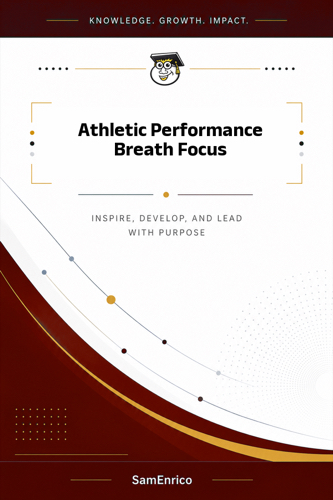
Athletic Performance Breath Focus eBook
Use anapanasati to enter flow state, regulate effo
Use anapanasati to enter flow state, regulate effort, and reduce performance anxiety.
Formats
Free sample
Chapter 1: The Two-Second Killer--–- The arena holds 18,000 people. The clock reads 3.2 seconds. Your team trails by one point. You have been practicing this free throw since you were eight years old—thirty thousand repetitions, maybe more. Your muscles know what to do.
Your brain, however, has just received a different instruction. The crowd noise collapses into a single frequency—a low roar that vibrates in your sternum. You bounce the ball twice. You feel your chest rising instead of your belly. You take a quick, shallow sip of air.
And in that moment—that tiny, two-second window between the thought "don't miss" and the release of the ball—you have already lost.This is not a failure of skill. It is not a lack of practice, talent, or heart. It is a failure of breath. And until you understand why, you will continue to choke on the biggest stages, not because you aren't good enough, but because you are breathing wrong when it matters most.Welcome to the Performance Paradox.The Nightmare That Has No Name Every athlete knows this feeling. The golfer standing over a three-foot putt to win the Masters.
The tennis player serving for the match at Wimbledon. The quarterback with a clean pocket and an open receiver. The gymnast on the balance beam in the Olympic finals. In each case, the athlete has performed this exact movement thousands of times in practice. In each case, the athlete has the physical ability to succeed.
And in each case, something invisible and merciless reaches up from the nervous system and sabotages everything.We call it choking. But that word is a cop-out. It implies a moral failure—a weakness of character, a lack of grit, a deficiency in the will. Coaches shout "just relax" as if relaxation were a switch you could flip. Commentators whisper about "nerves" as if nerves were a weather pattern you could wait out.
Sports psychologists talk about "performance anxiety" as if anxiety were a thought you could talk yourself out of.None of this works. In fact, it makes things worse.Consider the case of Greg Norman at the 1996 Masters. Norman entered the final round with a six-shot lead—one of the largest cushions in tournament history. He had won two major championships. He was the number one ranked golfer in the world.
By any objective measure, he should have won. He shot a 78. He lost by five strokes. In the years that followed, analysts dissected his swing, his putting stroke, his mental game. They missed the real culprit.
Television footage shows Norman breathing high in his chest on every shot of that final round—short, shallow, rapid breaths that triggered his sympathetic nervous system, tightened his muscles, and turned his fine motor skills into rubble.Norman did not choke because he was weak. He choked because his breathing pattern changed under pressure, and he had no training to change it back.The Two Types of Anxiety That Destroy Performance To understand why this happens, we need to distinguish between two very different forms of anxiety. Most athletes and coaches lump them together. That is a catastrophic mistake.The first is somatic anxiety. This is physical.
It is the racing heart, the sweaty palms, the trembling fingers, the tightness in the chest, the butterflies in the stomach. Somatic anxiety is your body preparing for a threat. It is evolutionarily ancient and deeply automatic. You cannot talk yourself out of somatic anxiety any more than you can talk yourself out of a fever. It is a physiological event.The second is cognitive anxiety.
This is mental. It is the voice in your head saying "don't miss," "everyone is watching," "you always choke in big moments," "this is your one chance." Cognitive anxiety is the inner critic—the commentator who never stops talking and never has anything helpful to say.Here is what almost no one understands: somatic anxiety and cognitive anxiety reinforce each other in a deadly loop. The physical sensations of a racing heart trigger the thought "I am panicking." That thought triggers more shallow breathing. More shallow breathing increases heart rate. Increased heart rate triggers more catastrophic thoughts.
Within seconds, you are trapped in a feedback loop that spirals downward with terrifying speed.The solution is not to fight either form of anxiety directly. You cannot win a fight against your own nervous system. The solution is to interrupt the loop at its most accessible point—the breath.The Bridge Between Voluntary and Involuntary Here is a question that most athletes never consider: what is the only automatic function of your body that you can consciously control?You cannot consciously control your heart rate. Try to make your heart beat faster just by thinking about it. You cannot.
You cannot consciously control your digestion, your kidney function, or the dilation of your pupils. These are the domains of the autonomic nervous system—the part of you that runs without your permission.But you can control your breath. You can slow it down. You can speed it up. You can hold it.
You can change its depth, its rhythm, its pathway through your nose or mouth. And here is the extraordinary fact: when you change your breath, you change your entire nervous system.The ancient practice of Anapanasati—mindfulness of breathing—has a name for this connection. It is called Kaya-sankhara, which translates roughly to "the bodily formation." The breath is the formation that bridges the voluntary and involuntary worlds. It is the remote control for your nervous system. Change the breath, and you change the body.
Change the body, and you change the mind.Most athletes spend thousands of hours training their muscles, their skills, their strategies. They spend almost zero hours training their breath. This is like owning a race car with a high-performance engine and never learning how to use the steering wheel.Why "Just Relax" Is the Worst Advice in Sports Let us examine the most common piece of advice given to choking athletes: "just relax." On its surface, this seems benign. Beneath the surface, it is actively destructive.The problem is the reverse psychology effect, also known as ironic process theory. When you try not to think about something, your brain must first think about that thing in order to monitor whether you are thinking about it.
Try this right now: for the next ten seconds, do NOT think about a pink elephant. What happened? You thought about a pink elephant. The instruction to suppress a thought requires the thought to be activated."Just relax" works the same way. When an athlete is told to relax, their brain immediately scans for evidence of not-relaxing—which means it finds the racing heart, the tight chest, the trembling hands.
This confirms the threat. The sympathetic nervous system fires harder. The athlete becomes less relaxed, not more.Worse, "just relax" implies that the athlete's current state is wrong, bad, or weak. This adds shame to the existing anxiety. Shame is a powerful amplifier of the stress response.
Now the athlete is not only anxious but also ashamed of being anxious. The loop tightens.The breath offers a way out because it…
This is the end of the free sample. Get the eBook to keep going. Buy now
About this book
Details
- Author
- Lawler Ivelisse
- Publisher
- SamEnrico
- Language
- English
- Genre
- Non-Fiction, Self-Help, Sports Psychology
- Released
- 2026-06-07
- Pages (approx.)
- 142
- Available as
- eBook, Audiobook

Read better in the ZLOADR app
Your eBooks on your phone or tablet. Sign in with your SamEnrico account and start reading.
More by Lawler Ivelisse
 Vertical Farming Capital GuideLawler Ivelisse$12.99
 Waiting Period Shopping GuideLawler Ivelisse$11.99
 Norwegian American Return To Fjords MemoirLawler Ivelisse$11.99
 Baby Sleep Forum RecommendationsLawler Ivelisse$11.99
 The Disaster Customer Credit PolicyLawler Ivelisse$11.99
 The Urban Visionary: Christopher Wren and the Rebirth of LondonLawler Ivelisse$11.99
 Understanding Mmep SyndromeLawler Ivelisse$17.99
 Electronic Systems EngineeringLawler Ivelisse$11.99Vertical Farming Capital GuideLawler Ivelisse$12.99
 Legal Document Review MasteryLawler Ivelisse$12.99
 How to Become a Nitroglycerin DistributorLawler Ivelisse$11.99
You may also like
 Hong Kong Handover 1997Dunn Johnnie$11.99
 Zumba For Postnatal Recovery CourseNeal Christian$11.99
 Zumba for BeginnersLadner Nikia$11.99
 YouTube Comment Mining GuideHumes Pandora$12.99
 Worry Box MeditationCarlin Rudy$11.99
 Workplace Stress MeditationNguyen Lynn$11.99
 Workplace Stress and Sleep RepairHawley Ivory$11.99
 Workplace Perfectionism CureDelaney Jeffry$11.99
 Workplace Injustice Anger GuideWallen Isabelle$11.99
 Work Addiction and Burnout LinkGreenwood Ester$11.99
 Women in Yoga and WellnessBeattie Galina$11.99
 Women in Stand Up ComedyChun Evangeline$11.99