
Non-FictionBusiness BriefTechnical WritingDocumentation
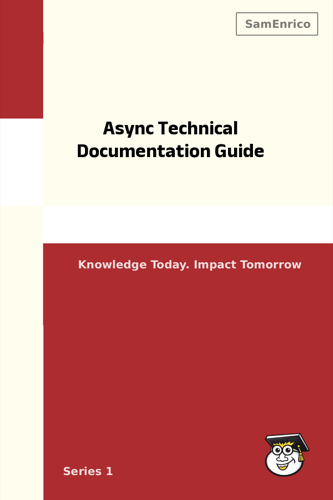
Async Technical Documentation Guide eBook
Write API docs, runbooks, and architecture decisio
Write API docs, runbooks, and architecture decision records as the primary async communication for engineering teams.
Formats
Free sample
Chapter 1: The Sync Tax--–- It was 2:17 AM when the pager went off. Again.I fumbled for my phone, knocked over a glass of water, and squinted at the screen. Another 500 error spike. The same service. The same symptoms.
The third time this month.I opened Slack. Forty-seven unread messages. Three people had already been woken up. One was asking "has anyone seen this before?" Another had pasted a log snippet. The on-call manager was typing, "let's hop on a quick Zoom."Quick Zoom.
At 2:30 AM. For an error that had happened twice before and that someone had definitely debugged already.I knew what was coming. Forty-five minutes of six exhausted people listening to one person talk through their screen share, scrolling through logs, while everyone else fought to stay awake. Then someone would say "oh right, we saw this last month—you just need to restart the sidecar container." Then we would all go back to bed, having lost another hour of sleep to a problem that should have been documented.That was the night I stopped believing in "just ask me" culture.That was the night I started this book.The Hidden Cost of Verbal Communication Let me tell you about the Sync Tax. It is the single largest drain on engineering productivity that nobody talks about.The Sync Tax is the cumulative cost of every conversation, meeting, Slack thread, and hallway chat required to transfer information that could have been written down once.
It includes the time of the person asking, the time of the person answering, the time of everyone who listens in “just in case,” and the time of every future person who will ask the same question again because the answer was never captured.Most engineers think they work in an environment of scarcity. We say things like “we don’t have time to write documentation” or “we need to ship this feature first.” But here is the lie hiding beneath those words: you are already spending the time. You are just spending it inefficiently, one interrupted conversation at a time.Let me prove it to you.The Sync Tax Calculator Take a simple example. An engineer asks in Slack: “How do I deploy the payment service to staging?”Someone answers. Maybe it takes two minutes to type the answer.
Maybe it takes a five-minute voice huddle. Let us be generous and say three minutes total.That is three minutes. No big deal, right?Now multiply that by the number of people who will ask that same question over the next year. A team of eight engineers. Each engineer needs to deploy to staging maybe twice a week.
That is sixteen questions per week. Times fifty weeks. Eight hundred questions per year.Three minutes per question times eight hundred questions equals forty hours.That is a full work week. Every year. Spent answering a single question that could have been answered by a three-paragraph runbook written once.But it gets worse.The Multiplier Effect The Sync Tax does not just include the answer time.
It includes the interruption cost.Research on context switching (the term comes from computer science, but it applies brutally well to human cognition) shows that after an interruption, it takes an average of twenty-three minutes to return to full focus. When you answer a Slack question, you are not losing just the three minutes of answering. You are losing twenty-three minutes of your own deep work time, plus twenty-three minutes of the asker’s deep work time, plus the three minutes of the conversation itself.That is forty-nine minutes. Per question.Now apply that to our eight hundred questions. That is more than six hundred and fifty hours per year.
That is sixteen full work weeks. Four months of productivity. Gone.And that is just one question.The Meeting Tax Now consider the meeting culture.A team schedules a “quick sync” to discuss an API change. Six people attend. The meeting lasts thirty minutes.
That is three person-hours right there.But the hidden cost is larger. Each of those six people had to context-switch into the meeting (five minutes), attend the meeting (thirty minutes), and context-switch back to their work (twenty-three minutes). That is fifty-eight minutes per person. Times six people. Three hundred and forty-eight minutes.
Nearly six hours.For a “quick sync.”And what was the output of that meeting? Usually, a decision that could have been written in a ten-minute Architecture Decision Record. And someone will ask about that decision again in six months, because there is no written record.The Sync Tax is not a rounding error. It is the dominant term in the equation of engineering productivity.The Myth of Self-Documenting Code Before I go further, let me kill an idea that has caused more wasted time than almost any other in software engineering: the myth of self-documenting code.I have heard some version of this argument hundreds of times. “The code is the documentation.” “If you need comments, your code isn’t clear enough.” “We don’t need docs because the tests explain everything.”This is nonsense.
And I want to be very clear about why.Code describes what the computer does. It describes the mechanics, the algorithms, the data transformations. It does not—and cannot—describe why certain decisions were made. It cannot describe what the author intended. It cannot describe what failure modes were considered and rejected.Here is a simple experiment.
Open any file in your codebase. Find a conditional statement—an if-else block that handles an error case. Now ask yourself: why is that error handled this way? What happens if we change it? What alternatives were considered?The code cannot tell you.
It can only tell you what happens. Not why.The Bus Factor There is a grim term in engineering management: the bus factor. It is the number of people who would need to be hit by a bus (or win the lottery, or take a parental leave, or get hired away by a competitor) before your project becomes unmaintainable.A bus factor of one means the project dies when that person leaves. A bus factor of two means you need two departures. And so on.Most undocumented teams have a bus factor of one.
They rely on tribal knowledge. The deployment process lives in one person’s head. The runbook for the critical service is “ask Sarah.” The reason for the weird database schema is “oh, Mark set that up three years ago.”When that person leaves, the knowledge leaves with them. And the team spends months rediscovering what was already known.Documentation is not a luxury. It is insurance against the bus.Why Text Removes Ego Here is something I did not expect when I started pushing for more documentation: it made my team less political.When decisions are made in meetings, they are made by the loudest voice in the room.
The person with the strongest opinions. The senior engineer who talks the most. The manager who has the final say. Ego is baked into the format.When decisions are made in text, something changes.A written document does not care who wrote it. It can be read…
This is the end of the free sample. Get the eBook to keep going. Buy now
About this book
Details
- Author
- Lindgren Emilie
- Publisher
- SamEnrico
- Language
- English
- Genre
- Non-Fiction, Business Brief, Technical Writing, Documentation
- Released
- 2026-06-10
- Pages (approx.)
- 143
- Available as
- eBook, Audiobook

Read better in the ZLOADR app
Your eBooks on your phone or tablet. Sign in with your SamEnrico account and start reading.
More by Lindgren Emilie
 Prostate Health Travel GuideLindgren Emilie$11.99
 Aromatherapy for EczemaLindgren Emilie$11.99
 Relationship Management EQLindgren Emilie$11.99
 Demurrage and Detention GuideLindgren Emilie$11.99
 The Chessboard Conspiracy: How Bobby Fischer Took Down the Soviet EmpireLindgren Emilie$11.99
 Beverage Cart AttendantLindgren Emilie$11.99
 Understanding Corneal Crystals Myopathy NeuropathyLindgren Emilie$17.99
 Google Lead Gen PolicyLindgren Emilie$12.99
 Cheap Product Photography GuideLindgren Emilie$12.99
 How to Start a Motorway Maintenance Unit Business (Beginners Guide)Lindgren Emilie$11.99
You may also like
 Hong Kong Handover 1997Dunn Johnnie$11.99
 Zumba For Postnatal Recovery CourseNeal Christian$11.99
 Zumba for BeginnersLadner Nikia$11.99
 YouTube Comment Mining GuideHumes Pandora$12.99
 Worry Box MeditationCarlin Rudy$11.99
 Workplace Stress MeditationNguyen Lynn$11.99
 Workplace Stress and Sleep RepairHawley Ivory$11.99
 Workplace Perfectionism CureDelaney Jeffry$11.99
 Workplace Injustice Anger GuideWallen Isabelle$11.99
 Work Addiction and Burnout LinkGreenwood Ester$11.99
 Women in Yoga and WellnessBeattie Galina$11.99
 Women in Stand Up ComedyChun Evangeline$11.99