
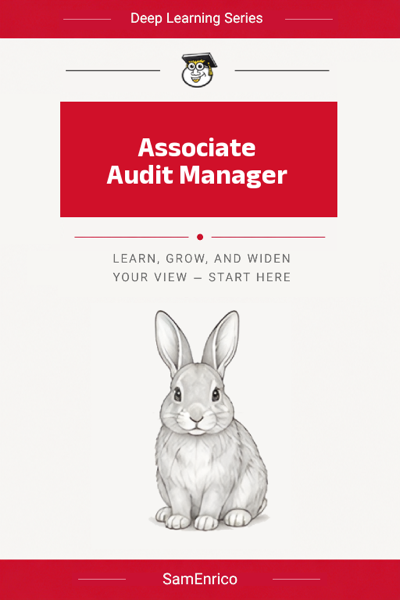
Non-FictionInformativeEducational
Associate Audit Manager eBook
A Coursebook on Associate Audit Manager
by Locke Dia
A Coursebook on Associate Audit Manager
Formats
Free sample
Chapter 1: The Review Trap...--–- You’ve just been promoted. The email came three days ago: “Congratulations, you are now an Associate Audit Manager.” Your salary increased. Your title changed. Your name now appears on engagement letters. But yesterday, you sat down to review your first workpaper as a manager—a simple accounts receivable aging test prepared by a senior who used to be your peer.
You read it once. Then again. You know something feels off, but you can’t articulate it. The partner is waiting. The client is waiting.
The budget is already 10 percent consumed before fieldwork even begins. And the senior is looking at you, expecting guidance.You freeze.This chapter is about why you froze, why every new manager freezes, and how to break that paralysis before it breaks your engagement.The Unspoken Crisis of the First Review The transition from senior auditor to associate audit manager is not a promotion. It is a profession change.As a senior, you were rewarded for speed, completeness, and technical accuracy. Your job had a clear finish line: finish the workpaper, document the test, move to the next item. You could measure your day in completed tasks.
The partner or manager reviewed your work, and when they signed off, you were done. Your anxiety had an expiration date.Now you are the reviewer. The finish line is gone. You do not “complete” a workpaper anymore; you evaluate it. And evaluation has no natural end.
You could always ask one more question, request one more piece of evidence, challenge one more assumption. The partner will not tell you when to stop. The budget will. But the budget is a constraint, not a standard.This is the Review Trap: the paralysis that occurs when a new manager cannot distinguish between a genuine deficiency and a tolerable imperfection. Trapped managers do one of two things.
Some over-review, writing thirty or forty review notes on a single workpaper, exhausting the team and destroying the budget. Others under-review, approving deficient work because they are afraid to admit they do not know what “good enough” looks like.Both responses get you sued. The first destroys profitability. The second destroys quality. Either can end your career as a manager.The Mindset Shift: From Completion to Conclusion The single most important word in your new vocabulary is not “review.” It is “conclusion.”As a senior, you asked: “Did I finish the test?” As a manager, you ask: “Does the evidence collected support the conclusion documented?”These are not the same question.
A senior can finish a test perfectly and still produce a workpaper that supports the wrong conclusion because the test itself was designed incorrectly. A senior can also produce a workpaper that looks incomplete but actually contains sufficient evidence for a reasonable conclusion. Your job is no longer to check the boxes. It is to evaluate whether the boxes were the right boxes in the first place.Consider a concrete example. A senior tests the existence of accounts receivable by selecting thirty customer balances from the year-end aging and confirming them directly.
All thirty confirmations agree with the client’s records. The senior documents: “Existence testing complete, no exceptions.” The workpaper is neat, organized, and mathematically accurate.As a senior, you would have been proud of this work. As a manager, you should be suspicious. Did the senior select the thirty largest balances? Or a random sample?
If random, what was the confidence level and tolerable misstatement? Did the senior verify that the confirmation addresses belonged to legitimate customers, or did they use addresses provided by the client? Did any confirmations come back undelivered? Were alternative procedures performed for non-responses?The workpaper does not answer these questions. But it is not wrong, either.
It is incomplete in a way that a senior cannot see because the senior is still thinking about completion. You must now think about conclusion.Professional Skepticism Is Not Suspicion One of the most misunderstood concepts in auditing is professional skepticism. Many new managers believe it means distrusting the client. That is suspicion, not skepticism. Suspicion is an emotion.
Skepticism is a discipline.Professional skepticism, as you will apply it at the manager level, has two targets. The first is the client’s data and representations. The second, which is far more difficult, is your own team’s assumptions and shortcuts.Your team wants to please you. They want to finish. They want to go home.
These are normal, human desires. They also create unconscious bias in the workpapers they prepare. A senior who has worked sixty hours in a week is not motivated to find problems. They are motivated to document solutions. Your job is not to assume they are dishonest.
Your job is to recognize that exhaustion, pressure, and familiarity all reduce the quality of professional judgment.This is why the most dangerous review note you will ever write is no review note at all.The framework we will use throughout this book is simple but demanding. Before you approve any workpaper, ask yourself five questions:First, does the evidence address the correct assertion? A workpaper that proves existence does not help you with valuation. A workpaper that proves completeness does not help you with cutoff. Misaligned evidence is worse than no evidence because it creates false confidence.Second, was the evidence obtained from an independent source?
Internal client documents are useful but not sufficient for high-risk assertions. The more the evidence depends on the client’s own systems and personnel, the more you should question it.Third, is the evidence sufficient in quantity, not just quality? A perfectly designed test of twenty items may be useless if the population has a million transactions. A poorly designed test of five hundred items is still poorly designed. Quantity never cures a defect in quality.Fourth, has the team documented their judgment, not just their procedure?
A workpaper that says “tested twenty invoices, no exceptions” tells you nothing about why twenty was the right number, what risk the test was addressing, or how an exception would have been defined. You cannot review a conclusion that has not been written.Fifth, would you defend this workpaper under oath? This is not hyperbole. As a manager, you can be deposed, subpoenaed, and sued for workpapers you reviewed. The question is not whether you prepared them.
The question is whether you approved them. If you cannot imagine explaining the workpaper to a judge or a board of inquiry, you should not approve it.These five questions are not a checklist to be completed mechanically. They are a discipline to be practiced until it becomes instinct.The Review Liability You Did Not Know You Accepted Let us talk about something most training programs avoid: your personal legal exposure.As a senior, you had a comfortable legal position. You prepared workpapers under the supervision of a manager or partner. If something went wrong, the firm’s liability was primary, and your exposure was minimal.
You were an employee following instructions.As a manager, that protection evaporates.Under securities laws, audit standards, and professional regulations in most jurisdictions, a manager who reviews a workpaper is deemed to have adopted that…
This is the end of the free sample. Get the eBook to keep going. Buy now
About this book
Details
- Author
- Locke Dia
- Publisher
- SamEnrico
- Language
- English
- Genre
- Non-Fiction, Informative, Educational
- Released
- 2026-05-09
- Pages (approx.)
- 156
- Available as
- eBook, Audiobook

Read better in the ZLOADR app
Your eBooks on your phone or tablet. Sign in with your SamEnrico account and start reading.
More by Locke Dia
 Brokerage Research Tools GuideLocke Dia$11.99
 The Hybrid Performance ReviewLocke Dia$11.99
 NVC For Neurodiverse CouplesLocke Dia$11.99
 Bag Valve Mask MasteryLocke Dia$11.99
 The Bloodied Plains of Shanhai Pass: The Last Stand of the MingLocke Dia$11.99
 How to Start a Beverages (commission Agent) Business (Beginners Guide)Locke Dia$11.99
 How to Produce a Blasting MachineLocke Dia$11.99
 US Business Loan ReadinessLocke Dia$12.99
You may also like
 Hong Kong Handover 1997Dunn Johnnie$11.99
 Zumba For Postnatal Recovery CourseNeal Christian$11.99
 Zumba for BeginnersLadner Nikia$11.99
 YouTube Comment Mining GuideHumes Pandora$12.99
 Worry Box MeditationCarlin Rudy$11.99
 Workplace Stress MeditationNguyen Lynn$11.99
 Workplace Stress and Sleep RepairHawley Ivory$11.99
 Workplace Perfectionism CureDelaney Jeffry$11.99
 Workplace Injustice Anger GuideWallen Isabelle$11.99
 Work Addiction and Burnout LinkGreenwood Ester$11.99
 Women in Yoga and WellnessBeattie Galina$11.99
 Women in Stand Up ComedyChun Evangeline$11.99