
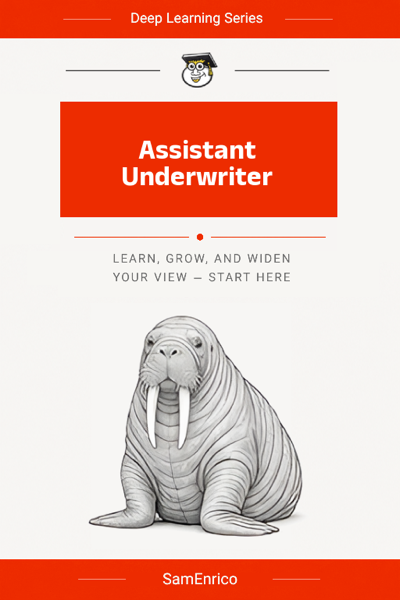
Assistant Underwriter eBook
A Coursebook on Assistant Underwriter
A Coursebook on Assistant Underwriter
Formats
Free sample
Chapter 1: The Gatekeeper’s Gambit...--It begins with a single piece of paper. Or more likely these days, a PDF attachment in an inbox that is already overflowing with forty-seven other unread messages. The subject line reads: “Submission – ABC Plumbing – General Liability – Urgent.” The clock is ticking because the broker needs a quote by end of day, and the underwriter is in back-to-back meetings until 3:00 PM. Somewhere in that PDF—buried on page twelve of a fifteen-page application, or hidden in a loss run summary that looks like it was scanned in 1997—is a single data point that will determine whether this risk is profitable or poisonous. Find it.
Verify it. Flag it. Pass it along. Do it fast. Do it right.
Do it again forty more times before the week is over.This is the world of the Assistant Underwriter. And if you are reading this book, you have either just stepped into that world, are trying to step into it, or have been living in it for a while and suspect there has to be a better way to do your job than the chaos you are currently surviving. You are correct on all counts.The Assistant Underwriter role is simultaneously one of the most overlooked and most essential positions in modern finance. Insurance is a six-trillion-dollar global industry—larger than banking, larger than the entire GDP of every country except the United States and China—yet it operates largely in the shadows of public consciousness. Most people cannot tell you the difference between a carrier and a broker, let alone what an Assistant Underwriter does all day.
But here is the secret that the industry does not advertise: the Assistant Underwriter sits at the gateway of every single financial transaction that happens in this enormous, invisible empire. No risk moves from a client to a carrier without passing through the hands of an AU. No premium is collected, no policy is issued, no claim is paid without the foundational work of the person who checks the data, cleans the file, and hands a usable submission to the underwriter who makes the final call.This chapter is your introduction to that world. It is not a list of job duties or a dry recitation of industry statistics. It is a map of the hidden territory you are about to navigate.
By the end of this chapter, you will understand the four primary players in the insurance ecosystem and how money flows between them. You will know exactly where the Assistant Underwriter fits into that flow. You will see why this role is not a dead-end clerical job but the single best on-ramp to a stable, lucrative, promotion-rich career that most college graduates never even hear about. And you will begin to understand why mastering the art of the AU—the gatekeeper’s gambit—can take you from a cubicle to a corner office faster than almost any other path in finance.Let us begin where every insurance transaction begins: with risk.The Architecture of Risk Risk is the oldest commodity ever traded. Long before there were stock exchanges or bond markets, there were merchants pooling their resources to insure each other’s ships against the perils of the Mediterranean Sea.
The basic transaction has not changed in three thousand years. Someone—a person, a business, a government—faces the possibility of a future loss. They cannot predict whether that loss will happen, but they know that if it does, the financial consequences could be catastrophic. So they pay someone else a smaller, certain amount of money in exchange for a promise: if the bad thing happens, the other party will pay for it. That is insurance.
Everything else is paperwork, regulation, and mathematics dressed up as a business.The paperwork, however, is substantial. And the mathematics is real. And the regulation is unforgiving. This is why the insurance industry has evolved into a complex ecosystem of specialized players, each with a distinct role in the chain that connects the client’s fear of loss to the carrier’s capacity to assume that fear as a calculable risk.There are four primary players in this ecosystem. Every Assistant Underwriter must know them, because every single submission you touch will involve at least two of these players, and most will involve three or four.The Carrier The carrier is the entity that actually assumes the risk.
When you buy car insurance, the company that sends you the bill and pays your claim is a carrier. When a corporation buys a million-dollar property policy, the carrier is the one holding the financial exposure. Carriers are often called insurance companies, and they range in size from global giants like State Farm, Allstate, and Chubb to regional carriers you have never heard of that specialize in insuring wheat farms in Nebraska or fishing boats in the Gulf of Mexico.Carriers make money in two ways. First, they collect premiums. If they collect more in premiums than they pay out in claims and operating expenses, they make an underwriting profit.
Second, they invest the premiums between the time they are collected and the time claims are paid. This is called the float, and it is a massive source of income for large carriers. Warren Buffett built Berkshire Hathaway largely on the float from his insurance subsidiaries.The carrier employs the underwriters who decide whether to accept a risk and at what price. The carrier also employs the Assistant Underwriters who support those underwriters. When you work as an AU, your paycheck ultimately comes from a carrier, even if you are physically located at a brokerage or an MGA.The Broker The broker represents the client.
If a business needs insurance, they typically do not call a carrier directly. They call a broker. The broker’s job is to shop the client’s risk to multiple carriers, negotiate terms, and place the coverage with the carrier offering the best combination of price, coverage, and service.Brokers are paid by commission, typically a percentage of the premium the client pays. This creates an inherent tension: the broker wants the lowest possible premium for the client, because that keeps the client happy and competitive, but the broker also wants the carrier to accept the risk, because no placement means no commission. Skilled brokers navigate this tension by building relationships with carriers, presenting risks in the most accurate and compelling light, and pushing back when terms are unreasonable.The largest brokers in the world—Marsh, Aon, Willis Towers Watson, Gallagher—are enormous global enterprises with thousands of employees and billions in revenue.
But there are also thousands of small, regional, and specialty brokers who focus on specific industries or geographic areas. As an AU, you will interact with brokers constantly. They will send you submissions. They will ask you for updates. They will push you for quotes.
They will thank you when you deliver. They will complain to your manager when you do not. Learning to manage broker relationships is one of the most important skills you will develop, and we will spend an entire chapter on it later.The Managing General Agent (MGA)The MGA is a hybrid creature.…
This is the end of the free sample. Get the eBook to keep going. Buy now
About this book
Details
- Author
- Sturgeon Lulu
- Publisher
- SamEnrico
- Language
- English
- Genre
- Non-Fiction, Informative, Educational
- Released
- 2026-05-18
- Pages (approx.)
- 141
- Available as
- eBook, Audiobook

Read better in the ZLOADR app
Your eBooks on your phone or tablet. Sign in with your SamEnrico account and start reading.
More by Sturgeon Lulu
 Remote Chat ManagementSturgeon Lulu$11.99
 Mindfulness for Job SeekersSturgeon Lulu$11.99
 Difficult Conversations Made EasySturgeon Lulu$11.99
 Lonely Recovery From AddictionSturgeon Lulu$11.99
 The Walking Creativity RitualSturgeon Lulu$11.99
 The Russian Enlightenment: From Catherine the Great to Tolstoy’s WisdomSturgeon Lulu$11.99
 Learn to Play the BandoneónSturgeon Lulu$11.99
 Express Entry Graduate GuideSturgeon Lulu$12.99
 Pre Launch Paid Ads GuideSturgeon Lulu$12.99
 How to Become a Steam-conditioner OperatorSturgeon Lulu$11.99