
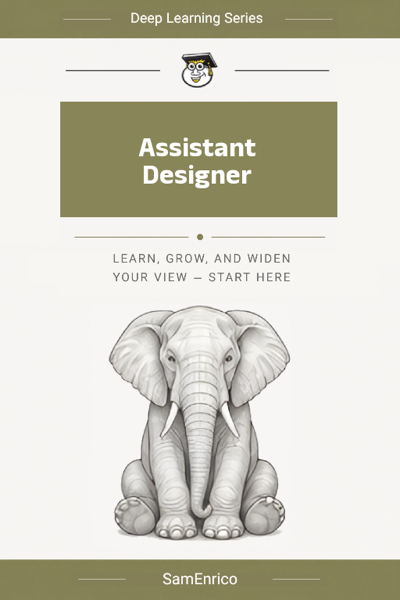
Non-FictionInformativeEducational
Assistant Designer eBook
A Coursebook on Assistant Designer
A Coursebook on Assistant Designer
Formats
Free sample
Chapter 1: The Operational Engine...--–- The first thing you need to understand about being an Assistant Designer is that no one will hand you a manual. Not your lead designer, not your product development manager, not the human resources department that hired you. You will walk into your first day—probably a Monday, probably in the middle of a proto review, probably while someone is yelling about a missing zipper—and you will be expected to know things. Not everything, but enough. Enough to take notes that don't confuse the factory.
Enough to open a tech pack without breaking it. Enough to know that when the designer says "make the sleeve wider," you do not simply type "make sleeve wider" into the PLM system and walk away.This chapter is that missing manual. It is the first twenty pages of a book that should have existed before you ever sat down at your studio desk. Here, we dismantle the myth that the Assistant Designer is an entry-level "gofer" or a creative apprentice waiting for permission to be useful. Instead, we rebuild the role as what it truly is: the strategic operational engine of a modern design studio.
You are not fetching coffee. You are building situational awareness while holding a cup. You are not taking notes. You are capturing decisions that will determine whether a $50,000 production run succeeds or fails. You are not "just an assistant." You are the person who makes sure the designer can design, the merchant can merchandise, and the factory can factory.
Without you, the machine stops. With you, it hums.This chapter covers three foundational pillars: first, what the Assistant Designer actually does across different sectors of the industry (and why the title varies wildly); second, the three core competencies that separate the indispensable assistant from the replaceable one; and third, the single most important framework you will carry through this entire book—your scope of authority, or the clean line between executing someone else's vision and contributing your own. By the end of this chapter, you will not only understand what you are supposed to do. You will understand why it matters, how to do it well, and where the invisible boundaries of your role begin and end.Let us begin with a confession. Every Assistant Designer I have ever mentored—and I have mentored dozens—started their first week terrified of being exposed as a fraud.
They worried they did not know enough Illustrator. They worried their flats were ugly. They worried the lead designer would ask them a question about grading rules and they would freeze like a deer in headlights. Here is the secret that no one tells you in design school: your lead designer is also terrified. Not of being exposed as a fraud, necessarily, but of the calendar.
They are terrified of missing a proto deadline. They are terrified of the merchant finding out that the margin on the hero style just dropped by two percent. They are terrified of a fit model pointing out that the armhole is too tight during a live review with the vice president watching.Your designer's fear is your opportunity. Because the one thing your designer does not have time to do is manage the machine. They need someone who can take the chaos of a seasonal calendar and turn it into checklists.
They need someone who can translate their half-baked sketch into a production-ready tech pack without losing the spirit of the design. They need someone who can sit through a two-hour fit session, take photos from seven angles, annotate every drag line, and then write a summary email that the factory in Vietnam can understand despite the twelve-hour time difference. That someone is you. That is the Assistant Designer. Not a gopher.
An engine.Let us be precise about what that engine looks like in practice.The Three Faces of the Role Before we go any further, we need to address a source of endless confusion: job titles. If you search for "Assistant Designer" on Linked In or Indeed, you will find three seemingly different roles that all describe roughly the same work but with different emphasis. Understanding these variations will save you from applying to the wrong job or, worse, accepting a position that does not match your skills.The first and most common variant is the Assistant Designer in apparel and fashion. This role lives in the world of soft goods—clothing, dresses, outerwear, activewear, swimwear, sleepwear, accessories like bags and small leather goods. Your primary deliverables will be tech packs (the technical specification packages that tell a factory how to make a garment), flat sketches (the two-dimensional technical drawings that show every seam and stitch), fit session documentation (photographs and notes from live model fittings), and material library management (organizing physical swatches of fabric, zippers, buttons, and labels).
You will work directly under a Lead Designer or Design Director. Your days will be split between the computer (Illustrator, PLM, email) and the physical studio (the fitting room, the swatch library, the sample rack). You will learn to hate the phrase "can you just quickly..." because nothing in this role is quick, but you will say yes anyway because that is the job.The second variant is the Design Assistant in soft goods and accessories. Notice the word order: "Design Assistant" instead of "Assistant Designer." In some companies, this is a distinction without a difference. In others, it signals a more tactile, hands-on role.
A Design Assistant spends less time in Illustrator and more time handling physical samples, tracing patterns, communicating with vendors about trim shipments, and maintaining the physical organization of the studio. If you love the feeling of fabric between your fingers and hate staring at a screen for eight hours, this might be your path. The trade-off is less exposure to the high-level creative decisions—you will be executing rather than ideating.The third variant is the Junior Designer in hardlines and consumer goods. This is the most autonomous of the three, but also the most siloed. Hardlines include products like water bottles, luggage, electronics cases, home goods, and toys.
A Junior Designer might own a single SKU (stock-keeping unit) from concept to production—say, a new colorway of a best-selling travel mug. They have more creative freedom on that one product, but they see less of the full collection building that happens in apparel. If you are the kind of person who loves diving deep into a single problem rather than juggling forty styles at once, this variant might suit you.Here is the critical point, and I want you to underline it in your mind: these titles vary by company, and many companies use them interchangeably. You might apply for an "Assistant Designer" role at a handbag company and discover that your actual responsibilities match the "Design Assistant" description above. You might take a "Junior Designer" role in activewear and find yourself doing tech packs for thirty styles.
Do not get hung up on the title. What matters is the work. This book is written for the person who does the work—whether your business card says Assistant Designer, Design Assistant, Junior Designer, or…
This is the end of the free sample. Get the eBook to keep going. Buy now
About this book
Details
- Author
- Clanton Nelia
- Publisher
- SamEnrico
- Language
- English
- Genre
- Non-Fiction, Informative, Educational
- Released
- 2026-06-02
- Pages (approx.)
- 142
- Available as
- eBook, Audiobook

Read better in the ZLOADR app
Your eBooks on your phone or tablet. Sign in with your SamEnrico account and start reading.
More by Clanton Nelia
 Progressive Relaxation AngerClanton Nelia$11.99
 Spin Class Metrics Tracking WorkbookClanton Nelia$11.99
 The Speed Visualization GuideClanton Nelia$11.99
 Theranos Securities FraudClanton Nelia$11.99
 Family Gifting Home EquityClanton Nelia$11.99
 The Last Dance of the DodoClanton Nelia$11.99
 The Ghost in the Lab: How a Forgotten Scientist Fooled the WorldClanton Nelia$11.99
 Argentina Free University GuideClanton Nelia$12.99
 UK Sponsor Compliance AuditClanton Nelia$12.99
 Understanding Diffuse Palmoplantar Keratoderma, Bothnian TypeClanton Nelia$17.99
 How to Become a Molasses PreparerClanton Nelia$11.99
You may also like
 Hong Kong Handover 1997Dunn Johnnie$11.99
 Zumba For Postnatal Recovery CourseNeal Christian$11.99
 Zumba for BeginnersLadner Nikia$11.99
 YouTube Comment Mining GuideHumes Pandora$12.99
 Worry Box MeditationCarlin Rudy$11.99
 Workplace Stress MeditationNguyen Lynn$11.99
 Workplace Stress and Sleep RepairHawley Ivory$11.99
 Workplace Perfectionism CureDelaney Jeffry$11.99
 Workplace Injustice Anger GuideWallen Isabelle$11.99
 Work Addiction and Burnout LinkGreenwood Ester$11.99
 Women in Yoga and WellnessBeattie Galina$11.99
 Women in Stand Up ComedyChun Evangeline$11.99